

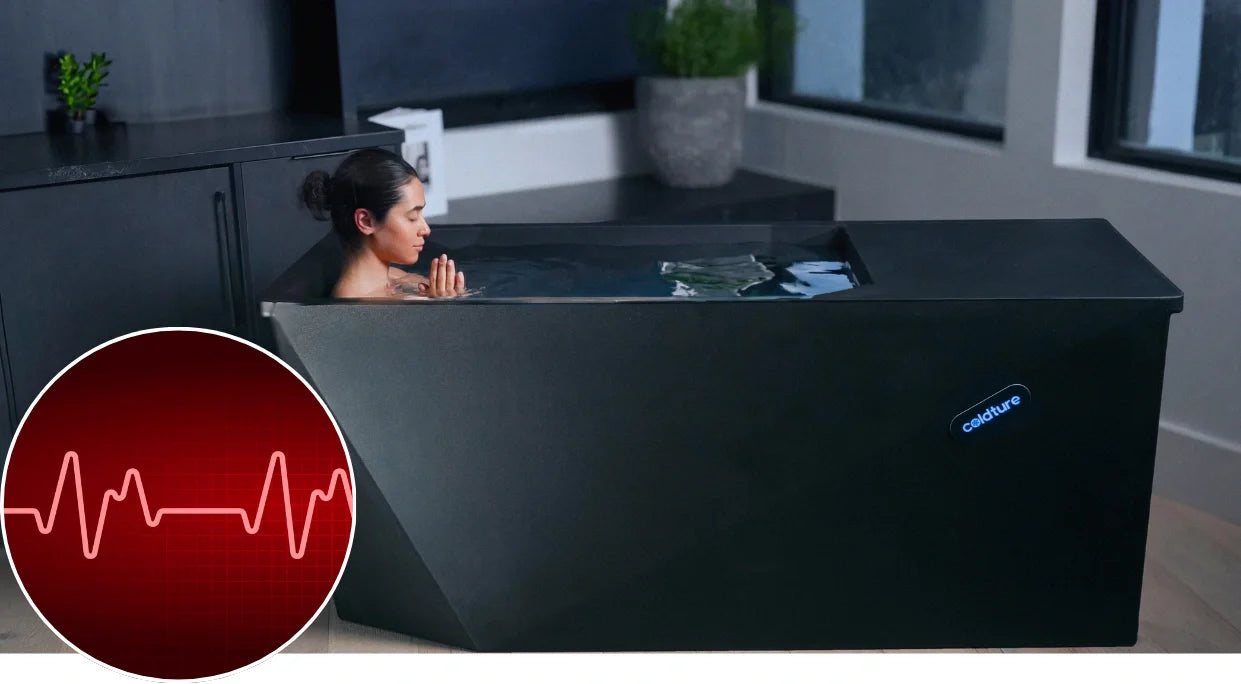
Within 10 seconds of cold water hitting your chest, your heart rate does something most people would never expect. It is not adrenaline. It is not panic. It is a precise, hardwired nervous system response that you do not have to think about, and once you understand the mechanism, the entire experience of cold exposure starts to make a different kind of sense.
The Vagus Nerve Fires
Running from your brainstem down through your chest and into your abdomen, the vagus nerve is the longest cranial nerve in the body and the main communication line between your brain and your internal organs, including your heart. [1] It is the primary nerve of the parasympathetic nervous system, the branch responsible for the "rest and digest" state that counterbalances the fight-or-flight response.
Cold water hitting the chest and face activates this system faster than almost anything you can do consciously. The face and chest are densely populated with cold-sensitive receptors, and stimulating them triggers a reflex response that engages the vagus nerve almost immediately. [2] This is not something you have to learn or force. It is a reflex, the same category of involuntary response as your pupil contracting in bright light.

Heart Rate Drops Immediately
The moment the vagus nerve fires, it releases acetylcholine at the heart, which slows the heart rate. [3] This is part of what physiologists call the diving response, a reflex shared across mammals that prioritises oxygen conservation when the face and body contact cold water. Heart rate slows, blood flow redistributes toward the core and vital organs, and the body shifts into a more conserving state. [2]
That sudden sense of calm and control people describe when they settle into cold water is not purely mental toughness. A measurable part of it is the nervous system applying the brakes on command. The body is doing something specific and physiological, and the subjective feeling is downstream of that mechanism.
It is worth a note of accuracy: the very first instant of cold exposure also triggers a brief cold shock response, an initial gasp and a short spike in heart rate and breathing, before the vagal, parasympathetic response settles in. [4] This is exactly why controlled entry and steady breathing matter, and why a predictable, temperature-controlled environment is safer than an uncontrolled plunge into unknown cold.

Cortisol Falls
Beyond the immediate cardiac effect, regular cold water immersion is associated with changes in the body's stress hormone profile. Research on cold exposure has documented effects on cortisol, the primary stress hormone, with regular practice associated with improved regulation of the stress response over time. [5]
The mechanism connects back to the parasympathetic activation. By repeatedly engaging the system that downregulates the stress response, cold exposure functions as a form of training for the nervous system: a controlled, voluntary stressor that the body learns to move through and recover from. Over time, this is associated with improved resilience to stress in general, not just to cold. [5]
This is the basis for a deliberate, consistent cold practice rather than occasional extreme exposure. The adaptation comes from repetition in a controlled setting, which is exactly what a temperature-stable home system makes possible.

The Clinical Parallel
The connection between vagal activation and stress regulation is not a fringe idea. Vagus nerve stimulation is an established clinical tool, used in medical settings to treat conditions including treatment-resistant epilepsy and depression, and studied for its effects on heart rate variability and anxiety. [6]
Cold water exposure engages a version of the same pathway through natural means. The clinical approach uses an implanted or external device to stimulate the nerve directly. Cold exposure recruits the body's own reflex arc to activate it. The body already has the mechanism built in. A cold plunge is one of the more reliable ways to pull the trigger on it voluntarily.
This is not a claim that cold water immersion is a medical treatment or a substitute for clinical care. It is an observation that the same physiological pathway clinicians target deliberately is one the body activates naturally in response to cold, which helps explain why so many people report a distinct shift in mental state after a session.
What This Means for a Cold Practice
The takeaway is that the calm you feel after cold exposure is a physiological event, not a personality trait. That reframes the whole practice. You are not white-knuckling your way through discomfort to prove something. You are deliberately engaging a nervous system reflex that downregulates stress, and the benefit comes from doing it consistently.
Consistency is the variable that matters most, and consistency depends on control. An uncontrolled plunge into cold water of unknown temperature is unpredictable and harder to make a daily habit. A temperature-controlled system removes the friction and the guesswork.
The Coldture Classic Tub + Chiller holds an exact temperature anywhere from 3 to 40°C, set from your phone, on a standard household outlet with no installation. The 1 HP chiller means the water is the same temperature every session, so the variable you are training is the cold itself, not whether the setup will cooperate. For smaller spaces, the Barrel Tub + Chiller delivers the same temperature range and control in a vertical, footprint-efficient design, and the Ultra Barrel Lite + Chiller is the most compact option in the lineup at 86 cm in diameter, built for condos and indoor setups.
And because the same systems run from 3 to 40°C, they support full contrast therapy, pairing cold exposure with heat, which is where cold plunges and saunas work together rather than as alternatives. Browse the full Coldture cold plunge lineup.
That feeling after you get out is your vagus nerve. Not your willpower. The practice just gives it a reason to fire.
This article discusses the physiological effects of cold water exposure for general wellness purposes. Cold water immersion carries risks, particularly for people with cardiovascular conditions. Consult a physician before beginning a cold exposure practice.
References
[1] Breit S, et al. "Vagus nerve as modulator of the brain-gut axis in psychiatric and inflammatory disorders." Frontiers in Psychiatry. 2018;9:44. doi.org/10.3389/fpsyt.2018.00044
[2] Datta A, Tipton M. "Respiratory responses to cold water immersion: neural pathways, interactions, and clinical consequences." Journal of Applied Physiology. 2006;100(6):2057-2064. doi.org/10.1152/japplphysiol.01201.2005
[3] Gourine AV, et al. "Cardiac vagal preganglionic neurones and the regulation of heart rate." Experimental Physiology. 2016;101(1):37-43. doi.org/10.1113/EP085261
[4] Tipton MJ, et al. "Cold water immersion: kill or cure?" Experimental Physiology. 2017;102(11):1335-1355. doi.org/10.1113/EP086283
[5] Šrámek P, et al. "Human physiological responses to immersion into water of different temperatures." European Journal of Applied Physiology. 2000;81(5):436-442. doi.org/10.1007/s004210050065
[6] Johnson RL, Wilson CG. "A review of vagus nerve stimulation as a therapeutic intervention." Journal of Inflammation Research. 2018;11:203-213. doi.org/10.2147/JIR.S163248
Share:
Infrared Light vs. Infrared Sauna: Why They Are Not the Same Thing
A 30-Day Cold Shower Study With 3,018 People Found Something Surprising