

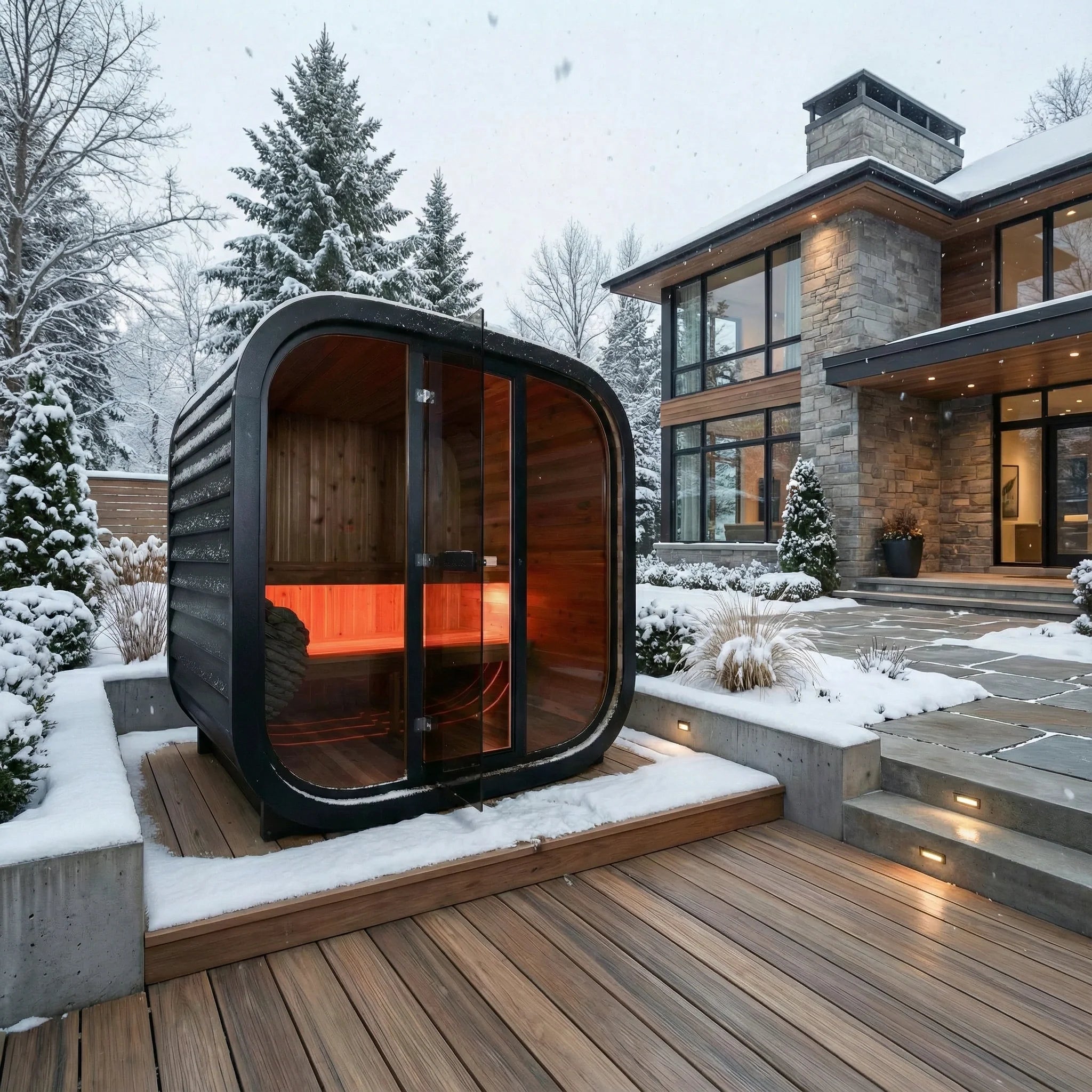
An outdoor sauna lives through the worst conditions a piece of wood will ever see
Every session pushes interior temperatures to 110°C with humidity swinging from near zero to over 60% in a single sitting. Outside the cabin, the structure handles freeze-thaw cycles, UV, snow load, and Canadian winters that can sit at -30°C for weeks. Then the cycle repeats two or three times a week, for twenty years if the build is right.
The wood you put in an outdoor sauna is not an aesthetic choice. It is the engineering decision that determines whether the sauna is still performing in two decades, or already cracking, weeping sap, and leaking through finger-jointed seams in year three. Both the Coldture pro outdoor sauna and the Coldture xtreme outdoor sauna are built around one specific answer: knotty western red cedar walls, clear western red cedar benches, full-length boards from the Canadian Pacific Northwest, wrapped inside a hurricane-rated metal exterior so the wood never has to be the weather-facing material. Here is why that combination matters, and what the cheap alternatives are actually trading off.

Why western red cedar is the standard
Western red cedar (Thuja plicata) is the only wood species that handles a full outdoor sauna environment without chemical treatment, structural failure, or off-gassing at temperature. Three reasons.
It grows slowly. Western red cedar grows in the cool, wet forests of Canada's Pacific coast and wet interior belt. Mature trees commonly reach 800 to 1,000 years of age. Slow growth produces dense, tight, straight grain, which is what allows the wood to cycle through 80°C+ swings without cupping, splitting, or pulling apart at joints. Fast-growing plantation woods do not have the same cellular structure and do not behave the same way under thermal cycling.
It produces its own preservatives. Older western red cedar develops natural compounds in its heartwood called thujaplicins. Thujaplicins are natural fungicides: they make the wood resist rot, mold, and insect attack without any chemical treatment. In an outdoor sauna, this is the difference between a 20-year build and a 5-year one.
Its oils stay locked in the wood. Pine and standard spruce bleed sticky pitch onto skin at sauna temperatures, especially in the first months of use. Cedar's oils release as aroma, not residue. At 110°C, sitting on the bench, this is what you actually feel.
Properly milled and maintained, premium western red cedar lasts 20 to 30 years in an outdoor sauna. That is the ceiling. Below it is a long list of compromises, most of which stay invisible until they fail.

Knotty walls, clear benches: why the split matters
Cedar comes in grades. Both knotty and clear are real western red cedar with the same natural oils and the same rot resistance. They are not interchangeable. The right answer is knotty for walls, clear for benches, which is exactly how both Coldture outdoor saunas are built.
Knotty cedar walls. Knots are visual character, not structural compromise (assuming tight-knot grade, which is what Coldture specifies). On the walls of an outdoor sauna, knotty cedar reads as warmth and natural texture, and it is the right grade for the role: load is distributed across the panel, skin contact is incidental, and heat exposure is uniform.
Clear cedar benches. Clear cedar is graded for the absence of knots, and on a bench this is functional, not aesthetic. A knot is denser than the surrounding wood, so at 110°C it retains and re-radiates more heat than the wood around it, creating localized hot spots exactly where skin makes contact. Clear cedar distributes heat evenly. The second reason is structural: a knot is a discontinuity in the grain, and over thousands of heat cycles, knots are where benches start to crack, loosen, and fail. Clear grade eliminates the failure point.
This is why both the pro outdoor sauna and the xtreme outdoor sauna run knotty western red cedar walls with clear western red cedar benches. The grade is matched to the job.

What the cheaper outdoor saunas are actually built from
Two real alternatives, and a few common substitutions worth flagging.
Eastern white cedar (Thuja occidentalis) is a different species native to southeastern Canada and the northeastern US. It contains fewer of the natural protective oils that make western red cedar perform, and it is meaningfully less resistant to decay in long-term high-humidity outdoor use. It works for entry-level barrel saunas. In a year-round outdoor build at 110°C, it does not match the structural lifespan of western red cedar.
Thermowood is not a species. It is a process: standard pine, spruce, or aspen heated to 185–215°C in a low-oxygen kiln for 24 to 72 hours, which breaks down the sugars fungi feed on and drives off the resin. The result is rot-resistant, resin-free wood with an outdoor sauna lifespan often quoted around 30 years. It is a legitimate alternative. The trade-offs are also real: thermal modification increases brittleness, which raises the risk of splitting at fasteners. The aroma of cedar is gone (the volatile oils are driven off during processing). For buyers who specifically want the slow-grown structural integrity and natural color depth of premium western red cedar, thermowood is a different product.
Two common substitutions to watch for: Eastern red cedar is technically a juniper, not a true cedar, and has lower moisture resistance than western red cedar. Hemlock is a legitimate indoor wood (Coldture uses it inside the pod infrared sauna and corner pod infrared sauna, where the controlled environment plays to its strengths) but is not an outdoor wood. When a budget "outdoor" sauna is built from hemlock without serious exterior protection, the lifespan reflects that.
The construction shortcut almost no outdoor sauna brand discloses: finger joints
This is the one most buyers never hear about, and in an outdoor sauna it matters more than almost anything else on the spec sheet.
A finger joint is a method of splicing short wood offcuts together into a longer board. The ends are cut into interlocking finger patterns, glued, and pressed into what looks, at first glance, like a single continuous plank. Finger-jointed sauna paneling and bench wood is made by collecting leftover offcuts from larger lumber operations, then assembling them with adhesive.

In low-stress, painted, indoor applications, finger jointing is acceptable construction. In an outdoor sauna it introduces three problems that the sauna environment specifically exposes:
Glue lines under heat, humidity, and freeze-thaw. A traditional outdoor sauna runs every joint in the wood through tens of thousands of heat-humidity cycles, plus a Canadian winter outside the cabin. The cedar expands and contracts a known amount. The glue line does not behave identically to the wood. Over time, finger joints telegraph through the surface, swell unevenly, and start to separate. On exterior cladding this is a water entry point. On a bench, it is a glued seam under your body in the hottest, wettest, most cyclic surface in the building.
Mixed wood within a single board. The offcuts feeding a finger-jointing line come from different boards with different grain orientations and slightly different densities. They do not expand and contract at the same rate. The board looks uniform on day one and reveals its seams within a year or two of regular use.
It is how cheap outdoor saunas are made cheap. Premium clear western red cedar is expensive because it is graded, slow-grown, and harvested in longer, knot-free runs. Manufacturers who advertise "western red cedar" but quietly use finger-jointed assemblies are buying short offcuts at a fraction of the cost of full-length premium boards. The marketing language stays the same. The product is not the same.
Coldture does not use finger-jointed construction in its outdoor saunas. The walls and benches in both the pro outdoor sauna and the xtreme outdoor sauna are real, full-length boards of the grade specified for their role. This is one of the largest invisible cost lines in building a real premium outdoor sauna, and it is one of the reasons Coldture outdoor saunas cost what they cost and last as long as they do.
How the cedar fits inside the rest of the build
The cedar is one part of the answer. The outdoor engineering is the other. Both Coldture outdoor saunas are built so the wood never has to be the weather-facing material.
The cedar interior is wrapped in a hurricane-rated powder-coated metal exterior, bound by stainless steel exterior bands, and elevated on a 3/4-inch composite base that resists rot and intercepts ground moisture before it ever reaches the wood. Non-toxic adhesives are used throughout, because at 110°C off-gassing from standard sauna construction is at its worst.
The structural logic: cedar handles what cedar does best (heat, humidity, skin contact, aroma, longevity inside the cabin). The metal exterior, stainless structure, and composite base handle what cedar should never have to handle alone (snow load, UV, hurricane wind, freeze-thaw cycling, and the ground moisture that is the single most common failure point in outdoor sauna construction). The wood inside the cabin gets to last 20 to 30 years because nothing else in the build is asking it to be the sacrificial layer.

Three questions to ask before you buy any outdoor sauna
- What species, by both common and scientific name? "Cedar" is not an answer. "Western red cedar (Thuja plicata)" is. If the company cannot or will not specify, assume the worst case.
- What grade goes where? Knotty on walls and clear on benches is the right structure. Clear everywhere is overkill but acceptable. Knotty on the benches is a corner cut. No grade specified at all is a red flag.
- Finger-jointed or full-length boards? Ask directly. A premium manufacturer will answer immediately. A budget manufacturer will either dodge the question or reframe finger jointing as a sustainability feature. Both responses tell you what you need to know.
An outdoor sauna is a 20-to-30-year purchase. The wood is the part that decides whether you get those 20 to 30 years, or whether you are shopping for the next one in five.
Built in Canada, from Canadian cedar, for Canadian climates

- Pro outdoor sauna: 2–3 person, 6 kW HUUM heater, real 110°C Finnish dry heat, full western red cedar interior.
- Xtreme outdoor sauna: 4–6 person at the category ceiling, 9 kW HUUM heater, extra-deep clear cedar benches, same outdoor engineering stack.
- Browse the full Coldture sauna lineup.
Knotty walls. Clear benches. Full-length boards. No finger joints. Real western red cedar from the forests where it actually grows.
Share:
The Concept of Luxury Wellness: What It Really Means
The Role of Red Light in Recovery: What Actually Works