

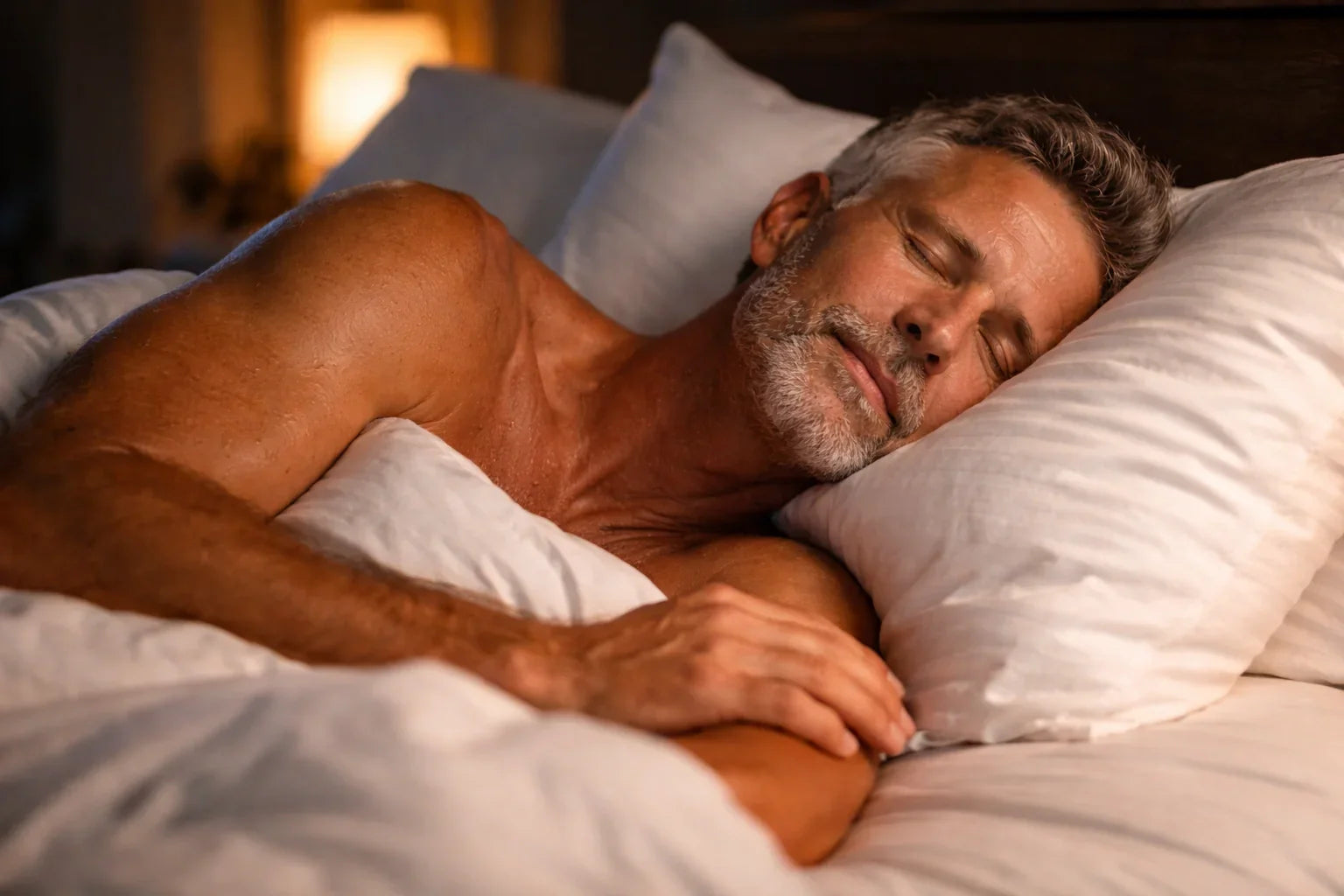
most people think the connection between sauna and sleep is simple: heat relaxes you, relaxation helps you sleep. that's true, but it's the least interesting part of the story.
what actually happens during and after a sauna session is a coordinated sequence of hormonal, neurological, and thermoregulatory events that prime your body for the kind of deep, restorative sleep that no mattress, supplement, or sleep app can replicate. and the effects aren't subtle. they're measurable, reproducible, and they compound with consistent use.
here's what's going on, and how to use it.
growth hormone output spikes![]()

growth hormone (GH) is one of the most important compounds your body produces for recovery. it drives tissue repair, fat metabolism, muscle maintenance, and cellular regeneration. your body releases the majority of its daily GH during deep sleep, which is why poor sleep quality accelerates aging and slows recovery.
sauna use directly increases GH secretion. a study of healthy subjects found that 15-minute sessions at 75°C increased human growth hormone by approximately 142% immediately post-session, with elevated levels persisting through the overnight recovery period when most muscle repair occurs. foundational research by Leppäluoto and colleagues documented 2-to-5-fold increases in serum GH following sauna exposure at 80-100°C, with the response being consistent, reproducible, and dose-dependent relative to session duration.
more aggressive protocols produce even larger responses. a study published in the Journal of Clinical Endocrinology and Metabolism found that two 20-minute sauna sessions at 80°C, separated by a cooling interval, produced GH levels up to 16-fold above baseline. that's a magnitude comparable to moderate-intensity exercise, achieved while sitting still.
what makes this especially relevant to sleep is timing. GH released during an evening sauna session doesn't just spike and disappear. it sets the stage for the body's overnight repair cycle. the elevated GH from the session compounds with the natural GH pulse that occurs during deep sleep, creating a recovery window that's meaningfully larger than either one alone.
this is the hormone responsible for waking up feeling repaired rather than just rested. and the sauna is one of the most reliable, non-pharmacological ways to increase it.
your nervous system switches modes
your autonomic nervous system operates in two primary modes. the sympathetic branch handles activation: alertness, stress response, fight-or-flight. the parasympathetic branch handles recovery: rest, digestion, repair. for most people, especially those carrying chronic stress, the sympathetic branch dominates well into the evening, which is one of the primary reasons they can't fall asleep or stay asleep.
heat exposure forces a transition. during a sauna session, the initial heat stress briefly activates the sympathetic branch (heart rate increases, blood flow redirects, sweating begins). but as the session continues and the body acclimates, the parasympathetic branch takes over. heart rate begins to slow. breathing deepens. the body shifts from an activation state into a recovery state.
this shift doesn't end when you step out. research on autonomic nervous system responses to sauna bathing has shown that parasympathetic activity increases significantly post-session, with measurable improvements in heart rate variability (HRV), a key biomarker of recovery readiness and sleep quality. one personal tracking study found parasympathetic nervous system activity increased by 43% post-sauna.
cortisol, your primary stress hormone, follows a complementary pattern. research has shown that immediately following sauna use, cortisol levels can drop by approximately 25% below baseline. over time, regular sauna use helps recalibrate the cortisol rhythm so it's lower in the evening (when it should be) and appropriately elevated in the morning (when it needs to be).
the practical result: by the time you leave the sauna, your nervous system is already in sleep-prep mode. the transition from "wired" to "tired" that normally takes hours of winding down happens in 15-20 minutes.
deep muscle tension releases
this is the benefit you feel most directly, and it's the one that removes one of the most common physical barriers to sleep: residual tension.
traditional sauna heat (80-100°C) warms the body from the outside in through convection. the air heats your skin, which warms underlying tissue. infrared heat works differently. far-infrared wavelengths penetrate 1-2 inches into tissue, warming muscle directly at lower air temperatures (typically 45-65°C). this deeper penetration reaches the layers where chronic tension, adhesions, and soreness tend to accumulate.
heat increases blood flow to muscle tissue, which delivers oxygen and nutrients while flushing metabolic waste. it activates heat shock proteins (HSP70) that identify and repair damaged cellular structures. and it reduces the neural signaling that maintains muscle guarding, the involuntary contraction patterns that create knots and stiffness.
the result: muscles that have been holding tension all day, from training, from sitting, from stress, finally release. no foam rolling, no stretching routine, no massage appointment. just heat, applied long enough and deep enough to let the tissue let go.
for anyone who lies in bed with a stiff back, tight shoulders, or that low-grade ache that never fully resolves, this alone can transform sleep quality. you can't enter deep sleep while your body is bracing against discomfort. the sauna removes that barrier.
Coldture's infrared saunas are designed around this kind of daily use. the pod sauna delivers far-infrared heat up to 65°C with 360° red light therapy coverage, so you're getting deep tissue warmth and therapeutic light exposure simultaneously. the corner pod adds 6 dedicated red light panels and a rotatable therapy lamp for targeted relief on specific problem areas. both run on a standard 110V outlet with wireless control.
if you want both infrared depth and traditional high-heat intensity, the hybrid sauna runs a dedicated 6 kW heater (up to 90°C) and 2,920W of independent ultra-low EMF infrared panels on the same system. use infrared for gentle evening sessions focused on tension release. use traditional heat when you want the full hormonal and cardiovascular response.
core temperature drops post-session and deep sleep follows
this is the mechanism that ties everything together, and it's one of the most well-supported findings in sleep science.
your brain uses the decline in core body temperature as one of its primary signals to initiate deep sleep. as evening approaches, core temperature naturally drops, triggering melatonin production and the transition into slow-wave (deep) sleep. this is the same reason a cool bedroom helps you sleep and a hot room keeps you awake.
a sauna session amplifies this process. during 15-20 minutes of heat exposure, your core temperature rises by 1-2°C. when you exit, your body activates aggressive cooling mechanisms: vasodilation in the hands and feet dumps heat from the core, sweating accelerates surface cooling, and core temperature drops faster and more dramatically than it would on its own.
that enhanced temperature drop creates a stronger signal to the brain that it's time to sleep. research published in Sleep Medicine Reviews found that passive body heating 1-2 hours before bedtime significantly shortened the time it takes to fall asleep and improved overall sleep efficiency. a landmark study in the American Journal of Physiology found that the distal-to-proximal skin temperature gradient (warm hands and feet, cool core) was the single best predictor of how quickly someone fell asleep, outperforming melatonin onset, heart rate, and subjective sleepiness ratings.
the data from Oura Ring's analysis of over 75,000 members who logged sauna sessions showed an average of 14.9% more deep sleep on sauna nights compared to non-sauna nights. studies published in the Journal of Physiological Anthropology found that regular sauna use can increase deep sleep phases by up to 10-32%.
the timing matters. 1-2 hours between sauna exit and bedtime is the sweet spot. this gives your core temperature time to drop below baseline, which is when melatonin production ramps up and sleep pressure peaks. too close to bedtime and you're still warm. too far out and the cooling effect dissipates before you reach bed.
the compound effect: sleep architecture changes
each of these mechanisms, growth hormone elevation, parasympathetic activation, muscle tension release, and thermoregulatory cooling, is significant on its own. but the real transformation happens when they stack.
on a single sauna night, you fall asleep faster, spend more time in deep sleep, wake fewer times, and produce more growth hormone during the overnight repair window. your muscles are loose. your cortisol is low. your nervous system is in recovery mode.
over days and weeks of consistent evening use, the effects compound. your circadian rhythm strengthens. your HRV trends upward. your baseline cortisol normalizes. and the quality of your sleep shifts in ways that affect everything downstream: cognitive function, mood, training recovery, immune resilience, and long-term healthspan.
this is what separates "feeling relaxed after a sauna" from actually engineering better sleep. relaxation is a nice side effect. the real value is in the measurable, physiological changes that happen at the hormonal, neurological, and thermoregulatory level when you make the sauna a consistent part of your evening routine.
making it work
timing. finish your sauna session 1-2 hours before bed. this is the optimal window for the core temperature drop to align with your natural sleep onset.
duration. 15-20 minutes is sufficient for most of these benefits. longer sessions produce larger GH responses, but 15-20 minutes hits the sweet spot for sleep without overstimulating the system.
temperature. 80-100°C for traditional heat. 45-65°C for infrared. both are effective. infrared may be better suited for evening use because the lower air temperature feels less stimulating while still raising core temperature effectively.
frequency. 3-5 sessions per week produces the most consistent improvements in sleep quality. the effects are dose-dependent and compound over time.
hydration. you lose significant fluid during a sauna session. drink water before, during, and after. dehydration disrupts sleep on its own, so this step isn't optional.
for outdoor setups, the outdoor sauna pro delivers authentic finnish dry heat up to 110°C via a 6.0 kW HUUM heater with wi-fi control, so you can start preheating from your phone while you finish dinner. step outside, sit for 20 minutes, cool down, and be in bed within the hour. canadian-built for year-round use, no seasonal teardown.
that's not relaxation. that's sleep engineering.
the sauna doesn't help you sleep because it's calming. it helps you sleep because it triggers a precise sequence of hormonal, neurological, and thermal events that your body uses to initiate and sustain deep recovery. growth hormone spikes. cortisol drops. your nervous system shifts into repair mode. your muscles release. your core temperature falls. and your brain reads every one of those signals as permission to enter the deepest, most restorative sleep of your week.
you're not just relaxing. you're engineering the conditions for recovery.
explore Coldture's full sauna lineup: indoor infrared, hybrid, and outdoor traditional models. all built with natural wood interiors, non-toxic materials, and the engineering to support daily evening use. shop saunas.
Share:
cold plunging doesn't wreck your hormones. bad protocols do.
contrast therapy, explained: what happens when you go from sauna to cold water