

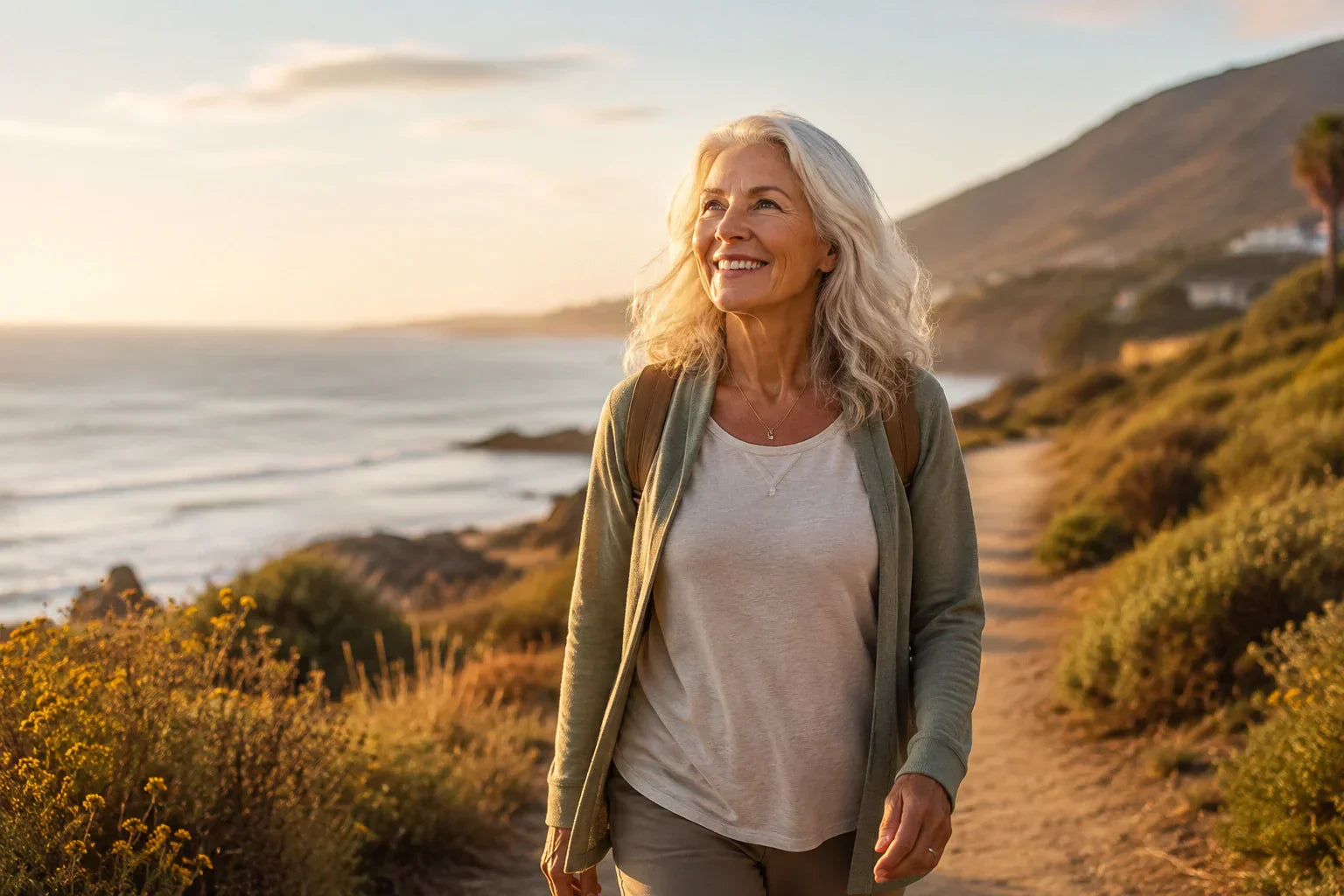
The Good News in Longevity Science That Almost No One Is Talking About
Science + Living Well | 8 min read
The headlines about health tend toward doom: what is killing us, what to fear, what we are doing wrong. But beneath the noise, 2025 and 2026 delivered a run of genuinely encouraging longevity research, and most of it points to something hopeful. The things that move the needle most are turning out to be accessible, affordable, and within reach of ordinary life. Here are five quiet pieces of good news.
A Common Vitamin May Slow Biological Aging
In May 2025, a Harvard-led clinical trial published in The American Journal of Clinical Nutrition found that daily vitamin D3 supplementation helped slow a measurable marker of biological aging. Researchers explored the effect vitamin D3 and omega-3 supplementation have on telomeres, the protective caps at the ends of chromosomes whose shortening is a natural part of aging. [1] Mayo Clinic Health System
 The result was striking. Compared to a placebo, adults who took vitamin D3 daily for four years reduced telomere shortening to such an extent that it may have prevented the equivalent of about three years of biological aging. [2] The study drew on the large VITAL randomized trial, with the telomere sub-study following more than 1,000 participants over four years. [1] Notably, omega-3 supplementation alone did not show the same telomere effect; vitamin D3 was the standout. [3] Fortune
This is not a fringe biohack. Vitamin D3 is one of the most accessible supplements in the world, and the research suggests it may be quietly doing more than anyone expected. It is a reminder of a theme that runs through all of this: the inputs that protect us at the cellular level tend to be simple, accessible, and effective when used consistently, the same principle behind daily recovery practices like red light therapy, which works at the level of the cell. As always, it is worth discussing supplementation with your doctor.
Longevity May Be Less About Discipline Than We Thought
At the 2026 World Economic Forum, a session of the Davos Alzheimer's Collaborative explored the world's "Blue Zones," the regions with the highest concentrations of healthy centenarians. The figures shared were remarkable.
 According to Blue Zones research presented at the forum, people in these longevity hotspots maintain the longest disability-free life expectancy in the world, around seven good years longer than most Americans, alongside one-fifth the rate of dementia and a sixth the rate of cardiovascular disease. [4] Harvard Gazette
The most encouraging part was the explanation. The reason was not extreme discipline or punishing routines. None of these people was pursuing health or longevity; it ensued as a byproduct of where they lived and the culture they belonged to. [4] Daily movement, real food, and strong social connection were simply built into ordinary life. Longevity, in other words, looked less like willpower and more like environment, which suggests it is something we can design into our own lives rather than grind toward. Harvard Gazette
The Simplest Habit Keeps Proving Itself
If there is one intervention the research keeps validating, it is the least glamorous one: walking.
A review published in GeroScience, examining everything from Blue Zones to molecular mechanisms, confirmed that walking briskly for 30 minutes a day, five days a week, can reduce the risk of several age-associated diseases. [5] The review found that walking decreases the risk or severity of cardiovascular and cerebrovascular disease, type 2 diabetes, cognitive impairment, and dementia, while improving mental wellbeing, sleep, and longevity. [5] Public Health Ontario
 Not a new drug. Not an expensive device. Walking. It remains one of the most underrated longevity tools available, and it costs nothing. Movement built consistently into a day, the way it is in the Blue Zones, appears to be one of the most powerful and accessible health interventions we have.
Scientists Are Learning to Slow Aging Inside the Cell
The most futuristic piece of good news came from Japan. In a study published in the journal Aging Cell in late 2025, researchers at the Tokyo Metropolitan Institute for Geriatrics and Gerontology boosted a single mitochondrial protein called COX7RP, which helps mitochondria, the cell's energy producers, work more efficiently. [6]
In the mice studied, increasing this protein led to longer lifespan, better metabolism, healthier fat tissue, and reduced markers of cellular aging. [6] The mitochondria were, as one summary put it, working smarter rather than harder, producing more energy while generating less of the oxidative stress that damages cells over time. [7]
 An important caveat: this was research in mice, and the protein was increased genetically, so it is not something available to people today. But the significance is the direction it points. The cellular machinery behind aging is turning out to be far more adjustable than scientists once believed, which opens the door to future interventions, potentially including supplements or medications, aimed at supporting healthy aging from the inside out. [6]
What makes this research resonate beyond the lab is how it reframes mitochondria as something we can actively support. That idea is not entirely futuristic. Red light therapy works through a related principle: specific red and near infrared wavelengths are absorbed by an enzyme in the mitochondria called cytochrome c oxidase, which increases the cell's energy (ATP) production. It is a far gentler, non-genetic mechanism than the one in the Tokyo study, but it points in the same direction, supporting the cell's energy machinery rather than working against the aging process from the outside. The Coldture red light therapy lineup is built around exactly that mechanism, and we cover the science in depth in our red light therapy FAQ.
Connection Is Medicine
Across every longevity hotspot studied, one factor showed up as consistently as diet and movement: strong social bonds.
The Blue Zones research repeatedly points to social connection as a central contributor to long, healthy life, sitting right alongside lifestyle, diet, and physical activity. [8] When asked what people truly need, one 98-year-old from a Blue Zone community offered a simple formula: someone to love, something to do, some way to give back, and something to look forward to. [4] Harvard Gazette
 The research keeps pointing to the same quiet truth: the people who live longest are rarely doing it alone. Connection is not a soft add-on to health. It appears to be a core ingredient.
What This All Adds Up To
Step back and a pattern emerges. The most powerful longevity findings of the past two years are not locked behind expensive technology or extreme regimens. An affordable vitamin. A daily walk. Real food. Strong relationships. Environments that make healthy living the default. Even the cutting-edge cellular research points toward making the body's own machinery work better, not replacing it.
The throughline is consistency: small, repeatable inputs built into ordinary life, exactly the way the Blue Zones do it. That principle is what guides how we think about recovery at Coldture. The benefits of heat and cold exposure, like nearly everything in the research above, come from showing up regularly rather than chasing intensity. A sauna used consistently carries some of the strongest longevity evidence of any recovery practice, with frequent use linked to lower cardiovascular and dementia risk in long-term studies. A cold plunge that fits your routine, or red light therapy as a daily habit, work the same way the findings above do: through repetition woven into everyday life. The goal is not to add another chore, but to build recovery into your environment so it happens by default. Explore the full Coldture lineup.
The science is clear and, for once, the news is good. Most of what extends a healthy life is already within reach.
This article is for general informational and wellness purposes and is not medical advice. Talk to your doctor before starting any supplement or significant change to your health routine. Animal research does not always translate directly to humans.
References
[1] Zhu H, Manson JE, Cook NR, et al. "Vitamin D3 and marine ω-3 fatty acids supplementation and leukocyte telomere length: 4-year findings from the VITAL randomized controlled trial." The American Journal of Clinical Nutrition. 2025. doi.org/10.1016/j.ajcnut.2025.05.003
[2] Mass General Brigham / Harvard. "Vitamin D supplements show signs of protection against biological aging." May 21, 2025.
[3] Harvard Gazette. "Vitamin D supplements may slow biological aging." May 22, 2025.
[4] Health Policy Watch. "Healthy minds, longer lives: inside the science and promise of Blue Zones." (Coverage of the Davos Alzheimer's Collaborative session, 2026 World Economic Forum; remarks by Dan Buettner Jr.) February 2026.
[5] "The multifaceted benefits of walking for healthy aging: from Blue Zones to molecular mechanisms." GeroScience. 2023. doi.org/10.1007/s11357-023-00873-8
[6] Ikeda K, Shiba S, Yokoyama M, et al. "Mitochondrial respiratory supercomplex assembly factor COX7RP contributes to lifespan extension in mice." Aging Cell. 2025. doi.org/10.1111/acel.70294
[7] Tokyo Metropolitan Institute for Geriatrics and Gerontology. "A mitochondrial protein may hold the secret to longevity." December 2025.
[8] News-Medical. "Blue zones longevity claims validated by new research." January 2026.
Share:
Cold Plunge FAQ: The 5 Questions Everyone Asks, Answered With Research
heat exposure triggers 3 changes in your brain chemistry that most people have no idea about