

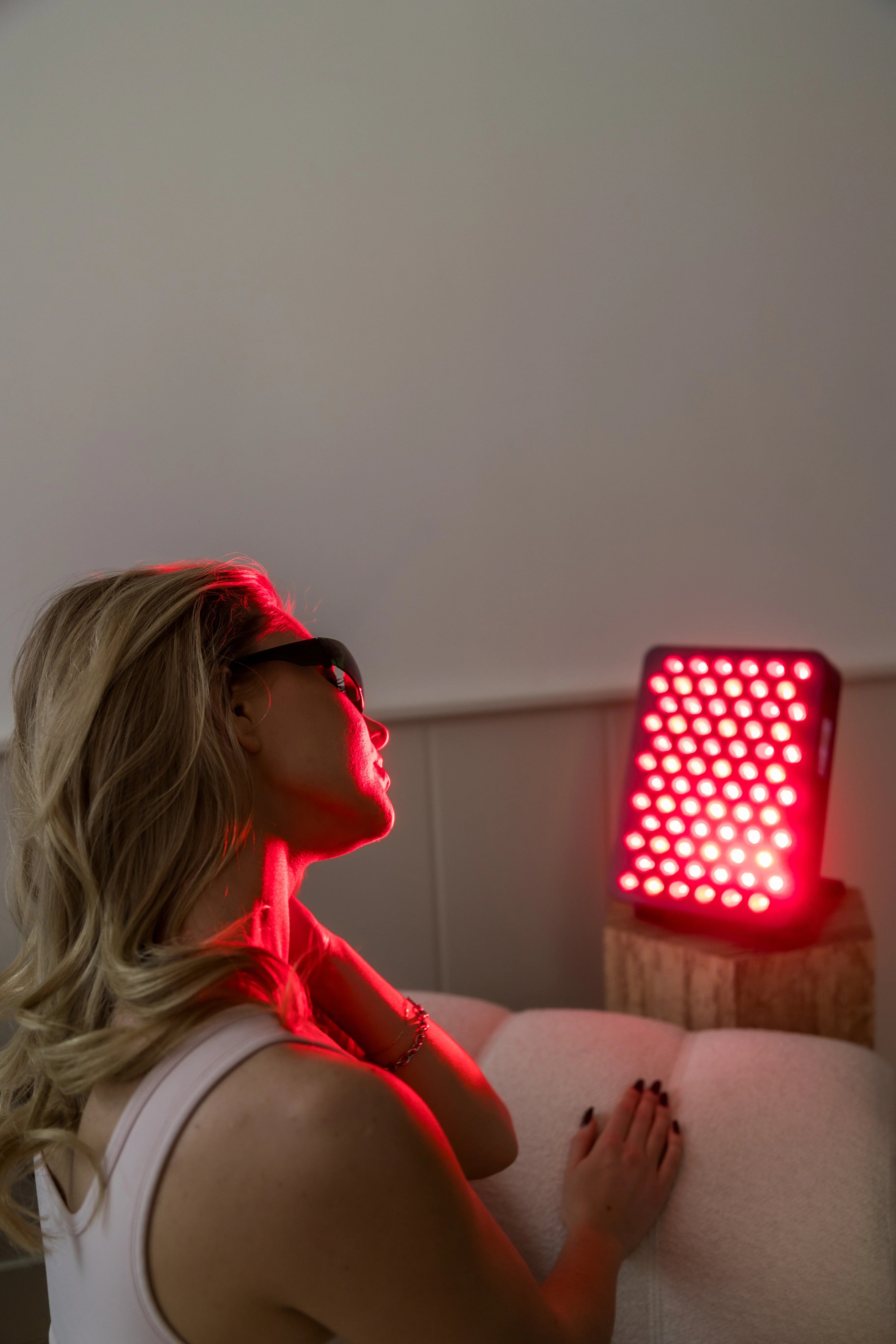
Red Light Therapy FAQ: The 5 Questions Everyone Asks, Answered With Research
Science + Recovery | 9 min read
Key Takeaways
- What it is: Red and near infrared light that cells absorb to boost energy production. The mechanism is called photobiomodulation, not heat.
- What it's good for: Strongest evidence is in skin (collagen, wrinkles, acne), wound healing, and muscle/joint recovery, with emerging research elsewhere.
- How often: Typically 3 to 5 sessions per week, 10 to 20 minutes each. More is not better; cells have a ceiling.
- Safety: Considered safe and non-invasive, with no UV. Minor, temporary redness is the most common side effect. Use eye protection near the face.
- Results: Skin and pain effects often show within a few weeks; fuller results typically take a month or more of consistent use.
1. What Is Red Light Therapy and How Does It Work?
Red light therapy, also called photobiomodulation or low-level light therapy, uses specific wavelengths of red and near infrared light, typically in the 630 to 850 nm range, delivered to the body via LED panels or devices. [1]
The mechanism is not heat. The light is absorbed by an enzyme in the mitochondria called cytochrome c oxidase. [1] Mitochondria are the energy-producing structures inside cells, and when they absorb these wavelengths, ATP production increases, giving cells more available energy for repair and function. [2] This is associated with reduced inflammation, improved tissue repair, and better cellular energy in the treated area.
The history is longer than the recent hype suggests. NASA scientists first used red light therapy to stimulate plant growth on international space stations in the 1980s, and then began investigating the potential benefits of light therapy for astronauts. The technology has been studied for decades; the at-home device boom is what brought it into the mainstream recently. Celluma
We break the mechanism down further, and explain how it differs from an infrared sauna, in our guide on infrared light therapy vs. infrared sauna.
2. What Is Red Light Therapy Good For?
This is where it matters to separate the strong evidence from the marketing. The research is strongest in a few specific areas.
Skin health. This is the most established application. Red light therapy is documented to support collagen production, improve skin tone, and reduce the appearance of fine lines and wrinkles, which is why it became a fixture in skincare. It works on an impressive array of conditions, is noninvasive, and requires minimal recovery time. [3] It has also been studied for acne, scarring, and wound healing. [3] harvard
Muscle and joint recovery. Red and near infrared light is studied for reducing muscle soreness, supporting recovery after exercise, and easing localized joint and tissue inflammation. [4] This is the application most relevant to a recovery-focused routine.
Wound and tissue repair. The cellular energy and circulation effects underpin research into wound healing and tissue recovery. [2]
Emerging areas. There is growing, though still earlier-stage, research into applications beyond skin and recovery. We covered one example, the preliminary thyroid research, in our piece on why red light therapy is more than a beauty tool. The honest framing on these is that they are promising but not yet settled science.
One common myth worth correcting: red light therapy is non-thermal and does not "melt" facial fat or damage tissue. The genuine benefits are cellular, not destructive.
3. How Often and How Long Should You Use Red Light Therapy?
A practical question with a practical answer, though it varies by device and goal.
Most protocols fall in the range of 10 to 20 minutes per session, 3 to 5 times per week. [5] For skin, many studies used around twice-weekly sessions over a number of weeks; for recovery and pain, more frequent sessions are common. [5][6]
Here is the important nuance: more is not better. Cells have a ceiling on how much ATP they can produce in response to light, so leaving a device on for an hour does not multiply the benefit. [5] There is an optimal dose window, and exceeding it provides no extra benefit and, in some cases, mild temporary irritation. Consistency at a sensible dose beats long or excessive sessions.
Distance and intensity also matter. The benefit depends on adequate irradiance (the amount of light actually reaching your tissue) at your working distance, which is why device quality matters, a point we cover in the safety section below.
4. Is Red Light Therapy Safe? Does It Have Side Effects?
For most people, red light therapy is considered safe and non-invasive.
Critically, it does not use ultraviolet light, so unlike sun exposure or tanning, it does not carry UV-related skin cancer risk or cause sunburn. [3] It's FDA-approved and considered safe, with side effects that are minimal and may include temporary skin redness. harvard
The main considerations:
- Mild, temporary effects. The most commonly reported side effects are temporary redness or, occasionally, mild headache or eye strain, which typically resolve on their own. [7]
- Eye protection. Although studies suggest red light does not damage the eyes, the sensible practice is to close your eyes or use the protective goggles that come with quality devices, especially when treating the face or scalp. [7]
- Don't fall asleep on a panel. Set a timer; falling asleep with a device running against the skin is best avoided.
- Medical conditions and medications. If you have a condition affected by light, take photosensitizing medication, or have any health concern, check with your doctor first. Red light therapy is not a substitute for medical treatment.
A note on device quality, because it directly affects both safety and whether you get any benefit. Many low-cost masks and devices are far too low-powered to deliver the irradiance the research is based on; they promote the concept of red light therapy without reaching the intensity needed for results. [8] Verified, measured irradiance is what separates a real device from a gadget.
This is exactly why Coldture publishes measured irradiance rather than just wattage. The Pro Red Light Panel delivers at least 1,400 W/m² at 6 inches across eight wavelengths, with FDA and Health Canada certification and third-party testing. The Focus Red Light Panel concentrates output for targeted use, and the Red Light Face Mask uses 288 light points across flexible silicone for even, full-face coverage.
5. How Long Does It Take to See Results?
The honest answer: red light therapy is not a quick fix, and consistency is everything.
For skin and pain, some people notice changes within a week or two of regular use, but fuller, more reliable results typically take a month or more. [9] One frequently cited approach saw skin improvements after around 30 sessions. [6] For recovery and pain, effects can appear faster, sometimes within the first several sessions, while deeper or chronic issues take longer. [4]
The pattern is the same one that runs through all of recovery science: results come from showing up consistently. Skipping sessions undercuts the benefit. Like most skincare, red light therapy requires consistent treatments to be effective; skipping sessions can impact your results. [9] Which is why owning a device you will actually use regularly tends to outperform occasional in-office sessions. Lumi Visage
Getting Red Light Therapy Right
Across all five questions, two themes decide whether red light therapy works for you: device quality (real, measured irradiance) and consistency (regular sessions at a sensible dose). Get those two right and the research-backed benefits, especially for skin and recovery, are well within reach.
The Coldture red light therapy lineup is built around exactly that. The Pro Red Light Panel for full-body coverage, the Focus Red Light Panel for targeted work, and the Red Light Face Mask for daily, hands-free facial use, all with published, verified output rather than advertised numbers. For a complete recovery setup, red light pairs naturally with sauna and cold exposure; browse the full Coldture lineup.
Frequently Asked Questions
What is red light therapy and how does it work? It uses red and near infrared light (around 630 to 850 nm) that cells absorb to boost energy (ATP) production through a process called photobiomodulation. It works through light, not heat, and does not use UV.
What is red light therapy good for? The strongest evidence is for skin (collagen, wrinkles, acne, scarring), wound healing, and muscle and joint recovery, with emerging research in other areas. It does not burn fat or damage tissue.
How often and how long should you use red light therapy? Typically 10 to 20 minutes per session, 3 to 5 times per week. More is not better, cells have a ceiling on how much they can use, so consistency at a sensible dose beats long sessions.
Is red light therapy safe? Does it have side effects? It is considered safe and non-invasive with no UV. The most common side effect is temporary redness. Use eye protection near the face, and consult a doctor if you have a relevant medical condition or take photosensitizing medication.
How long does red light therapy take to work? Some skin and pain effects show within a week or two, but fuller results typically take a month or more of consistent use. Recovery effects can appear faster than skin changes.
This article is for general informational and wellness purposes and is not medical advice. Red light therapy is not a proven treatment for any medical condition and is not a substitute for professional care. Consult a healthcare professional if you have a medical condition, take photosensitizing medication, or have concerns before starting.
References
[1] Karu T. "Primary and secondary mechanisms of action of visible to near-IR radiation on cells." Journal of Photochemistry and Photobiology B: Biology. 1999;49(1):1-17. doi.org/10.1016/S1011-1344(98)00219-X
[2] Hamblin MR. "Mechanisms and mitochondrial redox signaling in photobiomodulation." Photochemistry and Photobiology. 2018;94(2):199-212. doi.org/10.1111/php.12864
[3] Avci P, et al. "Low-level laser (light) therapy (LLLT) in skin: stimulating, healing, restoring." Seminars in Cutaneous Medicine and Surgery. 2013;32(1):41-52. PMID: 24049929.
[4] Leal Junior EC, et al. "Effect of phototherapy (low-level laser and LED therapy) on exercise performance and markers of exercise recovery." Lasers in Medical Science. 2012;27(2):285-294. doi.org/10.1007/s10103-011-1006-z
[5] Hamblin MR. "Photobiomodulation dosing and the biphasic dose response." Dose-Response. 2009;7(4):358-383. doi.org/10.2203/dose-response.09-027.Hamblin
[6] Wunsch A, Matuschka K. "A controlled trial to determine the efficacy of red and near-infrared light treatment in patient satisfaction, reduction of fine lines, wrinkles, skin roughness, and intradermal collagen density increase." Photomedicine and Laser Surgery. 2014;32(2):93-100. doi.org/10.1089/pho.2013.3616
[7] Cleveland Clinic. "Red light therapy: benefits, side effects and uses." (Overview of safety and side effects.) 2025.
[8] Harvard Health Publishing. "Red light therapy for skin care." Harvard Medical School. (On device standards and the unsettled question of optimal dosing.)
[9] Lumivisage. "How long does red light therapy take to work." (Practical guidance on timelines and consistency.) 2025.
Share:
Sauna FAQ: The 5 Questions Everyone Asks, Answered With Research
Cold Plunge FAQ: The 5 Questions Everyone Asks, Answered With Research