

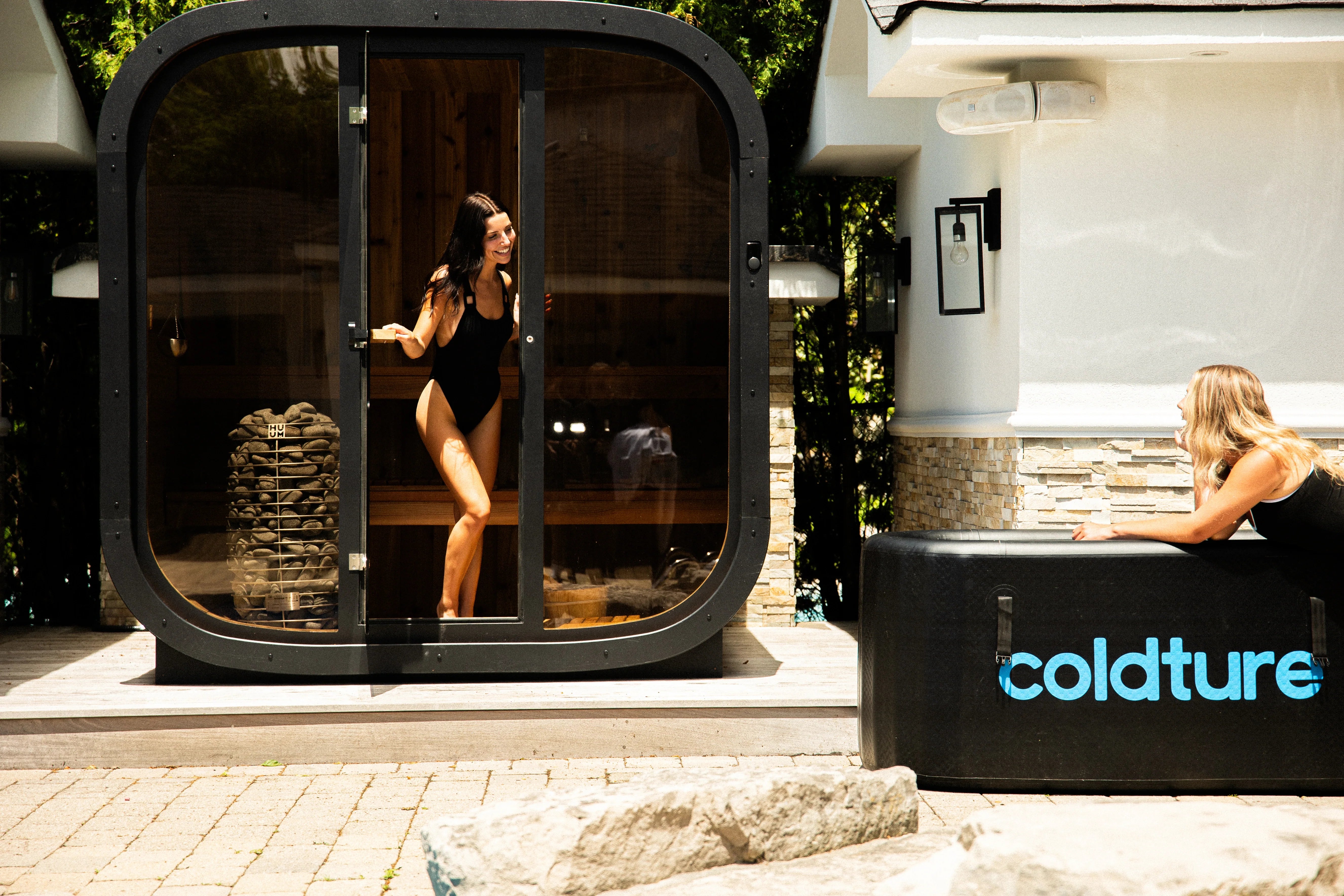
summer changes how you train. more outdoor sessions. longer days. higher intensity. bigger volume. everything scales up when the weather cooperates.
but most people never scale up the other side. the recovery stays the same. or worse, it drops. the sauna feels redundant when it's already hot. the cold plunge gets skipped because the pool is right there. the routine that was compounding quietly through winter and spring gets paused for the season.
that gap between increased training load and unchanged (or decreased) recovery is where progress stalls, burnout builds, and months of adaptation erode. the research explains why.
 the heat raises your recovery load
training in summer heat isn't the same as training in controlled conditions. higher ambient temperatures increase the physiological demand of the same workout, even when the perceived effort feels similar.
a study published in Frontiers in Physiology examined the effects of resistance exercise in heated conditions on hormonal and inflammatory markers in untrained males. the results were clear: exercise in a heated environment elevated inflammatory cytokines, including interleukin-6 (IL-6), and altered cortisol and catecholamine responses compared to the same exercise in temperate conditions. the researchers concluded that exercise in a heated environment may impose a higher physiological workload through elevated heart rate responses and altered metabolic stress.
research on endurance training in the heat has confirmed that plasma IL-6 concentrations rise 3-7x above resting levels during exercise in hot and humid conditions (35°C, ~40% humidity), with TNF-alpha (a key proinflammatory cytokine) increasing by approximately 33% (Selkirk et al., 2009, Applied Physiology, Nutrition, and Metabolism). these inflammatory responses were elevated both during exercise and during the recovery window afterward.
in practical terms: higher temperatures mean more sweat, more fluid loss, more inflammation, and more strain on the same systems that need to clear metabolic waste and repair tissue after training. your recovery need goes up in summer. most people never adjust for it.
 the fix: cold water immersion
cold water immersion (CWI) is one of the most well-studied recovery tools for exercise-induced muscle damage, and the research has gotten increasingly specific about optimal dosing.
a 2025 network meta-analysis published in Frontiers in Physiology, pooling data from 55 randomized controlled trials, evaluated different CWI protocols by temperature and duration. the findings identified a clear optimal range: immersion at 11-15°C for 10-15 minutes demonstrated the best efficacy for alleviating delayed-onset muscle soreness (DOMS), with a large and statistically significant effect size (SMD = -1.45, p < 0.01). the same protocol also significantly improved jump performance (SMD = 0.42, p = 0.02) and significantly reduced creatine kinase levels (SMD = -0.85, p = 0.01), a direct blood marker of muscle damage.
a separate systematic review and meta-analysis comparing CWI to whole-body cryotherapy found that CWI at 5-15°C was significantly more effective than cryotherapy at reducing DOMS within the first 24 hours post-exercise (MD = 1.07, p < .00001).
the physiological mechanisms are well-characterized. cold water triggers vasoconstriction, reducing blood flow to damaged tissue and limiting the secondary inflammatory cascade that amplifies soreness. it reduces nerve conduction velocity, which directly lowers pain perception. and the hydrostatic pressure of immersion supports lymphatic drainage and reduces edema.
the hotter and harder your summer, the more inflammation there is to clear. CWI at 10-15°C is one of the most efficient ways to do it.
Coldture cold plunge systems hold exact temperature from 3°C to 40°C via app control, so you can set 12°C and get 12°C every session. no ice, no guesswork, no drift. the pro plunge adds wi-fi control and continuous filtration for permanent outdoor installation. the classic and barrel bundles pair a portable insulated tub with the water chiller pro for the same precision on a standard 110V outlet.
 hot nights wreck your deep sleep
this is the part most people never connect to their training.
summer heat raises your core temperature at night. your brain uses the decline in core body temperature as one of its primary signals to initiate deep sleep (slow-wave sleep, or N3). when ambient temperature stays high, your body can't complete the thermoregulatory cooling process that triggers that transition. the result: you spend less time in deep sleep, more time in lighter, fragmented stages, and wake up less recovered even if you slept the same number of hours.
a 2025 study published in Nature Communications, analyzing 23 million nights of sleep data from 214,445 participants across mainland China, found that for every 10°C increase in ambient temperature, the odds of sleep insufficiency increased by 20.1% and total sleep duration decreased by 9.67 minutes, with deep sleep declining the most (by 2.82%). the effect was strongest during summer months.
research published in the Journal of Physiological Anthropology (Togo et al.) confirmed that slow-wave sleep is decreased when the usual decline in core body temperature is restricted by ambient temperature above the thermoneutral zone. a study in Scientific Reports (2024) demonstrated the inverse: when conductive body heat loss during sleep was enhanced, slow-wave sleep increased significantly.
deep sleep is when the majority of growth hormone is released. it's when muscle tissue repair peaks. it's when the immune system does its most critical work. you can train perfectly and still recover poorly because the heat is stealing your most important recovery window.
 the fix: cold plunge before bed
a cold plunge 1-2 hours before bed drops your core temperature rapidly. the rebound cooling after immersion mirrors the exact thermoregulatory signal your brain uses to initiate deep sleep: a falling core temperature paired with vasodilation in the extremities (warm hands and feet, cool core).
research has consistently shown that this distal-to-proximal skin temperature gradient is one of the strongest predictors of how quickly someone falls asleep. a cold plunge amplifies the gradient by triggering aggressive core cooling after the initial vasoconstriction resolves.
the same Coldture cold plunge systems work here. set 15°C for a gentler evening session, step in for 2-3 minutes, and let the thermoregulatory rebound do the rest. better nights, even in a heatwave.
you quit the habit that compounds
here's the mistake almost nobody talks about: most people retire the sauna in summer, right when heat adaptation pays off most.
sauna use produces a specific set of cardiovascular and thermoregulatory adaptations that are dose-dependent and cumulative. the most important of these is plasma volume expansion: your body increases the volume of plasma in your bloodstream, which improves stroke volume, reduces heart rate during exercise, and makes your cardiovascular system more efficient under thermal stress.
a study by Stanley et al. (2015), published in the European Journal of Applied Physiology, investigated the effect of post-exercise sauna bathing on plasma volume in well-trained cyclists. the results were striking: sauna bathing following normal training produced a peak plasma volume expansion of +17.8% after just four exposures. four sessions. that's the cardiovascular equivalent of weeks of altitude training, achieved in a sauna.
a 2021 study on elite cross-country skiers confirmed these findings in a high-performance population, noting that medium-term sauna-based heat acclimation improved cardiovascular function and plasma volume stability during and immediately after submaximal exercise.
these adaptations, expanded plasma volume, enhanced sweat response, reduced heart rate during heat stress, are exactly what makes every hot summer day, every outdoor workout, and every recovery window more efficient. but they're use-it-or-lose-it. stopping sauna use for the summer quietly erases months of progress.
athletes use the sauna more in summer, not less. that's the edge most people give away.
Coldture's hybrid sauna runs a dedicated 6 kW heater (up to 90°C) and 2,920W of independent infrared panels, so you can choose your modality based on the session. the pod infrared sauna fits a compact footprint and runs on 110V for daily use with wireless control. for outdoor setups, the outdoor sauna pro delivers finnish dry heat up to 110°C via a HUUM heater with wi-fi control for remote preheating.
the gap nobody connects
here's the full picture. in summer, three things happen simultaneously:
your training load increases. more volume, more intensity, more outdoor sessions. inflammation rises. fluid loss accelerates. the demand on your recovery systems goes up.
your sleep quality decreases. ambient heat disrupts the thermoregulatory cooling that triggers deep sleep. growth hormone output drops. tissue repair slows. you're accumulating more damage and recovering from less of it.
your recovery habits drop off. the sauna gets shelved. the cold plunge gets skipped. the routine that was compounding through the cooler months disappears at the exact moment your body needs it most.
these three things compound quietly until progress stalls and burnout starts. the training plateau that hits in late August isn't a training problem. it's a recovery problem that's been building since June.
closing the gap is the whole point of a real recovery setup at home. not something you do occasionally when you feel sore. something that's there every day, holding the exact temperature you need, ready when you walk through the door.
 the summer recovery protocol
cold plunge post-training. 10-15°C, 10-15 minutes, within 2 hours of your session. this is the protocol the meta-analyses consistently identify as optimal for reducing DOMS, lowering creatine kinase, and restoring neuromuscular function.
cold plunge before bed. 15°C, 2-3 minutes, 1-2 hours before sleep. the core temperature drop initiates the thermoregulatory cascade that triggers deep sleep. this is especially valuable on hot nights when ambient temperature is working against you.
sauna 3-5x per week. maintain your heat adaptation through the summer. the plasma volume expansion, the cardiovascular efficiency, the sweat response, all of it compounds with consistency and decays without it. 15-20 minutes at 80-100°C (traditional) or 45-65°C (infrared).
hydration. non-negotiable. you're losing more fluid in summer through both training and ambient heat. water before, during, and after both sauna and cold plunge sessions. electrolytes for longer sessions.
 the season starts now
summer isn't a reason to scale back recovery. it's the reason to scale it up. the training load is higher. the recovery demand is greater. the sleep is worse. and the tools that were compounding quietly through the year are most valuable right now.
you scaled up the training. scale up the recovery.
explore Coldture's full recovery lineup: cold plunges with app-controlled temperature from 3°C to 40°C and saunas built for daily use with non-toxic materials and wi-fi control. the season starts now. up to $2,000 off sitewide. shop all.
sources
- Cosio-Lima L et al. "Resistance Exercise in a Hot Environment Alters Serum Markers in Untrained Males." Frontiers in Physiology, 2020.
- Selkirk GA et al. "The Effects of Increased Endurance Training Load on Biomarkers of Heat Intolerance During Intense Exercise in the Heat." Applied Physiology, Nutrition, and Metabolism, 2009.
- Wang S et al. "Impact of Different Doses of Cold Water Immersion on Recovery from Acute Exercise-Induced Muscle Damage: A Network Meta-Analysis." Frontiers in Physiology, 2025.
- Zhu Y et al. "Effects of Cold Water Immersion vs Body Cryotherapy on DOMS and Jump Performance: A Systematic Review and Meta-Analysis." PMC, 2025.
- Peng Z et al. "Climate Warming May Undermine Sleep Duration and Quality." Nature Communications, 2025.
- Togo F et al. "Influence on Human Sleep Patterns of Lowering and Delaying the Minimum Core Body Temperature." Journal of Physiological Anthropology, 2007.
- Kräuchi K et al. "Enhanced Conductive Body Heat Loss During Sleep Increases Slow-Wave Sleep." Scientific Reports, 2024.
- Stanley J et al. "Effect of Sauna-Based Heat Acclimation on Plasma Volume and Heart Rate Variability." European Journal of Applied Physiology, 2015.
- Zurawlew MJ et al. "The Effect of Medium-Term Sauna-Based Heat Acclimation on Thermophysiological and Plasma Volume Responses in Elite Cross-Country Skiers." PMC, 2021.
Share:
12 minutes of red light, twice a week. what showed up under the microscope changed how researchers think about skin aging.
PEMF therapy, explained: what pulsed electromagnetic fields actually do and what the research supports