

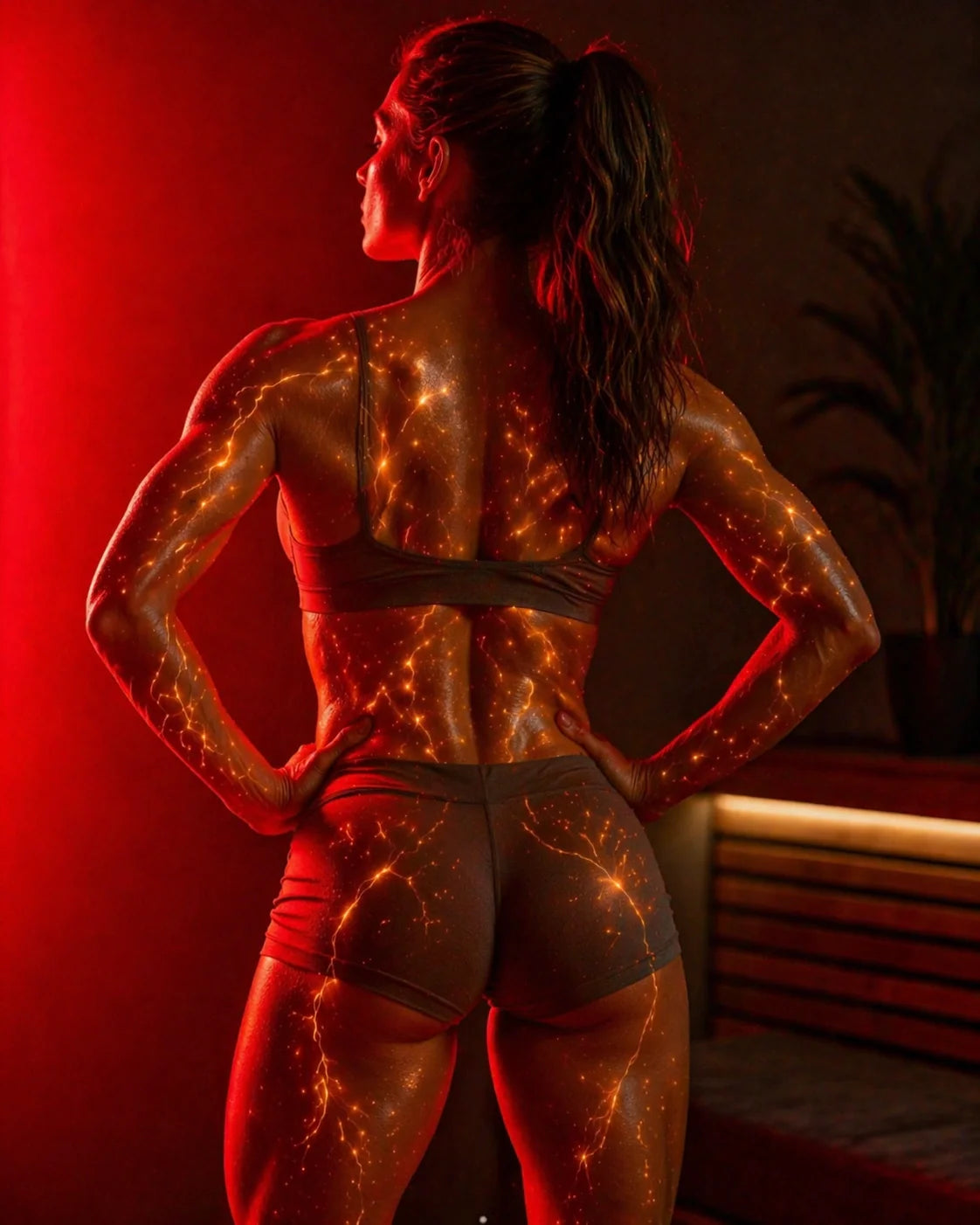
Most people who try red light therapy for the first time notice the same thing: not much. The light is warm. It feels pleasant. But nothing obvious is happening.
That's exactly the point.
What red light therapy does, it does silently. Inside your cells. At the level of your mitochondria, your collagen-producing fibroblasts, your inflammatory markers, and your vascular system. The changes start within the first 10 minutes of a session. They just don't announce themselves until later.
Here is what the science says is actually happening while you sit there.
WHAT HAPPENS FIRST
Your mitochondria start producing more energy
Red and near-infrared light in the 630 to 900 nanometre range penetrates skin and reaches your mitochondria directly. When it does, it activates a protein called cytochrome c oxidase, the enzyme responsible for driving your cells' energy production cycle.
The result is an increase in ATP, adenosine triphosphate, the molecule your cells use to power every repair, growth, and recovery process in your body. More ATP means more raw fuel available for every biological process that follows.
Red and near-infrared wavelengths reach your mitochondria directly. ATP production increases. That's the raw fuel behind every repair process in your body.
Research published in the Journal of Biophotonics found that 15 minutes of 670nm red light exposure increased mitochondrial membrane potential and ATP production, and reduced blood glucose elevation following a glucose challenge by 27.7 percent. The researchers concluded that photobiomodulation with red light directly upregulates mitochondrial energy production.
Source: Powner et al. (2024). Light stimulation of mitochondria reduces blood glucose levels. Journal of Biophotonics. PubMed: 38378043
A separate review published in NCBI confirmed that red light absorption by cytochrome c oxidase triggers enhanced mitochondrial function, increased ATP production, and reduced oxidative stress, collectively promoting cellular repair and tissue regeneration.
Source: Photobiomodulation in Ophthalmology: A Comprehensive Review. NCBI PMC11488463 (2024)
WHAT HAPPENS TO YOUR SKIN
Collagen production ramps up
Once your cells have more energy to work with, fibroblasts, the cells responsible for producing collagen and elastin, become more active. They use the increased ATP to accelerate the synthesis of the structural proteins that keep skin firm, smooth, and resilient.
This is not a cosmetic claim. It is a measurable, documented cellular response that dermatologists have been using in clinical settings for decades.
Fibroblasts become more active. Skin starts repairing faster at the cellular level. Dermatologists have used these wavelengths for decades.
A controlled trial published in the journal Photomedicine and Laser Surgery found significant improvements in skin complexion, skin roughness, and intradermal collagen density in participants who received consistent red and near-infrared light treatments. Blind evaluation of clinical photographs confirmed visible changes in wrinkles and skin texture.
Source: Wunsch & Matuschka (2014). A Controlled Trial to Determine the Efficacy of Red and Near-Infrared Light Treatment. PMC3926176
A study published in the Journal of the American Academy of Dermatology found that low-level red and infrared LED light significantly induced the expression of collagen types Col1A1 and Col1A3, elastin, and hyaluronic acid in human skin cells within one week of treatment.
Source: Journal of the American Academy of Dermatology (2019). Low-level red and infrared light increases expression of collagen, elastin, and hyaluronic acid in skin. JAAD S0190-9622(19)33160-3
Shop Coldture red light therapy panels: coldture.com/collections/red-light-therapy
WHAT HAPPENS TO SORENESS AND REDNESS
Inflammation quiets
Red light therapy has a well-documented anti-inflammatory effect. Pro-inflammatory cytokines, the signalling molecules that drive soreness, redness, swelling, and chronic inflammation, decrease in response to red and near-infrared light exposure.
This is why the soreness and redness most people carry around, from training, from skin conditions, from daily stress on the body, does not have to last as long as it typically does. Coldture's red light panels are built to deliver the wavelengths and power density required to produce this response consistently.
Pro-inflammatory markers decrease. The soreness and redness you carry around doesn't have to last as long as you think.
A 2024 meta-analysis of randomised controlled trials found that red light therapy significantly accelerated wound closure and reduced pain compared with standard care, with reductions in inflammatory markers observed across diabetic ulcers, pressure sores, and other chronic injuries.
Source: 2024 meta-analysis cited in: Research-Backed Benefits of Red Light Therapy. bodymotionpt.com (2025)
A study published in NCBI examining LED therapy on skin healing found that LED treatment significantly decreased interleukin IL-1B, IL-10, and TNF-alpha, key pro-inflammatory markers, on day 10 of treatment, while increasing antioxidant activity.
Source: Red light-emitting diode on skin healing: an in vitro and in vivo experimental study. NCBI PMC11745292 (2025)
Research in The Journal of Strength and Conditioning Research found that near-infrared light applied before exercise reduced delayed-onset muscle soreness by 40 percent and decreased creatine kinase levels, a marker of muscle damage, by 30 percent compared to sham treatment.
Source: Journal of Strength and Conditioning Research, cited in: Red Light Therapy Benefits. healthhighroad.com (2026)
WHAT HAPPENS TO CIRCULATION
Blood flow increases
Red and near-infrared light triggers the release of nitric oxide from cells, a molecule that causes blood vessels to dilate. As blood vessels open wider, more oxygen and nutrient-rich blood reaches damaged or fatigued tissue. Recovery accelerates not because something external is added but because your body's own delivery system is operating more efficiently.
Nitric oxide releases. Blood vessels open wider. More oxygen reaches damaged tissue. Recovery accelerates at the source.
Research confirms that photobiomodulation causes photodissociation of nitric oxide from cytochrome c oxidase, which increases mitochondrial membrane potential and oxygen consumption, and allows nitric oxide to diffuse outward and act as a vasodilator, improving circulation and promoting broader tissue healing.
Source: Evaluating Metabolic Changes Induced by PhotoBioModulation. ClinicalTrials.gov NCT06582511
A systematic review published in the British Journal of Sports Medicine concluded that photobiomodulation applied before exercise improves endurance performance by 2 to 4 percent and accelerates recovery between training sessions, with the mechanism involving enhanced mitochondrial function, improved blood flow through nitric oxide release, and reduced inflammatory cytokine production.
Source: British Journal of Sports Medicine systematic review, cited in: Red Light Therapy Benefits. healthhighroad.com (2026)
That's not just glow. That's repair.
The reason red light therapy has moved from clinical settings into homes, gyms, and wellness spaces is not because it looks impressive. It is because the mechanism is real, measurable, and well-documented across thousands of peer-reviewed studies.
You will not feel it working in the first 10 minutes. Your mitochondria do not send notifications. But the ATP is increasing, the fibroblasts are activating, the inflammation is quieting, and the blood is moving more freely through tissue that needed it.
The results show up later. In the mirror. In your recovery time. In the soreness that does not last as long as it used to.
That is what 10 minutes under Coldture red light actually does. Not magic. Just biology doing its job with better inputs.
Shop Coldture red light therapy panels: coldture.com/collections/red-light-therapy
Share:
Top advantages of heat therapy for fitness and recovery
Contrast therapy explained: Boost recovery and wellness safely