

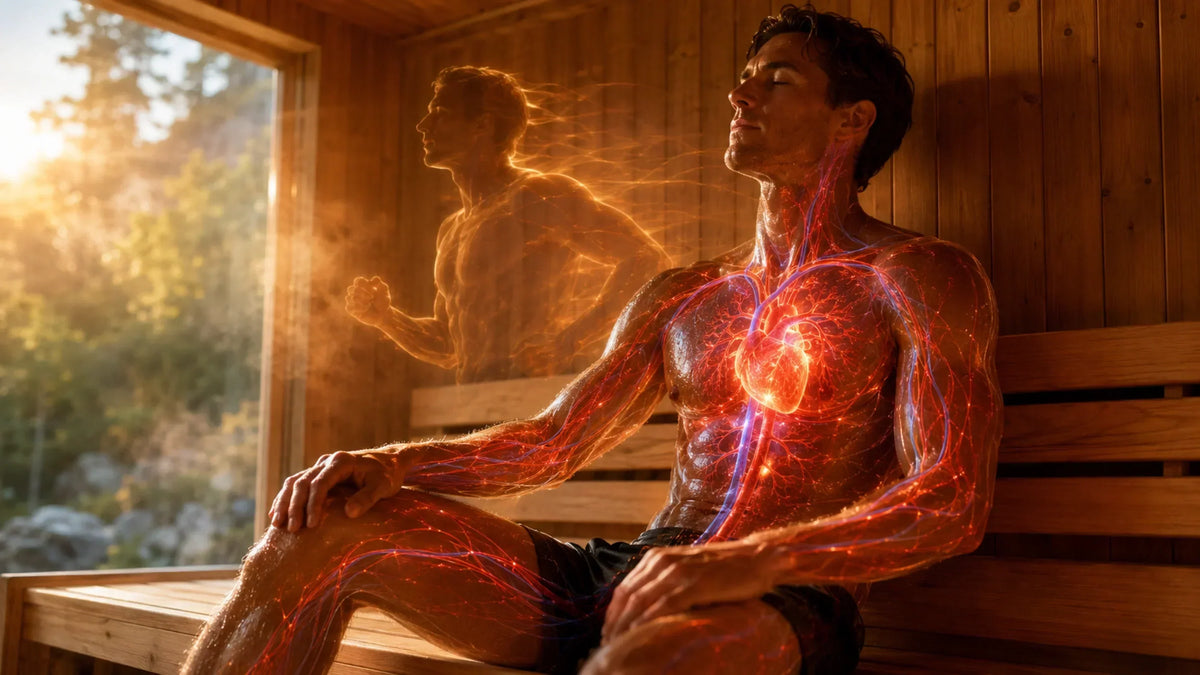
there's a simple question most people never ask after a workout: what if the 15 minutes after your session mattered as much as the session itself?
a 2022 randomized controlled trial answered it. same workouts. same participants. one group walked out when they finished. the other sat in a sauna for 15 minutes. after eight weeks, the sauna group had more than double the cardiovascular fitness improvement, significantly lower blood pressure, and better cholesterol numbers.
here's the study, what it found, why it works, and what it means for how you structure the time after you train.
the study
in 2022, Earric Lee and colleagues published a multi-arm randomized controlled trial in the American Journal of Physiology: Regulatory, Integrative and Comparative Physiology, one of the most respected journals in exercise and integrative physiology.
the design was clean and specific. 47 sedentary adults (average age 49, with at least one traditional cardiovascular disease risk factor) were randomly assigned in a 1:1:1 ratio to one of three groups:
group 1 (EXS): guideline-based regular exercise plus a 15-minute post-exercise sauna session.
group 2 (EXE): the same guideline-based regular exercise, no sauna.
group 3 (CON): control. no exercise, no sauna.
the exercise protocol was identical between the two active groups: moderate-to-vigorous physical activity, three times per week, following standard clinical exercise guidelines. the sauna sessions started at 65°C and increased by 5°C every two weeks, with humidity kept between 10% and 20%. sessions lasted 15 minutes, taken immediately after each workout.
the intervention ran for eight weeks. primary outcomes were blood pressure and cardiorespiratory fitness (measured by VO2 max). secondary outcomes included fat mass, total cholesterol, and arterial stiffness.
the result: more than double the cardiovascular gain
both active groups improved versus the control group. but the difference between the exercise-only group and the exercise-plus-sauna group was where the study got interesting.
cardiorespiratory fitness (VO2 max). the exercise-only group improved their VO2 max by +2.6 mL/kg/min versus baseline. the exercise-plus-sauna group improved by +5.6 mL/kg/min. the between-group difference was +2.7 mL/kg/min (95% CI: +0.2 to +5.3), which was statistically significant (p < 0.05). same workouts. more than double the cardiovascular gain, just by adding 15 minutes of heat after.
to put that in context: VO2 max is the gold-standard measure of cardiorespiratory fitness and one of the strongest predictors of all-cause mortality. each 1 mL/kg/min increase is associated with a roughly 9% reduction in cardiovascular mortality risk. the extra 2.7 mL/kg/min the sauna group gained translates to a meaningful shift in cardiovascular risk profile, achieved with zero additional exercise.
systolic blood pressure. the exercise-plus-sauna group reduced systolic blood pressure by an additional 8.0 mmHg versus the exercise-only group (95% CI: -14.6 to -1.4 mmHg). the exercise-only group showed no significant blood pressure improvement compared to control. only the sauna group moved the needle.
an 8 mmHg reduction in systolic blood pressure is clinically meaningful. it's enough to reclassify someone from stage 1 hypertension to elevated, or from elevated to normal. a 2002 meta-analysis in The Lancet estimated that a 10 mmHg reduction in systolic blood pressure reduces the risk of major cardiovascular events by approximately 22%. the sauna group came close to that threshold with 15 minutes of heat, three times a week, for eight weeks.
total cholesterol. the sauna group showed significantly lower total cholesterol levels compared to the exercise-only group. exercise alone did not produce a significant cholesterol improvement versus control. the sauna added what exercise alone didn't deliver.
 it wasn't just this study
the Lee et al. trial is the most controlled investigation of post-exercise sauna use in sedentary adults. but the broader evidence on sauna and cardiovascular adaptation runs deeper.
plasma volume expansion. a study by Stanley et al. (2015), published in the European Journal of Applied Physiology, found that post-exercise sauna bathing produced a peak plasma volume expansion of +17.8% in well-trained cyclists after just four exposures. plasma volume expansion increases stroke volume, reduces heart rate during exercise, and improves oxygen delivery to working muscles. it's the cardiovascular equivalent of weeks of altitude training.
endurance performance. a study by Scoon et al. (2007) found that post-exercise sauna bathing (30 minutes, 89.9°C, 3-4 times per week for 3 weeks) improved time to exhaustion during a run at VO2 max pace by 32% in competitive male runners. the authors attributed the improvement primarily to plasma volume expansion.
cardiovascular mortality. the Finnish Kuopio Ischemic Heart Disease Risk Factor Study (Laukkanen et al., 2015), a 20-year prospective study of 2,315 men, found that men who used the sauna 4-7 times per week had a 50% reduction in cardiovascular death and a 63% reduction in sudden cardiac death compared to those who used it once per week. the dose-response relationship was clear and statistically significant.
vascular function. a review in Mayo Clinic Proceedings (Laukkanen et al., 2018) concluded that regular sauna bathing improves endothelium-dependent vasodilation, reducesarterial stiffness, and modulates the autonomic nervous system toward parasympathetic dominance.
passive heat therapy. a 2016 study by Brunt et al., published in The Journal of Physiology, found that 8 weeks of passive heat therapy (hot water immersion) in sedentary individuals improved endothelial function, reduced arterial stiffness, and lowered blood pressure, demonstrating that heat exposure alone, without exercise, produces measurable cardiovascular benefit.
why heat after exercise works
the mechanism behind the Lee et al. results involves several overlapping physiological processes.
extended cardiovascular stimulus. during a sauna session, your heart rate rises to approximately 100-150 bpm, comparable to moderate-intensity aerobic exercise. a study by Ketelhut and Ketelhut (2019) published in Complementary Therapies in Medicine found that the blood pressure and heart rate responses during a sauna session correspond to cardiac responses during submaximal dynamic exercise at approximately 60-100 watts. when you add 15 minutes of sauna after a workout, your cardiovascular system continues working at a meaningful intensity without additional mechanical stress on joints and muscles.
plasma volume expansion. heat exposure stimulates the release of aldosterone and antidiuretic hormone, which promote fluid retention and expand plasma volume. more plasma means more blood volume per heartbeat (stroke volume), which means your heart needs to beat fewer times per minute to deliver the same oxygen. this is the primary mechanism behind the VO2 max improvement.
vascular adaptation. repeated heat exposure improves endothelial function (the ability of blood vessel walls to dilate and contract appropriately) and reduces arterial stiffness. these changes lower peripheral resistance, which directly reduces blood pressure.
in practical terms: your body reads the post-workout sauna as an extension of the training stimulus. your heart keeps pumping. your blood vessels keep adapting. your plasma volume keeps expanding. you're getting more cardiovascular training without another rep, another mile, or another set.
the protocol
the Lee et al. study used a simple, reproducible protocol:
timing: immediately after each workout. not hours later. not the next morning. the post-exercise window is when your cardiovascular system is already activated, and the heat extends that activation.
duration: 15 minutes. the study started at 65°C and increased by 5°C every two weeks. this progressive approach allowed participants to build heat tolerance without excessive discomfort early in the protocol.
frequency: 3 times per week, matching the exercise frequency. the sauna was added to each training session, not used on separate days.
consistency: 8 weeks. the improvements were measured at the end of the protocol. this isn't a single-session effect. it's a cumulative adaptation that builds over weeks of consistent use.
that's it. no complex periodization. no special breathing technique. no extreme temperatures. 15 minutes of sitting in a sauna after each workout, three times a week, for two months.
the nuance
the Lee et al. findings are strong, but a few points deserve honest framing.
the study enrolled 47 participants, which is respectable for an exercise physiology RCT but not enormous. the participants were sedentary adults with cardiovascular risk factors, which means the magnitude of improvement may be partly explained by their low baseline fitness. highly trained athletes may see smaller absolute gains.
a 2025 follow-up analysis from the same research group (Lee et al., Physiological Reports) found that post-exercise sauna bathing did not improve heart rate variability (HRV) over the same 8-week period. this is worth noting: the cardiovascular benefits (VO2 max, blood pressure, cholesterol) were clear and significant, but the autonomic nervous system adaptation measured by HRV was not. not every marker moved.
the sauna temperatures used were moderate (65-80°C over the 8-week progression). this is well within the range of most home infrared saunas (45-65°C) and on the lower end of traditional finnish saunas (80-100°C). you don't need extreme heat to replicate the protocol.
what this means for your setup
the Lee et al. protocol requires one thing above all: a sauna that's ready when your workout ends.
if your sauna takes 45 minutes to preheat, you won't use it post-workout. if it's at a gym across town, you won't drive there after training at home. the logistics have to be seamless enough that "walk from the workout space to the sauna" is a 30-second transition, not a 30-minute project.
Coldture's pod infrared sauna runs on a standard 110V outlet with wireless control, so you can start preheating from your phone during your last set. far-infrared heat up to 65°C, which sits right in the range the Lee study used in its early weeks. the corner pod adds capacity for 2-3 people with 6 dedicated red light therapy panels and a rotatable therapy lamp.
for the full traditional heat experience at higher temperatures, the hybrid sauna runs a dedicated 6 kW heater (up to 90°C) alongside 2,920W of independent infrared panels. use infrared for the 65°C post-workout protocol. use traditional heat when you want a longer, higher-temperature session on rest days.
the outdoor sauna pro delivers authentic finnish dry heat up to 110°C via a HUUM heater with wi-fi control. remote start from your phone means the sauna is at temperature by the time you finish your last exercise. step outside, sit for 15 minutes, and let the heat extend the work your training already started.
the workout builds it. the heat after doubles down.
the Lee et al. RCT demonstrated that 15 minutes of post-exercise sauna, three times a week, more than doubled the VO2 max improvement from exercise alone, dropped systolic blood pressure by an additional 8 mmHg, and improved cholesterol in sedentary adults with cardiovascular risk factors. the mechanism is well-characterized: extended cardiovascular stimulus, plasma volume expansion, and vascular adaptation.
you don't need more training. you don't need a harder workout. you need to not walk out the door the second you finish.
explore Coldture's full sauna lineup: indoor infrared, hybrid, and outdoor traditional models. all with wireless control so the sauna is at temperature when your workout ends. shop saunas.
sources
- Lee E, Kolunsarka I, Kostensalo J, et al. "Effects of Regular Sauna Bathing in Conjunction with Exercise on Cardiovascular Function: A Multi-Arm, Randomized Controlled Trial." American Journal of Physiology: Regulatory, Integrative and Comparative Physiology, 2022; 323(3):R289-R299.
- Lee E, Ketelhut S, Wiklund P, et al. "Regular Postexercise Sauna Bathing Does Not Improve Heart Rate Variability: A Multi-Arm Randomized Controlled Trial." Physiological Reports, 2025; 13(13):e70449.
- Stanley J, Halliday A, D'Auria S, et al. "Effect of Sauna-Based Heat Acclimation on Plasma Volume and Heart Rate Variability." European Journal of Applied Physiology, 2015; 115(2):299-307.
- Scoon GSM, Hopkins WG, Mayhew S, Cotter JD. "Effect of Post-Exercise Sauna Bathing on the Endurance Performance of Competitive Male Runners." Journal of Science and Medicine in Sport, 2007; 10(4):259-262.
- Laukkanen T, Khan H, Zaccardi F, Laukkanen JA. "Association Between Sauna Bathing and Fatal Cardiovascular and All-Cause Mortality Events." JAMA Internal Medicine, 2015; 175(4):542-548.
- Laukkanen JA, Laukkanen T, Kunutsor SK. "Cardiovascular and Other Health Benefits of Sauna Bathing: A Review of the Evidence." Mayo Clinic Proceedings, 2018; 93(8):1111-1121.
- Brunt VE, Howard MJ, Francisco MA, Ely BR, Minson CT. "Passive Heat Therapy Improves Endothelial Function, Arterial Stiffness and Blood Pressure in Sedentary Humans." The Journal of Physiology, 2016; 594(18):5329-5342.
- Ketelhut S, Ketelhut RG. "The Blood Pressure and Heart Rate During Sauna Bath Correspond to Cardiac Responses During Submaximal Dynamic Exercise." Complementary Therapies in Medicine, 2019; 44:218-222.
Share:
14°C water produced a 530% norepinephrine spike. that's warmer than most people think they need.
Three Types of Cedar Used in Saunas, and Why the Differences Matter More Than You Think