

Red Light Therapy Got Hijacked by the Beauty World. The Most Interesting Research Has Nothing to Do With Wrinkles.
Science + Recovery | 8 min read
If no one has ever told you that red light is being studied for thyroid function, with early research showing some patients able to reduce their medication under medical supervision, this one might reframe how you think about a device most people file under skincare. Because the anti-aging angle, the collagen and the wrinkles, is real, but it may be the least interesting thing red light does.
Where This Started for Me
I want to be honest about how I got here, because it was not through a wellness influencer or a product launch. It was through feeling off and not getting answers.
Low energy that coffee could not touch. Hair thinning enough that I noticed it in every photo. Hands and feet that were cold no matter the season. A face that looked puffy in the morning in a way that did not match how much sleep I had gotten. And a flat, grey mood that made motivation feel like pushing a boulder uphill.
I asked my doctor for a full thyroid panel. I was told I was young and looked healthy, and sent on my way. That experience is common, and it is worth saying clearly: if you suspect a thyroid issue, advocating for proper testing with your doctor is the right move, and this article is not a substitute for that. But being turned away sent me down a research path, and what I found in the literature on red light and thyroid function genuinely surprised me.
What the Research Actually Shows
Here is where I have to be careful, because this is exactly the kind of topic where the internet runs far ahead of the evidence.
The most cited study is a 2013 randomised, placebo-controlled trial by Höfling and colleagues, which examined near infrared light therapy in patients with hypothyroidism caused by Hashimoto's thyroiditis, an autoimmune thyroid condition. [1] In that study, patients who received the light therapy showed reductions in thyroid peroxidase antibodies, a marker of the autoimmune activity behind Hashimoto's, and a portion of patients were able to reduce their thyroid hormone medication under medical supervision during the follow-up period. [1] A later follow-up of the same cohort reported that the effects persisted for some patients well after treatment ended. [2]
Those are real, published, peer-reviewed findings, and they are genuinely promising. But the honest framing matters: this is a small body of evidence, centred on a single research group, with a modest number of participants and no large-scale replication to date. [3] It is a compelling early signal, not settled medical consensus. Anyone who tells you red light is a proven replacement for thyroid medication is overstating what exists.
What the research supports is that this is a legitimate area of scientific interest, not that you should change your treatment based on it. Any decision about thyroid medication belongs with your doctor, full stop. The value of the research is that it points to a mechanism worth understanding.
The Mechanism Underneath It
The reason thyroid researchers became interested in red and near infrared light at all comes back to how the light interacts with cells, and it is the same mechanism behind every other application of the technology.
Red and near infrared wavelengths, roughly 630 to 850 nm, are absorbed by cytochrome c oxidase, an enzyme in the mitochondria, the energy-producing structures inside cells. [4] When this enzyme absorbs the light, it increases the cell's production of ATP, the molecule that powers cellular function and repair. This process, called photobiomodulation, is associated with reduced inflammation, improved tissue repair, and better cellular energy availability in the treated area. [5]
The thyroid is a gland with a rich blood supply sitting relatively close to the skin surface, which is part of why researchers hypothesised it might respond to light delivered to the neck area. The proposed mechanism in the Hashimoto's research involves reduced inflammation and improved function in thyroid tissue, consistent with photobiomodulation's documented effects elsewhere in the body. [1][5]
This is the thread that ties everything together. The same mechanism studied for thyroid tissue is the one behind red light's documented effects on skin, muscle recovery, joint inflammation, and wound healing. It is not a different magic for each application. It is one cellular process with many potential targets.
Why It Got Sold as a Beauty Tool
The beauty industry adopted red light therapy early and aggressively, and for good reason: the skin effects are real. Red light is well documented to support collagen production, improve skin tone, and reduce the appearance of fine lines, which is why LED masks and panels became a fixture in skincare. [6]
But framing red light primarily as an anti-aging tool sells the technology short. The skin is simply the most visible tissue and the easiest place to market a before-and-after. The same device delivering the same wavelengths is being studied across a much wider range of applications, from muscle recovery and circulation to inflammation and, as above, early thyroid research.
If more people understood that the evidence base extends well beyond cosmetics, a red light panel would look less like a beauty gadget and more like what it arguably is: a long-term investment in cellular health and recovery. That reframing, from wrinkle tool to longevity tool, is the genuinely interesting story, and it is the one the beauty marketing tends to bury.
What I Actually Experienced
I will share my own experience, with the honest caveat that this is one person's anecdote, not data. Individual results vary enormously, and what I noticed cannot be promised to anyone else.
In the first couple of weeks of consistent use, the thing I noticed most was energy and mood: I felt lighter and less stuck in the grey. By around a month, the circulation in my hands and feet seemed to improve, less of the constant cold. Over a couple of months, my hair felt fuller and the puffiness in my face I had complained about seemed less pronounced.
How much of that was the red light, how much was placebo, how much was other changes I made alongside it, I cannot fully separate, and I would not pretend to. What I can say is that consistency was the common thread. Whatever benefit I got came from using it regularly, not from occasional sessions.
What This Means If You're Considering Red Light
The realistic takeaway is this. Red light therapy is a legitimately interesting technology with a documented mechanism and a growing, if still early, research base across multiple applications, including some genuinely promising thyroid work that deserves more study. It is not a cure, not a replacement for medical care, and not a substitute for working with your doctor on any diagnosed condition. Treat anyone who claims otherwise with skepticism.
What it can be is a consistent input to cellular health and recovery, with the strongest evidence in skin, muscle recovery, and inflammation, and emerging interest in areas like thyroid function. As with every application, the benefit depends on the right wavelengths at adequate intensity, used consistently.
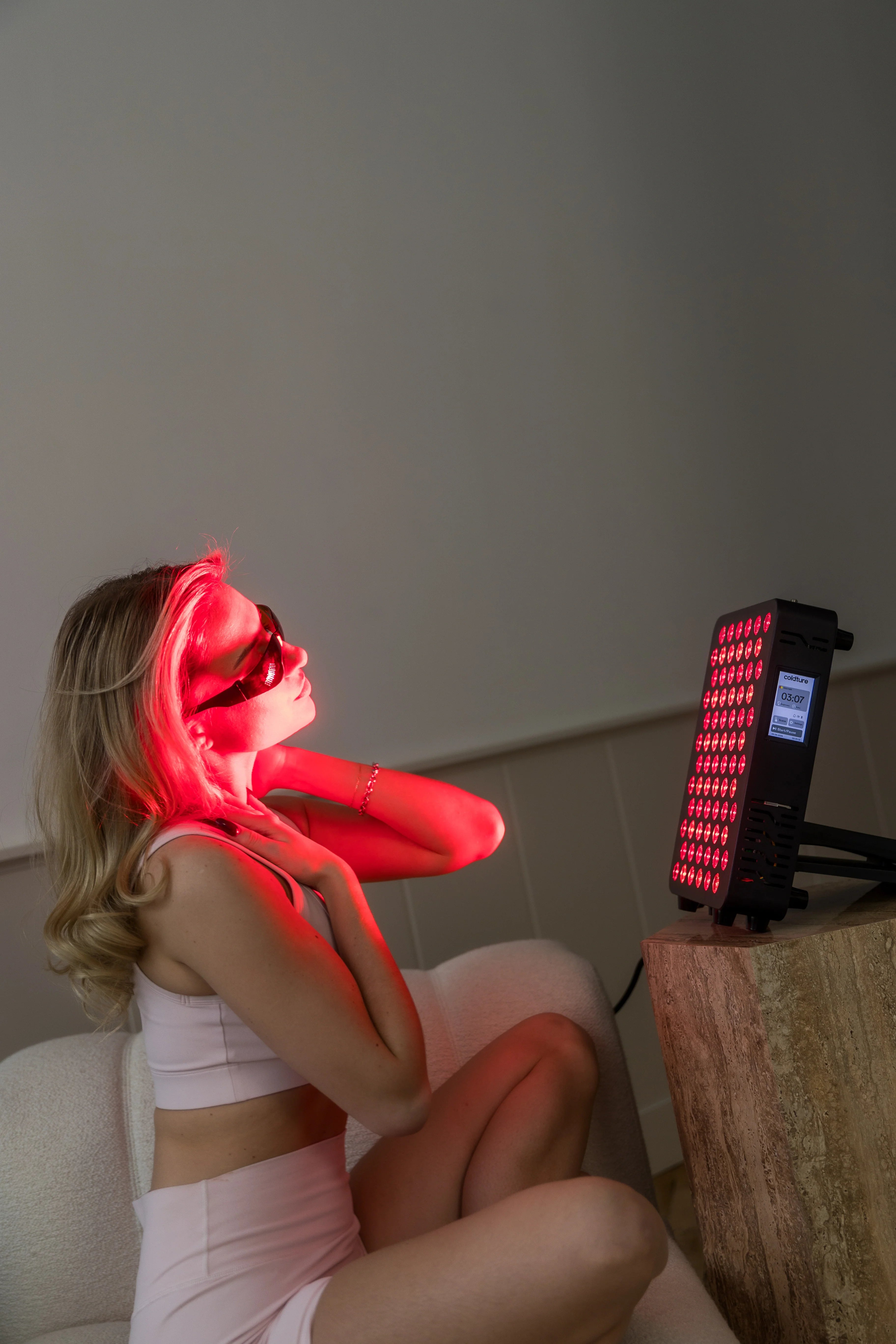
That is where the equipment matters. The Coldture Pro Red Light Panel delivers measured irradiance of at least 1,400 W/m² at 6 inches across eight wavelengths, including 1060 nm for deeper tissue, with FDA and Health Canada certification and independent third-party testing, so the output is verified rather than advertised. For targeted use, the Focus Red Light Panel concentrates output with a 30-degree beam angle for higher irradiance on a specific area, and the Red Light Face Mask brings four wavelengths to the face in a flexible, cordless format built for the daily consistency that makes any of this worthwhile. Browse the full Coldture red light therapy lineup.
The beauty world sold red light as a secret for wrinkles. The more interesting question is what happens when we start treating it as a longevity investment instead.
This article is for general informational and wellness purposes only and is not medical advice. Red light therapy is not a proven treatment for thyroid conditions or any medical condition, and it is not a substitute for professional medical care. Do not start, stop, or change any prescribed medication, including thyroid medication, without consulting your doctor. If you have symptoms that concern you, seek proper medical evaluation.
References
[1] Höfling DB, et al. "Low-level laser in the treatment of patients with hypothyroidism induced by chronic autoimmune thyroiditis: a randomized, placebo-controlled clinical trial." Lasers in Medical Science. 2013;28(3):743-753. doi.org/10.1007/s10103-012-1129-9
[2] Höfling DB, et al. "Effects of low-level laser therapy on the levels of thyroid antibodies and hormones: long-term follow-up." Lasers in Medical Science. 2018. (Follow-up of the original cohort.)
[3] Hamblin MR. "Photobiomodulation for the management of thyroid and autoimmune conditions: current evidence and limitations." (Review noting the early stage of the thyroid evidence base.) Photobiomodulation, Photomedicine, and Laser Surgery. 2019.
[4] Karu T. "Primary and secondary mechanisms of action of visible to near-IR radiation on cells." Journal of Photochemistry and Photobiology B: Biology. 1999;49(1):1-17. doi.org/10.1016/S1011-1344(98)00219-X
[5] Hamblin MR. "Mechanisms and mitochondrial redox signaling in photobiomodulation." Photochemistry and Photobiology. 2018;94(2):199-212. doi.org/10.1111/php.12864
[6] Avci P, et al. "Low-level laser (light) therapy (LLLT) in skin: stimulating, healing, restoring." Seminars in Cutaneous Medicine and Surgery. 2013;32(1):41-52. PMID: 24049929.
Share:
The Sauna and Your Metabolism: What the Research Really Shows
The Role of Light Therapy in Recovery: 2026 Guide