

Red light therapy is marketed for wrinkles, glow, and younger-looking skin. Search for it online and that is most of what you will find. But the largest body of clinical evidence points somewhere else entirely: pain.
A 2026 systematic review published in Sport Sciences for Health pooled 53 clinical studies covering roughly 2,800 patients. The results were consistent enough to be hard to ignore, and they reframe what red light therapy is actually best at.
Here is what the research found, how the mechanism works, what to look for in a panel, and how to build a protocol that actually delivers results.
What 53 studies found
Across knee osteoarthritis, tendinopathies, low back pain, and post-surgical recovery, red and near-infrared light reduced average pain scores by 32% compared with sham treatment. The range across studies was 28% to 40%. Functional improvement scores dropped 18% to 25%.
That is not a single lucky trial. It is a pattern across dozens of them, in different patient populations, across different types of musculoskeletal pain. The conditions studied are also the most common ones: the kind of chronic and recurring pain that sends people cycling through over-the-counter options without lasting relief.
Why it works on pain
Most over-the-counter pain options block the signal. Anti-inflammatories reduce swelling. Topical analgesics numb the area. Both wear off because neither addresses what is happening at the tissue level.
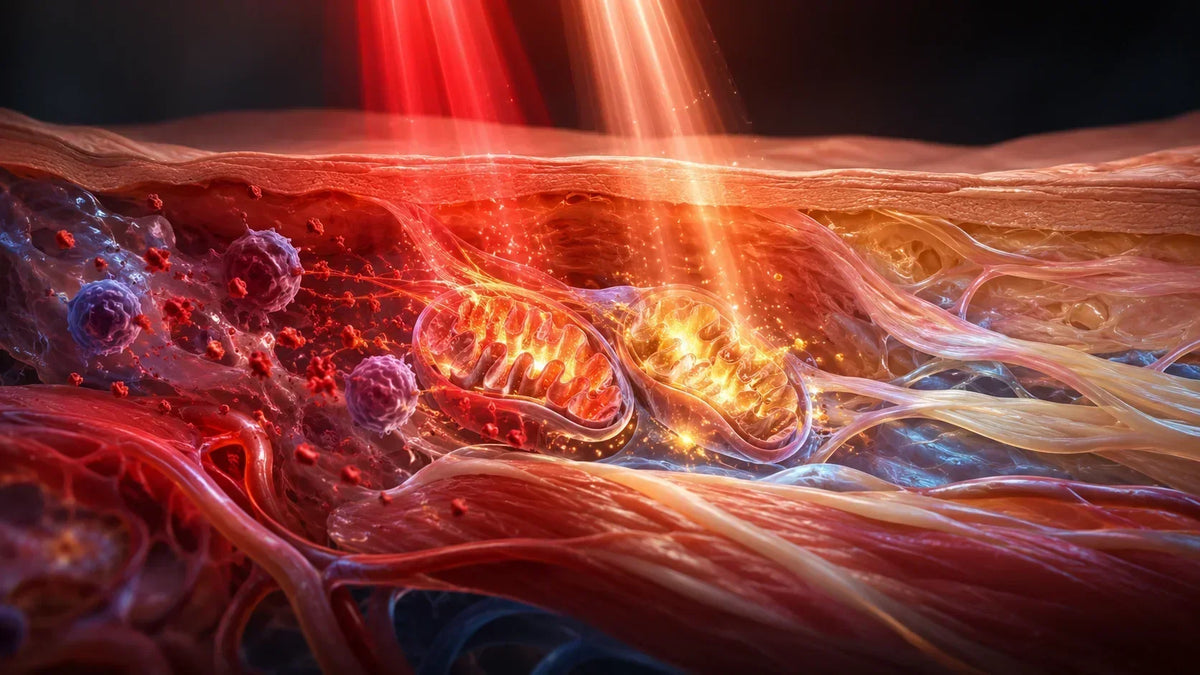
Red and near-infrared wavelengths work differently. They are absorbed by mitochondria in your cells, specifically by an enzyme called cytochrome c oxidase. That absorption triggers three things:
- Increased ATP production. More cellular energy means the tissue can repair faster.
- Reduced inflammatory signaling. The light lowers pro-inflammatory cytokines at the treatment site, which is what drives the swelling and pain cycle in joints and connective tissue.
- Improved local circulation. Better blood flow delivers oxygen and nutrients to the area and clears metabolic waste.
The relief builds because the underlying tissue condition improves. That is why the studies show cumulative results over weeks of consistent treatment, not instant relief from a single session.
Where the evidence is strongest
The 53 trials in the review concentrated on four areas:
| Condition | What the studies showed |
|---|---|
| Knee osteoarthritis | Consistent pain reduction and improved joint function across multiple trials. One of the most-studied applications of photobiomodulation. |
| Tendinopathies | Reduced pain and improved recovery in both upper and lower extremity tendons, including Achilles and lateral epicondyle (tennis elbow). |
| Low back pain | Significant VAS score reductions, particularly when combined with exercise therapy. |
| Post-surgical recovery | Faster pain reduction and functional return in post-operative rehabilitation protocols. |
These are all musculoskeletal conditions where inflammation is a primary driver. That is the common thread: red and near-infrared light performs best where the pain is being driven by an inflammatory process in tissue that the wavelengths can physically reach.
The research also shows that combining red light therapy with exercise produces stronger outcomes than either alone. If you already follow a structured cold plunge protocol or exercise-based recovery routine, red light adds a mechanism that works alongside cold exposure and movement rather than duplicating what they do.
What to look for in a pain-focused panel
Not all red light devices are built for pain. Most consumer panels are designed as skincare tools: surface-level red wavelengths at lower power densities, optimized for complexion rather than deep tissue penetration.
A panel that can meaningfully address musculoskeletal pain needs four things:
The right wavelengths. Red light (630-670 nm) penetrates skin and superficial tissue. Near-infrared (810-850 nm) reaches deeper into muscle and connective tissue. Deep near-infrared (1060 nm) penetrates further still, reaching joints and dense tissue. A panel with only red wavelengths is a skincare device. Pain applications require near-infrared, and ideally the full spectrum from red through deep NIR.
Sufficient power density. Irradiance (measured in mW/cm² or W/m² at a given distance) determines whether enough photons reach the target tissue. Low-powered panels may feel warm on the skin but deliver insufficient energy to tissue 2-4 cm below the surface. Clinical studies typically use irradiances well above what most consumer devices produce.
Adequate treatment area. A small panel treats a single joint or spot. That works for a knee or an elbow, but low back pain, bilateral joint issues, or post-surgical recovery across a larger area requires a panel that covers more surface at clinical intensity. Smaller panels can work, but treatment time per area increases significantly.
Consistent, repeatable dosing. Built-in timers, preset protocols, and app control remove guesswork from session to session. Consistency is what drives cumulative results.
Quick panel comparison
| FOCUS | PRO Lite | PRO | XTREME | |
|---|---|---|---|---|
| Best for | Single joint or targeted area | Half-body coverage in a compact footprint | Full-body coverage | Maximum output, clinical-grade |
| LEDs | 72 dual-chip | 216 dual-chip | 720 dual-chip | 1,152 dual-chip |
| Output | 120W | 360W | 1,200W | 1,650W |
| Irradiance at 6 in | 1,300+ W/m² | ≥1,751 W/m² | 1,400+ W/m² | 1,400+ W/m² |
| Wavelengths | 630-1060 nm (8 wavelengths, red through deep NIR) | 630-1060 nm (8 wavelengths, red through deep NIR) | 630-1060 nm (red through deep NIR) | 630-1060 nm (8+ wavelengths including deep NIR) |
| Weight | 3.9 kg | 9.2 kg | 28 kg | 116 kg (with stand) |
| Controls | Touchscreen, remote, app | Touchscreen, remote, app | Touchscreen, remote, app, 7 presets | Touchscreen, remote, app, 7 presets |
| Warranty | 3 yr modular | 3 yr modular | 3 yr modular | 3 yr modular |
| Health Canada Class II | Yes | Yes | Yes | Yes |
All panels in the Coldture red light therapy lineup include 1060 nm deep near-infrared, which is the wavelength that reaches the deepest musculoskeletal tissue. The PRO Lite sits between the FOCUS and PRO in size and output, hangs from a door, wall or ceiling with no floor space needed, and covers half the body per session at 360W.
For full-body posterior treatment, the BED lay-down system delivers 1,152 LEDs from below, and pairs with the XTREME panel above for the 360 Recovery System: 2,304 combined LEDs and 3,300W of total output covering both sides of the body simultaneously.
How to build a pain protocol
The clinical studies used structured protocols, not occasional sessions. The results came from consistency over time. Here is what the research and the panel specs point to:
Frequency: Daily or at minimum 3-5 sessions per week. The studies showing the strongest results used daily treatment over 2-4 weeks before measuring outcomes.
Session length: 10-20 minutes per treatment area. Longer is not necessarily better; the tissue can only absorb a given dose before additional time yields diminishing returns.
Distance: 6-12 inches from the treatment area. Irradiance drops with distance, so closer means more energy delivered in less time. The spec sheets list output at 6 inches for a reason: that is the effective treatment distance.
Timeline to results: Most studies measured outcomes at 2-4 weeks of consistent use. Some patients reported improvement within the first week, but the statistically significant results came after sustained protocol adherence. This is not a single-session solution.
Combination with other recovery: The review found that photobiomodulation combined with exercise therapy outperformed either modality alone. Pairing red light with cold exposure, movement, and active recovery creates a multi-mechanism approach. For guidance on session timing and sequencing, see the red light protocol.
The regulatory difference
Pain relief is not a claim we make lightly. Coldture's red light panels hold a Health Canada Class II medical device licence (Licence 116136) for pain relief. The licensed indication covers red light for skin surface pain, infrared light for muscle pain, and both combined for skin surface and muscle pain together.
That licence requires documented clinical evidence, quality management, and ongoing regulatory compliance. The PRO panel also carries FDA clearance. Most consumer red light panels on the market carry neither.
The covered models are the FOCUS, PRO Lite, PRO, XTREME, and BED. Each delivers the wavelength range and power density needed for the licensed pain-relief indication.
FAQ
Does red light therapy actually work for pain? The clinical evidence is substantial. A 2026 systematic review of 53 studies found a 32% average reduction in pain scores across knee osteoarthritis, tendinopathies, low back pain, and post-surgical recovery. The mechanism is well understood: red and near-infrared light reduce inflammation and accelerate tissue repair at the cellular level.
How long before I notice a difference? Most clinical studies measured significant results at 2-4 weeks of daily or near-daily use. Some people notice changes within the first week, but the cumulative effect over consistent use is where the strongest outcomes appear.
Which panel should I start with? For a single joint or targeted area (one knee, an elbow, a shoulder), the FOCUS panel covers the treatment area at clinical intensity. For full-body or multi-area treatment, the PRO panel covers more surface per session. Both deliver the full wavelength range including 1060 nm deep near-infrared.
Can I use red light therapy with cold plunging? Yes. The mechanisms are complementary: cold exposure constricts blood vessels and reduces acute inflammation, while red light stimulates tissue repair and reduces chronic inflammatory signaling. Many recovery protocols combine both. See the cold plunge protocol and red light protocol for session guidance.
Is Coldture's red light medically approved? Coldture's panels hold a Health Canada Class II medical device licence (Licence 116136) specifically for pain relief. The PRO panel is also FDA cleared. These are regulatory classifications that require clinical evidence and quality management, not self-certifications.
What is the difference between red light and near-infrared? Red light (630-670 nm) penetrates skin and superficial tissue, which is why it is associated with skincare. Near-infrared (810-850 nm and above) penetrates deeper into muscle, connective tissue, and joints. For pain applications, near-infrared is the critical range. Coldture panels deliver both, plus 1060 nm deep near-infrared for maximum tissue penetration.
Famous for skin. Proven for pain.
The research has moved well ahead of the marketing. 53 studies. Roughly 2,800 patients. A 32% reduction in pain scores across the most common musculoskeletal conditions. The evidence base for red light and pain is more developed than most people realize, and it continues to grow.
If you have been thinking about red light therapy for recovery, the data says the strongest reason to start is the one you hear about least.
Browse the full red light therapy collection to find the right panel for your space and your protocol.
Share:
Cold Plunge Materials Compared: Acrylic, Stainless Steel, Rotomolded and Drop Stitch
Why There Is Red Light in Your Infrared Sauna (and What the Research Supports)