

The Simple Habit That Quiets an Overthinking Brain
Most people know the feeling of a mind that will not switch off. The same worry on repeat. The conversation you keep replaying. The to-do list that runs on a loop at 11 p.m.
Psychologists have a name for that pattern: rumination. And one of the most interesting studies on how to quiet it did not test a pill, an app, or a breathing technique. It tested a walk.
Here is what that study found, what the wider research says about movement and mental health, and where cold and heat fit into the picture.
The walk
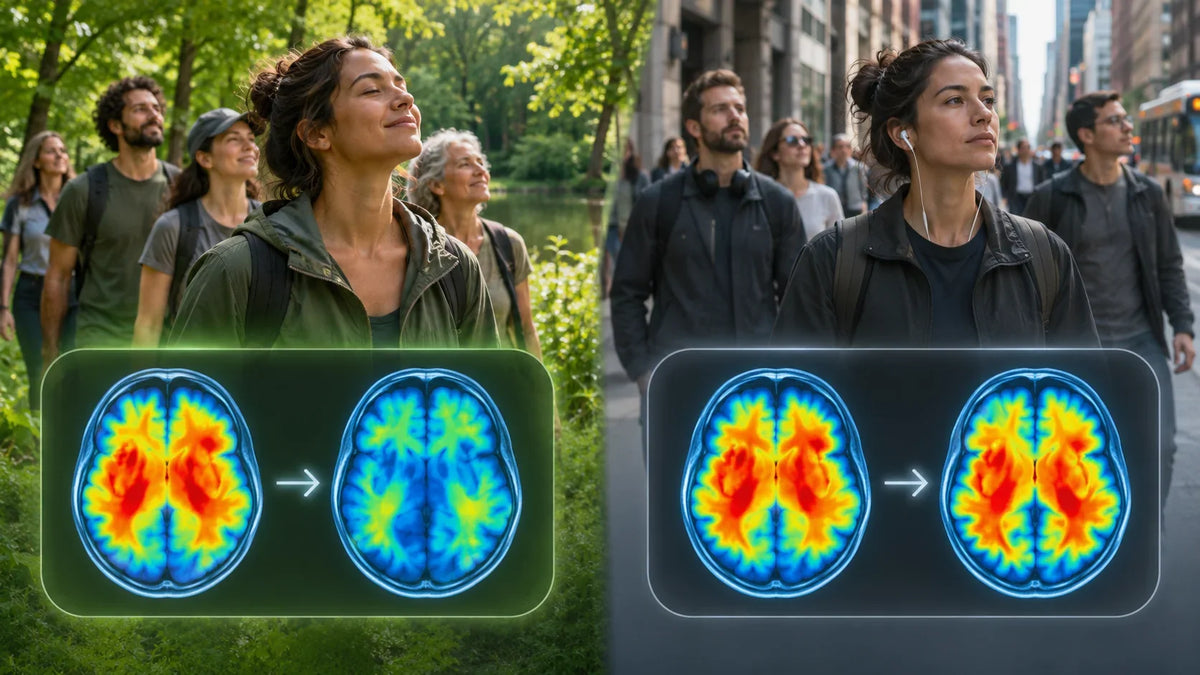
In 2015, researchers at Stanford University published a study in the Proceedings of the National Academy of Sciences that asked a simple question: does where you walk change what happens in your head?
They recruited 38 healthy adults with no history of mental illness and split them into two groups of 19. Both groups walked for 90 minutes. One group walked a loop through green space near the Stanford campus, with open grassland and scattered oak trees. The other walked the same distance along a busy, multi-lane road in Palo Alto.
Before and after the walk, every participant filled out a standard questionnaire measuring rumination and had a brain scan that measured blood flow to specific regions.
The urban group did not change. Their rumination scores were essentially identical before and after, and so was their brain activity.
The nature group did.
What went quiet
After the nature walk, two things dropped.
The first was self-reported rumination. Participants who walked through green space reported significantly less repetitive, negative self-focused thinking afterward.
The second was activity in the subgenual prefrontal cortex, a small region at the front of the brain that has been linked to rumination and to the sad, self-focused thought patterns associated with depression. After 90 minutes in nature, blood flow to that region decreased. After 90 minutes beside traffic, it did not.
In other words, the loop got quieter, and the researchers could see it on a scan.
It is worth being clear about the limits. This was one study, with 38 people, all of them healthy adults, measured right before and right after a single walk. It does not show how long the effect lasts or whether it would be the same for someone living with depression. But it is a striking finding: the same amount of walking, in two different settings, produced two different results.
The sitting link
If movement can quiet an overthinking brain, the opposite question is worth asking too. What does a lot of sitting do?
A systematic review in BMC Public Health, led by researchers at Deakin University in Australia, pulled together nine studies on sedentary behaviour and anxiety. Five of the nine found that more sedentary time was linked to a higher risk of anxiety. Four of them found that total sitting time specifically was associated with higher risk.
The researchers were careful about what this can and cannot show. These were observational studies, so they cannot prove that sitting causes anxiety. People who are already anxious might sit more, for example. The evidence base was also small, and the link with screen time in particular rested on very little data.
But the pattern kept showing up. And for anyone who spends most of the day at a desk, it is a reasonable nudge to stand up more often.
The bigger picture
The walk study and the sitting review are small pieces. The largest piece is very large.
In 2023, researchers at the University of South Australia published an umbrella review in the British Journal of Sports Medicine that pulled together 97 systematic reviews covering 1,039 trials and 128,119 participants. It is one of the most comprehensive reviews of exercise and mental health to date.
The finding was consistent: physical activity significantly reduced symptoms of depression, anxiety, and psychological distress compared with usual care. The benefits showed up across a wide range of people, from healthy adults to people living with depression or chronic illness, and among pregnant and postpartum women.
Just as important, the type of activity mattered less than doing it. Walking, yoga, and strength training all counted. Higher-intensity activity was associated with larger improvements, but you did not need to be an athlete to benefit.
You do not need a marathon. You need to move.
Where cold and heat fit
Cold plunges and saunas do not replace movement. If you only have time for one thing today, the research says go for a walk.
But both have their own measured effects on the brain and mood, and they fit naturally after you move.
Cold. A study in the European Journal of Applied Physiology found that immersion in 14°C water raised plasma noradrenaline by 530% and dopamine by 250%. Noradrenaline is one of the body's main alertness signals, and that sharp rise is a large part of why people describe the post-plunge feeling as clear, focused, and switched on.
Heat. In a 2026 UK study of 1,907 sauna-goers, more than half of the people surveyed said sauna had improved their mental health. The researchers found that much of that benefit was linked to regular use and to a sense of belonging, which is a reminder that the ritual matters as much as the heat.
The sequence that makes sense: move first, then reset.
Building it into your day
Walk, ideally somewhere green. In the Stanford study, a 90-minute walk in nature quieted rumination while a 90-minute walk beside traffic did not. A park, a trail, or a tree-lined street is a better choice than a busy road when you have the option.
Break up long stretches of sitting. Stand up, walk to get water, take calls on your feet. The sitting research is not proof, but the habit costs nothing.
Pick movement you will keep doing. Walking, yoga, and strength training all showed benefits. The best one is the one you will repeat.
Then cold or heat. A cold plunge after a walk or workout adds the noradrenaline lift. A sauna session adds heat and, if you share it, connection. For a full guide to combining them, see the recovery routine.
Know when to get help. If overthinking, anxiety, or low mood is affecting your daily life, talk to a healthcare professional. Movement, cold, and heat can sit alongside professional care, not replace it.
Your reset, at home
The easier the reset is to reach, the more often it happens.
For cold, the Pro Plunge and Pro Plunge Lite hold water anywhere from 3 to 40°C with a built-in chiller, so 14°C, the temperature used in the noradrenaline study, is a setting rather than a bag of ice. Browse the full cold plunge collection for portable and outdoor options.
For heat, the Pod Sauna brings infrared heat indoors and plugs into a 120V / 20A outlet with no permanent install. The Hybrid Sauna runs traditional and infrared heat in one cabin, and the Outdoor Sauna Pro and Outdoor Sauna XTREME bring traditional Finnish heat to the backyard. Browse the full sauna collection.
Move the body. Quiet the mind.
This content is educational information, not medical advice. If you are experiencing anxiety, depression, or other mental health concerns, please speak with a healthcare professional. Consult your physician before starting cold or heat exposure, especially if you have a cardiovascular condition, low blood pressure, or are pregnant. Cold plunges and saunas are complementary wellness practices, not treatments for any mental health condition.
Study citations
- Bratman GN, Hamilton JP, Hahn KS, Daily GC, Gross JJ. (2015). "Nature experience reduces rumination and subgenual prefrontal cortex activation." Proceedings of the National Academy of Sciences, 112(28):8567-8572. https://doi.org/10.1073/pnas.1510459112
- Teychenne M, Costigan SA, Parker K. (2015). "The association between sedentary behaviour and risk of anxiety: a systematic review." BMC Public Health, 15:513. https://doi.org/10.1186/s12889-015-1843-x
- Singh B, Olds T, Curtis R, et al. (2023). "Effectiveness of physical activity interventions for improving depression, anxiety and distress: an overview of systematic reviews." British Journal of Sports Medicine, 57(18):1203-1209. https://doi.org/10.1136/bjsports-2022-106195
- Šrámek P, Šimečková M, Janský L, Šavlíková J, Vybíral S. (2000). "Human physiological responses to immersion into water of different temperatures." European Journal of Applied Physiology, 81:436-442. https://link.springer.com/article/10.1007/s004210050065
- Newson M, McGrath R, Mosina I, Reason G, Peitz L. (2026). "Sauna culture improves physical and mental wellbeing in the UK through social connection and ritual." Social Science & Medicine, 394:119061. https://doi.org/10.1016/j.socscimed.2026.119061
Share:
Most Sauna Studies Only Tracked Men. Here Is What Research on Women Shows.