

Infrared light and an infrared sauna both use the same part of the spectrum. What they do to your body is not even close to the same thing. One works like a scalpel. The other works like a furnace. Both are useful, and confusing them leads people to expect outcomes from one that only the other can deliver.
What They Share
Both infrared light therapy and infrared saunas emit wavelengths in the infrared portion of the electromagnetic spectrum. That is where the similarity ends.
The delivery method, the depth of penetration, the biological response, and the outcomes they produce are fundamentally different. One is a targeted cellular intervention that does not meaningfully raise body temperature. The other is a systemic heat stress applied to the entire body. The shared word "infrared" obscures how little they actually have in common in practice. [1]
What Infrared Light Therapy Does
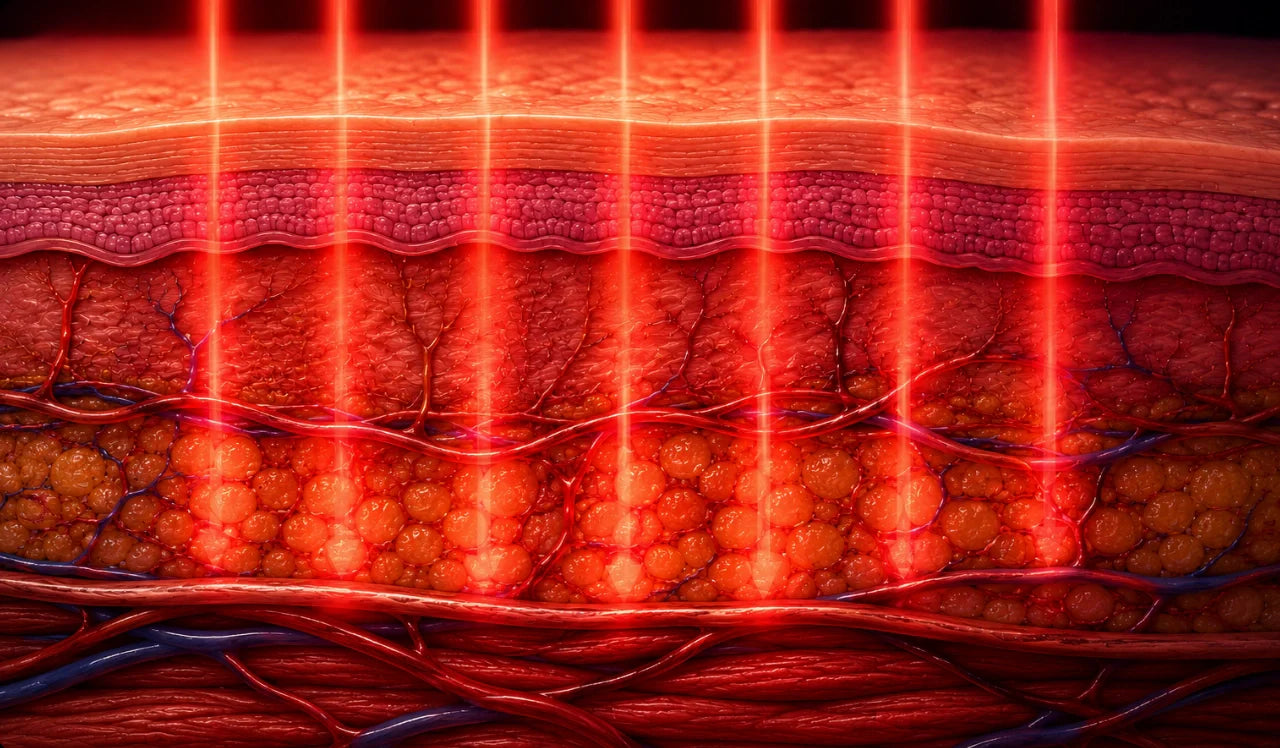
Red and near infrared light panels deliver specific, narrow wavelengths, typically in the 630 to 850 nm range, directly to targeted tissue. These wavelengths penetrate roughly 3 to 5 centimetres beneath the skin surface and are absorbed by cytochrome c oxidase, a key enzyme in the mitochondrial electron transport chain. [2]
When cytochrome c oxidase absorbs these wavelengths, a cascade follows: ATP production increases, giving cells more available energy for repair and function. Cellular repair processes accelerate. Collagen synthesis is upregulated, which is the basis for the skin and wound-healing applications. And localised inflammation is reduced. [3]
This mechanism is called photobiomodulation, and the critical point is that it is driven by light, not heat. The panel does not need to warm your body to work. It delivers a precise wavelength to a specific area and triggers a cellular response in that tissue directly. This is a targeted, cellular-level intervention.
The Coldture Pro Red Light Panel delivers this at full-body scale: 720 dual-chip LEDs across eight wavelengths, with measured irradiance of at least 1,400 W/m² at 6 inches and independent control of each wavelength channel. For targeted work, the Focus Red Light Panel concentrates output with a 30-degree beam angle for higher irradiance on a specific area, and the Red Light Face Mask brings four wavelengths, including 1064 nm, to the face in a flexible, cordless format built for daily consistency.
What an Infrared Sauna Does
An infrared sauna operates on a different principle entirely. It heats the air and your body to between 45 and 65°C. Your whole body absorbs that heat, core temperature rises, heart rate climbs, blood vessels dilate, and you sweat. [4]
There is an important technical distinction in the wavelengths involved. Infrared saunas rely primarily on far infrared, which is longer in wavelength and less penetrating than the near infrared used in light therapy panels. Far infrared is absorbed more at the surface and converted to heat, which is exactly what makes it effective for raising body temperature. [5]
The primary driver of benefit in an infrared sauna is the heat stress response, not cellular photostimulation. The body responds to the systemic thermal load with cardiovascular engagement similar to moderate exercise, metabolic activation, and heat shock protein upregulation, the same HSP70 response tied to the longevity outcomes in the Finnish research. [6] The benefit comes from the body's response to being heated, not from a specific wavelength activating a specific enzyme.
That said, saunas like the Coldture Pod Sauna and Corner Pod Sauna bridge both worlds: they combine far and near infrared heat with dedicated red light panels at 660 nm and 850 nm built into the cabin, so a single session delivers both the systemic heat response and a degree of the targeted photobiomodulation response in one sitting.
The Key Difference
The cleanest way to understand the distinction is by what each one targets and how.
Infrared light therapy is precise. It targets specific tissue, joints, skin, or wounds at a cellular level without raising your core body temperature. You can use it on a knee, a shoulder, or your face without breaking a sweat. It works like a scalpel: localised, specific, controlled.
An infrared sauna is systemic. It raises your core temperature and triggers cardiovascular, metabolic, and heat shock protein responses across your entire body at once. You cannot target it to one joint. It works like a furnace: whole-body, intense, sustained.
Both are useful. Neither replaces the other. A red light panel will not give you the cardiovascular conditioning of a sauna session, and a sauna will not deliver the targeted collagen synthesis or wound-healing precision of a light therapy panel applied directly to an area.
When to Use Each One
Knowing which one you need changes how you use them.
Infrared light therapy is best for targeted recovery on a specific muscle or joint, skin repair and collagen support, localised inflammation, wound healing, and restoring cellular energy in a defined area. It is the right tool when the goal is specific and the area is known.
An infrared sauna is best for full-body heat adaptation, cardiovascular conditioning, the cortisol and stress-response benefits of regular heat exposure, and the systemic longevity outcomes documented across decades of research. It is the right tool when the goal is whole-body and the mechanism is heat stress over time.
The most complete recovery setups use both, because they address different problems. Targeted cellular repair from the panel; systemic heat adaptation from the sauna. For those building a full recovery room, pairing a sauna with a dedicated red light panel covers both ends of the infrared spectrum, the precise and the systemic. Browse the full Coldture lineup.
References
[1] Hamblin MR. "Mechanisms and mitochondrial redox signaling in photobiomodulation." Photochemistry and Photobiology. 2018;94(2):199-212. doi.org/10.1111/php.12864
[2] Karu T. "Primary and secondary mechanisms of action of visible to near-IR radiation on cells." Journal of Photochemistry and Photobiology B: Biology. 1999;49(1):1-17. doi.org/10.1016/S1011-1344(98)00219-X
[3] Avci P, et al. "Low-level laser (light) therapy (LLLT) in skin: stimulating, healing, restoring." Seminars in Cutaneous Medicine and Surgery. 2013;32(1):41-52. PMID: 24049929.
[4] Beever R. "Far-infrared saunas for treatment of cardiovascular risk factors." Canadian Family Physician. 2009;55(7):691-696. PMID: 19602651.
[5] Vatansever F, Hamblin MR. "Far infrared radiation (FIR): its biological effects and medical applications." Photonics and Lasers in Medicine. 2012;4:255-266. doi.org/10.1515/plm-2012-0034
[6] Iguchi M, et al. "Heat stress and cardiovascular, hormonal, and heat shock proteins in humans." Journal of Athletic Training. 2012;47(2):184-190. doi.org/10.4085/1062-6050-47.2.184
Share:
Hot Tub vs. Sauna: What Researchers Found When They Compared Them Head to Head
What Cold Water Actually Does to Your Heart Rate in the First 10 Seconds