

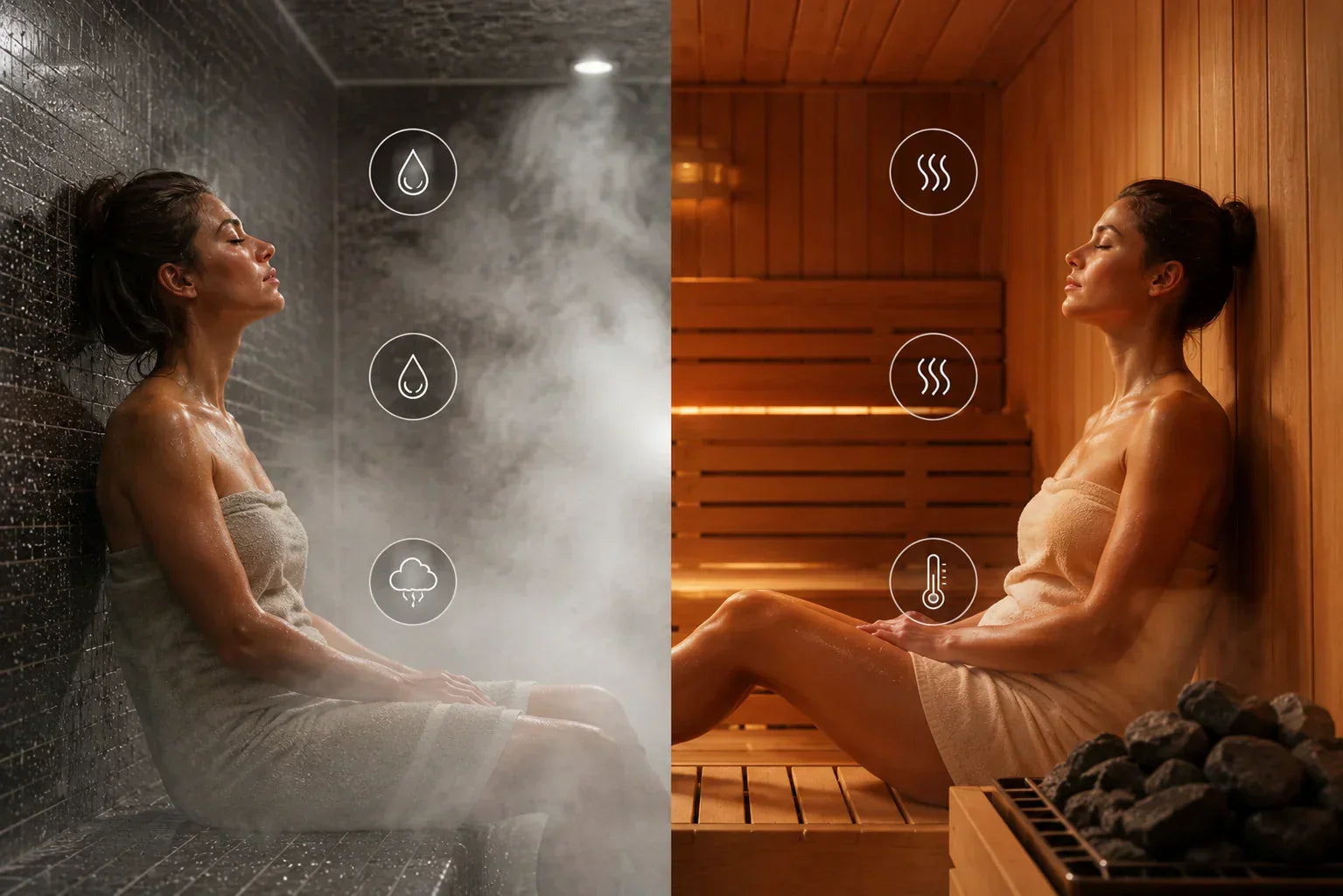
Steam Room vs Sauna: Which Is Better for You
They look like the same idea: a hot room you sit in to sweat and unwind. But a steam room and a sauna create that heat in opposite ways, and that one difference changes how they feel, how you maintain them, and which one actually makes sense to own. Here is the honest comparison.

The core difference: wet heat vs dry heat
A steam room uses a generator to fill the space with water vapor, pushing humidity close to 100 percent at a relatively low air temperature, usually around 40 to 50°C. Because the air is already saturated, your sweat cannot evaporate, so the heat feels heavy and wet and clings to your skin.
A traditional sauna does the opposite. A heater warms dry air to a high temperature, commonly 80 to 110°C, with humidity kept low. Your sweat evaporates freely, which is part of why the heat feels clean and intense rather than thick. An infrared sauna like the Pod is drier still, heating your body directly with light at an even lower air temperature.
So the simplest way to hold it in your head: steam room is low-temperature wet heat, sauna is high-temperature dry heat.
How each one feels
A steam room is enveloping and humid. Many people like that the moist air feels easy on the airways, though others find it stuffy or hard to breathe over a long sit. A sauna is dry and more intense, with that classic radiant heat, and in a traditional sauna you can pour a little water on the stones for a short burst of steam when you want it. It comes down to whether you prefer heat that feels heavy and wet or hot and dry.
What the research says
Most of the long-term research associating heat bathing with cardiovascular markers and recovery was carried out on traditional saunas, so that evidence base is the larger and better-established one. Steam rooms are less studied. Both expose you to heat, but if research depth matters to you, the sauna has more behind it. As always, this is general wellness and recovery, not a treatment for any medical condition.
The practical side, especially for a home setup
This is where the two really diverge, and it usually decides things for anyone choosing what to install at home.
- Maintenance. A steam room's constant moisture means surfaces have to be fully sealed and cleaned diligently, because the warm, wet environment is exactly where mold and mildew want to grow. A sauna's dry environment is far more forgiving and lower-maintenance.
- Installation. Steam rooms need waterproofing, a steam generator, and proper drainage. Saunas are simpler to install, and a traditional one can sit outdoors, which a steam room cannot easily do.
- Durability. Dry heat is gentler on materials over time than constant saturation.
For a gym or spa you visit, a steam room is a nice option to have on hand. For something you own and use several times a week at home, a sauna is usually the more durable, lower-hassle choice.
Which should you choose
If you mainly want easy, airway-opening wet heat and you will use it at a gym or spa, a steam room does that well.
If you are building something into your own home that is durable, lower-maintenance, better studied, and easy to pair with cold, a sauna is the stronger pick. Go traditional with the Pro Outdoor Sauna for the authentic high-heat experience, infrared with the Pod for gentler, longer sessions, or the Hybrid if you want both. You can see the full lineup across Coldture's sauna range.
And whichever you choose, the natural next step is contrast: following a sauna with a cold plunge gives you both ends of the temperature range in one sitting.
The bottom line
A steam room is low-temperature wet heat that feels heavy and opens the airways, but it demands more upkeep and is harder to install at home. A sauna is high-temperature dry heat that feels clean and intense, has the larger research base, lasts better, and is simpler to own. For a home recovery setup you will actually keep using, the sauna is usually the smarter long-term choice.
Share:
Sauna Use and Dementia Risk: What a 20-Year Study of 2,315 Men Actually Found
Infrared vs Traditional Sauna: Which Is Right for You