

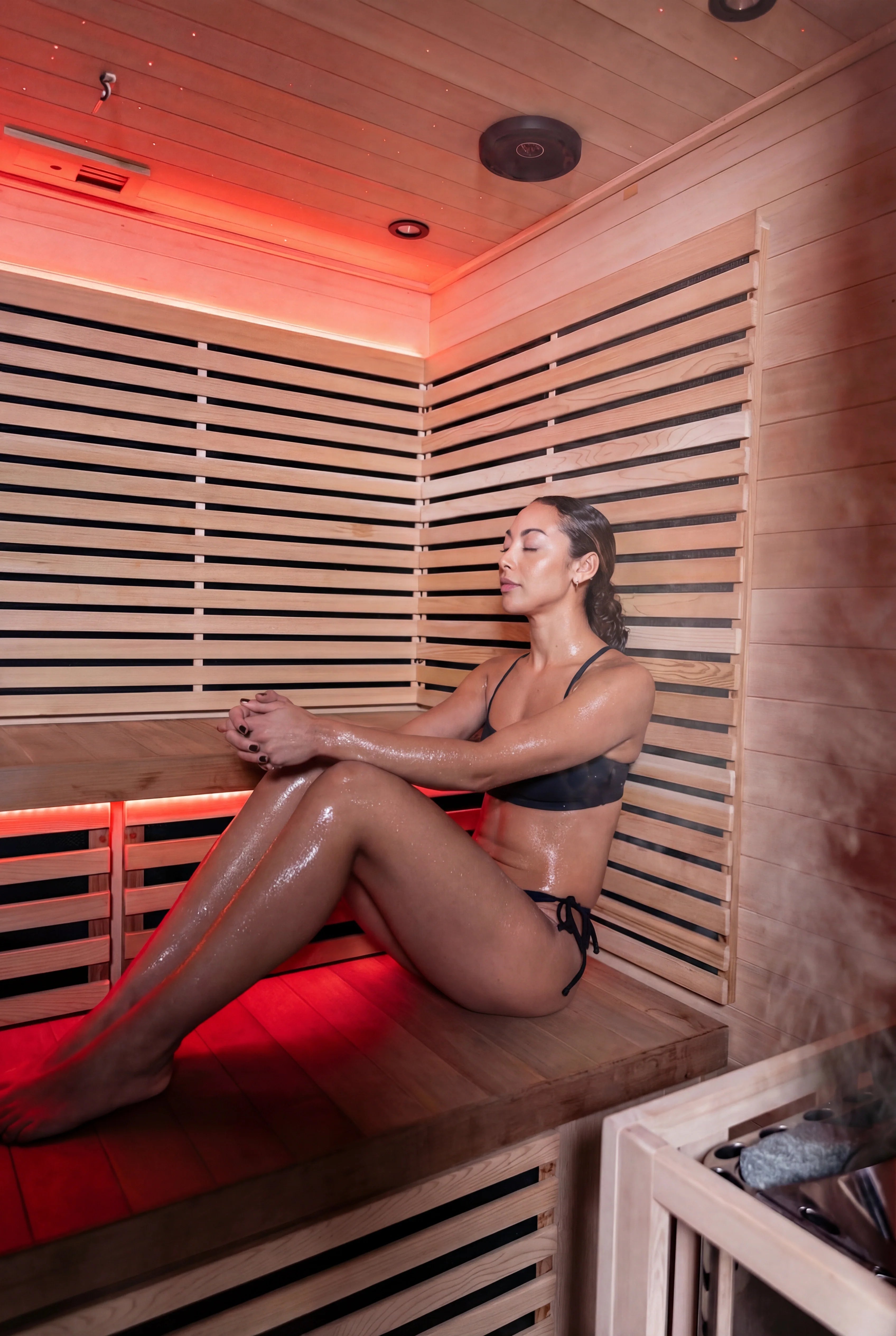
most people walk into a sauna to relax. they walk out feeling like a different person. lighter. calmer. looser in ways that last the rest of the evening.
that shift isn't subjective. within 20 minutes of heat exposure, your body initiates a cascade of measurable physiological changes, from hormonal shifts and protein activation to vascular responses that set up your nervous system for deep recovery.
here's what's actually happening, and why the sauna isn't just relaxation. it's recovery.
stress hormones drop
the feeling of weight lifting off your shoulders in a sauna has a chemical basis. heat exposure triggers a shift in your autonomic nervous system, moving from the sympathetic state (fight or flight) toward the parasympathetic state (rest and recovery). one of the most measurable outcomes of that shift is a reduction in cortisol, your body's primary stress hormone.
a study from the University of Warmia and Mazury measured cortisol levels in 30 young men across multiple sauna sessions at 90-91°C. serum cortisol decreased significantly, dropping from 13.61 to 9.67 µg/ml over the course of the sessions. that's roughly a 29% reduction, achieved through nothing more than sitting in heat.
the cortisol picture is nuanced, though. during a single session, especially for people unaccustomed to sauna, cortisol can briefly spike as the body registers the heat as a stressor. but with regular use, the body adapts. the acute spike diminishes, and overall baseline cortisol trends downward. a PubMed-indexed review on sauna endocrinology noted that in experienced Finnish sauna users, cortisol levels are typically not elevated during sessions, suggesting the body learns to process the heat as a recovery stimulus rather than a threat.
this matters because chronically elevated cortisol is linked to poor sleep, muscle breakdown, impaired immune function, and persistent anxiety. anything that reliably lowers baseline cortisol without medication has real long-term value. and the sauna does it in 15-20 minutes.
endorphins release
the warm, slightly euphoric feeling during and after a sauna session isn't just the absence of stress. it's the presence of something new.
heat exposure triggers the release of beta-endorphins, the same class of neurochemicals your body produces during intense exercise. endorphins bind to opioid receptors in the brain, producing natural pain relief and a sense of well-being that can last for hours after you leave the heat.
a review published in ScienceDirect on the endocrine effects of sauna bathing confirmed that beta-endorphin levels frequently increase during sauna use, and noted that this response likely contributes to the characteristic feeling of well-being people report afterward. the heat essentially mimics the reward chemistry of a hard workout, except you're sitting still.
this is one of the reasons people describe the sauna as "addictive" in the best sense. it's not a vague sense of relaxation. it's a specific neurochemical state that your body starts to crave because it's genuinely restorative.
muscles repair at the cellular level
this is the one most people don't know about, and it's arguably the most significant.
when your core body temperature rises above approximately 38-39°C (which happens within 15-20 minutes of sauna use at standard temperatures), your body activates a family of proteins called heat shock proteins (HSPs). the most studied of these, HSP70, acts as a molecular chaperone: it identifies damaged or misfolded proteins in your cells and either repairs them or marks them for removal.
in muscle tissue, this is especially impactful. HSP70 guides the folding of functional skeletal muscle proteins, directs amino acids and glucose toward areas of muscle damage, and reduces the inflammatory response that causes delayed-onset muscle soreness (DOMS). a study published in the Journal of Applied Physiology found that repeated heat exposure increased HSP70 levels in the body, and this increase was associated with improved muscle recovery and reduced inflammation.
a Finnish study examining 55 healthy individuals found that human growth hormone (hGH) levels were approximately 140% higher immediately following a sauna session. hGH is critical for cell regeneration, tissue repair, and muscle recovery. your body is literally accelerating its repair processes while you sit there.
this is why the phrase "your body thinks it's working" is more than a metaphor. at the cellular level, the heat stress response shares significant overlap with the exercise recovery response. the sauna doesn't replace training, but it amplifies recovery from it. and for anyone dealing with chronic muscle tension, soreness, or slow recovery between sessions, that amplification is meaningful.
for saunas that combine infrared heat with traditional dry heat, the recovery window expands even further. infrared wavelengths penetrate deeper into tissue at lower air temperatures, which means you can access these cellular benefits without the cardiovascular strain of extreme heat. Coldture's hybrid sauna runs both a dedicated 6 kW heater (up to 90°C traditional heat) and 2,920W of independent ultra-low EMF infrared panels, so you can choose your modality based on how your body feels that day. infrared for gentle, deep-tissue recovery. traditional for the full high-heat experience. or both.
deep sleep follows
this is the benefit people notice first, even before they understand why.
during a sauna session, your core body temperature rises by 1-2°C. when you exit, your body begins actively cooling itself, and that drop in core temperature triggers a well-documented physiological response: the initiation of sleep onset.
your brain uses the decline in core body temperature as one of its primary signals to begin producing melatonin and transitioning into deep (slow-wave) sleep. this is the same mechanism behind the common advice to keep your bedroom cool at night, and it's why a hot bath before bed can improve sleep quality. the sauna takes this effect and amplifies it.
the timing matters. the thermoregulatory cooling process after a sauna session accelerates the onset of deep sleep when used in the evening, typically 1-2 hours before bed. the drop in core temperature signals the hypothalamus that it's time to shift into recovery mode. cortisol is already lower from the session. endorphins have promoted a state of calm. and the body's repair systems (fueled by heat shock proteins and growth hormone) are primed to do their work during the deepest phases of sleep.
this is why people don't just "feel relaxed" after a sauna. they sleep differently. deeper. longer in the restorative phases. and they wake up feeling measurably more recovered.
the compound effect
each of these responses, cortisol reduction, endorphin release, heat shock protein activation, and sleep improvement, is significant on its own. but the real value is in how they compound over time with consistent use.
regular sauna users don't just feel better on the nights they use it. their baseline cortisol trends lower. their nervous system becomes more efficient at shifting between activation and recovery. their muscles recover faster between training sessions. and their sleep architecture improves in ways that support everything from cognitive function to immune health.
a comprehensive review published in Experimental Gerontology positioned sauna use as a lifestyle practice for extending healthspan, noting that repeated use optimizes stress responses via hormesis and heat shock proteins, and that frequent sauna bathing appears to reduce morbidity and mortality in a dose-dependent manner. the more consistently you use it, the stronger the effect.
this is what separates a sauna from a "nice thing to have." it's not an indulgence. it's a tool. and like any good tool, it works best when you use it regularly.
making it part of your routine
the research consistently points to 3-5 sessions per week at 15-20 minutes per session as the sweet spot for most of these benefits. the temperature range depends on the type of sauna: 80-100°C for traditional finnish dry heat, 45-65°C for infrared.
the key to consistency is reducing friction. if your sauna takes 45 minutes to preheat, you'll skip it. if the controls are clunky, you'll skip it. if it's seasonal or requires complex setup, you'll skip it.
Coldture saunas are designed around daily use. the pod infrared sauna fits a 1,100 mm x 1,020 mm footprint, runs on a standard 110V outlet, and includes wireless control so you can start it from your phone. the corner pod expands to 2-3 person capacity with 6 dedicated red light therapy panels and a rotatable therapy lamp for targeted recovery. both use canadian hemlock and red cedar interiors with non-toxic adhesives, because what you breathe at these temperatures matters.
for outdoor setups, the outdoor sauna pro delivers authentic finnish dry heat up to 110°C via a 6.0 kW HUUM heater with wi-fi control for remote start and scheduling. canadian-built with hurricane-rated construction for permanent year-round installation.
that's not relaxation. that's recovery.
the sauna feels like relaxation because everything in your body is moving in the right direction at once. cortisol is falling. endorphins are rising. damaged proteins are being repaired. and your nervous system is resetting for the deepest sleep of your week.
it's not a luxury. it's one of the most efficient recovery tools available. and 20 minutes is all it takes.
explore Coldture's full sauna lineup: indoor infrared, hybrid, and outdoor traditional models. all built with natural wood interiors, non-toxic materials, and engineering designed for daily use. shop saunas.
Share:
the post-plunge feeling, explained: what's actually happening in your body
cold plunging doesn't wreck your hormones. bad protocols do.