

TL;DR:
- Rest and recovery are essential for muscle repair, adaptation, and performance enhancement.
- Sleep, nutrition, and strategic rest are proven methods that outperform many popular recovery tools.
- Prioritizing recovery prevents injuries, supports mental health, and extends athletic longevity.
You can train perfectly, eat well, and still plateau or break down if you skip recovery. Most athletes focus obsessively on the work they put in but treat rest as optional. That mindset costs performance, and sometimes it costs a season. Muscle recovery is not passive downtime. It is the phase where your body actually builds the fitness you worked for, repairs the damage training creates, and prepares you for the next session. This guide breaks down the science, the strategies that actually work, and how to build a recovery plan that matches your ambitions.
Table of Contents
- The science behind muscle recovery
- How muscle recovery enhances performance and prevents injury
- Comparing muscle recovery strategies: What really works?
- Wellness, adaptation, and long-term benefits of muscle recovery
- Our perspective: Muscle recovery is the real difference-maker
- Enhance your recovery with proven tools
- Frequently asked questions
Key Takeaways
| Point | Details |
|---|---|
| Recovery fuels progress | Muscle recovery ensures your hard work in training delivers real performance gains. |
| Injury prevention | Strategic recovery reduces the risk of overuse injuries and chronic fatigue. |
| Multimodal works best | Combining sleep, nutrition, and selective therapies outperforms any single recovery method. |
| Personalization is key | The most effective recovery strategies depend on your sport, routine, and individual needs. |
The science behind muscle recovery
Every hard training session creates a controlled form of damage. Muscle fibers develop small tears, energy stores drop, and inflammation spikes. That is not a problem. That is the stimulus. The problem starts when you do not give your body the time and resources to respond to that stimulus properly.
During recovery, your body goes through a precise sequence: inflammation peaks and then resolves, satellite cells (muscle stem cells) activate and fuse to repair damaged fibers, glycogen stores refill from dietary carbohydrates, and protein synthesis builds new contractile tissue. Muscle recovery restores physiological homeostasis, replenishes glycogen, repairs muscle, and enhances performance. Skip or rush this process and you show up to your next session with muscles that are still compromised.
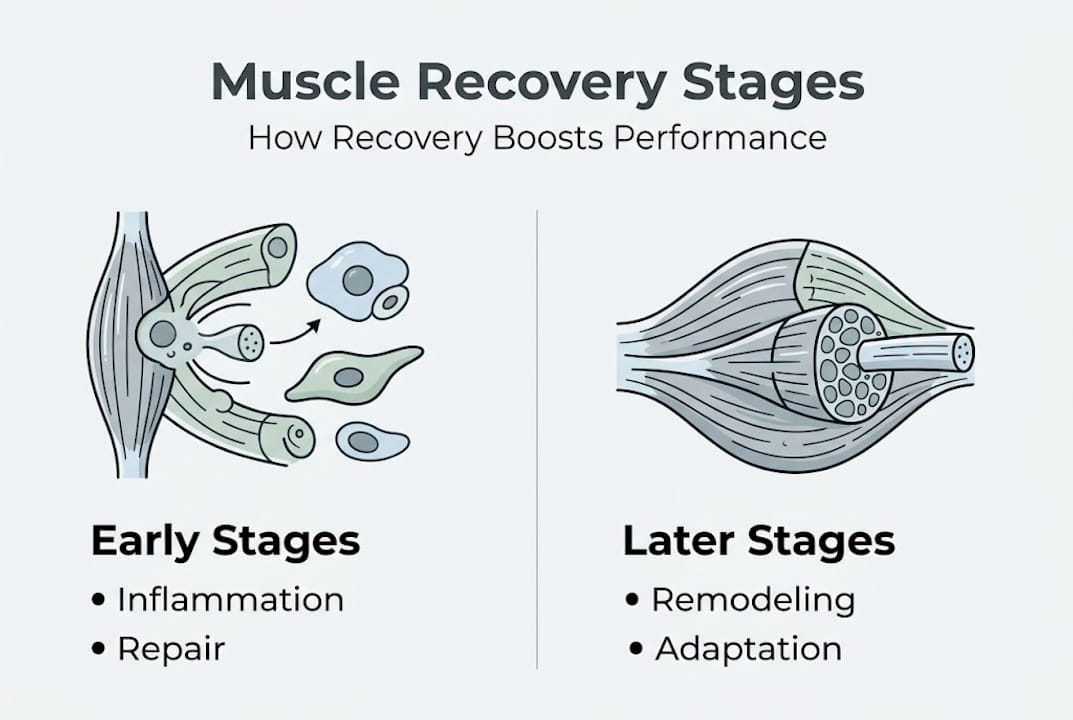
Here is what that looks like across the recovery timeline:
| Stage | Timeframe | What happens | What impairs it |
|---|---|---|---|
| Acute inflammation | 0 to 6 hours | Blood flow increases, immune cells flood the tissue | Alcohol, NSAIDs overuse |
| Repair phase | 6 to 48 hours | Satellite cells activate, protein synthesis peaks | Poor sleep, low protein intake |
| Remodeling phase | 48 to 96 hours | Muscle fibers strengthen and adapt | Consecutive hard sessions |
| Full restoration | 96 to 168 hours | Glycogen fully replenished, neuromuscular function restored | Chronic stress, poor nutrition |
The remodeling phase is where adaptation actually happens. This is when muscles come back stronger, more efficient, and more resilient than before. Cutting this phase short by training again too soon does not build fitness faster. It stacks damage on top of damage.
Building effective recovery routines around these stages helps you time your training loads intelligently and avoid the compounding fatigue that derails progress. Athletes who understand this timeline train smarter, not just harder, and they stay healthy long enough to see real results.
How muscle recovery enhances performance and prevents injury
Once you understand the biology, the performance argument for recovery becomes impossible to ignore. Better recovery directly translates to more power output, higher endurance capacity, faster reaction times, and reduced perception of effort during training. You feel better, move better, and push harder when your muscles are actually ready.
The injury prevention side is equally compelling. Muscles that have not fully recovered are mechanically weaker, less coordinated, and more prone to failure under load. The connective tissue around joints, tendons, and ligaments also needs recovery time. Ignoring that reality leads to a predictable set of problems:
- Muscle strains and tears from training on fatigued, under-repaired tissue
- Stress fractures from repetitive loading without adequate bone remodeling time
- Tendinopathy from chronic overuse without recovery periods
- Joint inflammation from compounding mechanical stress
- Neuromuscular fatigue that degrades movement patterns and coordination
These are not freak accidents. They are the natural consequence of a training load that consistently outpaces recovery capacity.
Overtraining syndrome affects 30 to 60% of athletes who do not prioritize adequate recovery, and it does not just mean feeling tired. It means performance declines, mood drops, immunity weakens, and the body stops responding to training stimulus at all. It can take weeks or months to reverse.
The top recovery methods that consistently show results are not complicated. Sleep quality, protein and carbohydrate timing, and structured rest days form the foundation. Everything else builds on top of that base.

Pro Tip: No single recovery tool outperforms high-quality sleep combined with timed nutrition. If your sleep is inconsistent or your post-workout nutrition is poor, no amount of ice baths or massage will compensate. Fix the foundation first.
Comparing muscle recovery strategies: What really works?
Not all recovery methods are created equal, and some popular ones are far less effective than their reputation suggests. Here is how the major strategies compare across key recovery outcomes:
| Strategy | Soreness reduction | Strength recovery | Endurance recovery | Best use case |
|---|---|---|---|---|
| Sleep | High | High | High | Every session |
| Protein and carb nutrition | High | High | High | Every session |
| Massage | Moderate | Moderate | Moderate | High-volume blocks |
| Active recovery | Moderate | Low | Moderate | Day after hard sessions |
| Cold water immersion | Moderate | Low to negative | Moderate | Post-endurance only |
| Static stretching | Low | None | Low | Flexibility goals only |
| Strength training (light) | Moderate | Moderate | Moderate | Off-season or deload |
Sleep, protein-carbohydrate feeding, massage, and strength training yield quantifiable performance benefits, while other methods offer narrower or more conditional gains.
The cold immersion data is particularly nuanced. Stretching shows no impact on soreness or strength, and routine cold immersion after strength work may actually hinder hypertrophy gains by blunting the inflammatory signals your muscles need to grow. That does not mean cold water immersion is useless. It means using it strategically matters.
For endurance athletes or anyone managing high training volumes, ice baths for recovery can meaningfully reduce soreness and accelerate readiness between sessions. The ice bath recovery guide outlines exactly when and how to use cold immersion for maximum benefit without the tradeoffs.
Here is a practical summary of what to prioritize:
- Use every session: Sleep 7 to 9 hours, eat protein within 30 to 60 minutes post-workout
- Use selectively: Cold immersion after endurance or high-volume days, not after heavy strength sessions
- Use periodically: Massage during high-volume training blocks, active recovery on easy days
- Skip or minimize: Static stretching for recovery purposes, passive rest without nutrition support
Wellness, adaptation, and long-term benefits of muscle recovery
Here is what most training plans miss entirely. Muscle recovery is not just about physical readiness for the next session. It is a foundational pillar of mental health, immune function, and career longevity as an athlete.
“Pushing through” is sometimes necessary. But athletes who treat it as a permanent strategy do not become legends. They become cautionary tales.
Recovery is linked to improved mental health, immune function, and longer athletic careers, while overtraining consistently leads to illness, performance plateaus, and burnout. The body does not separate physical stress from psychological stress. Chronic training fatigue raises cortisol, disrupts sleep, suppresses immunity, and degrades mood. You start dreading sessions you used to love.
Here are the holistic benefits athletes gain from consistent, well-structured recovery:
- Reduced psychological stress as cortisol levels normalize and mood stabilizes between sessions
- Stronger immune response because the body is not perpetually in a state of repair
- Sharper focus and motivation as the nervous system gets adequate downtime
- Lower injury frequency across an entire season, not just individual sessions
- Sustained performance gains over months and years instead of short spikes followed by breakdown
- Extended athletic career because the body accumulates adaptation without accumulating damage
The wellness and recovery connection is real and measurable. Multimodal approaches combining nutrition, sleep, and technology yield the best results, and importantly, some inflammation is adaptive and should not always be suppressed. The goal is not to eliminate the stress response. It is to let it complete its job.
Pro Tip: Personalize your recovery to your actual training load. A 45-minute easy run needs far less recovery investment than a two-hour threshold session or a heavy squat day. Matching recovery intensity to training intensity is what separates smart athletes from burned-out ones.
Our perspective: Muscle recovery is the real difference-maker
We have seen a consistent pattern across the athletes who get the best long-term results. It is not always the ones who train the hardest. It is the ones who recover the best. They show up consistently, avoid the injury cycles that derail their peers, and keep accumulating adaptation month after month.
The “push through the pain” mentality is not toughness. It is a failure to understand how adaptation actually works. Your muscles do not get stronger during training. They get stronger during recovery. Training is just the signal. Recovery is where the response happens.
The athletes who figure this out early stop treating rest as a reward for hard work and start treating it as a non-negotiable part of the process. They build proven recovery routines around their sport, their body’s specific response patterns, and their training phase. That is not soft. That is strategic.
If you are serious about performance, recovery deserves the same planning, discipline, and investment as your training sessions.
Enhance your recovery with proven tools
Understanding the science is step one. Putting it into practice with the right tools is what separates athletes who plateau from those who keep progressing. Cold plunges and red light therapy are two of the most research-aligned tools you can add to a structured recovery plan, and they work best when used with intention, not habit.
At Coldture, we design cold plunge options built for athletes who take recovery seriously, from home setups to commercial-grade systems. Our red light therapy systems support cellular repair and inflammation management between sessions. If you are ready to build a recovery stack that matches your training ambitions, explore our full lineup and find what fits your goals.
Frequently asked questions
What happens to muscles if you skip recovery?
Skipping recovery leaves muscles in a damaged, glycogen-depleted state, which increases injury risks and makes overuse injuries far more likely over time.
How does sleep affect muscle recovery?
Sleep extension improves performance and accelerates muscle repair more reliably than any single recovery tool you can add to your routine.
Is cold water immersion good for muscle recovery after every workout?
Not after every session. Routine CWI post-strength may blunt hypertrophy gains, so cold immersion is best reserved for endurance or high-volume training days.
Can recovery strategies boost long-term athletic performance?
Absolutely. Multimodal recovery enhances longevity and mental well-being, giving athletes the consistency needed to build performance over a full career rather than just a single training cycle.
Share:
Ice bath workflow for gyms: A practical guide for peak recovery
How cold therapy impacts longevity: evidence and insights