

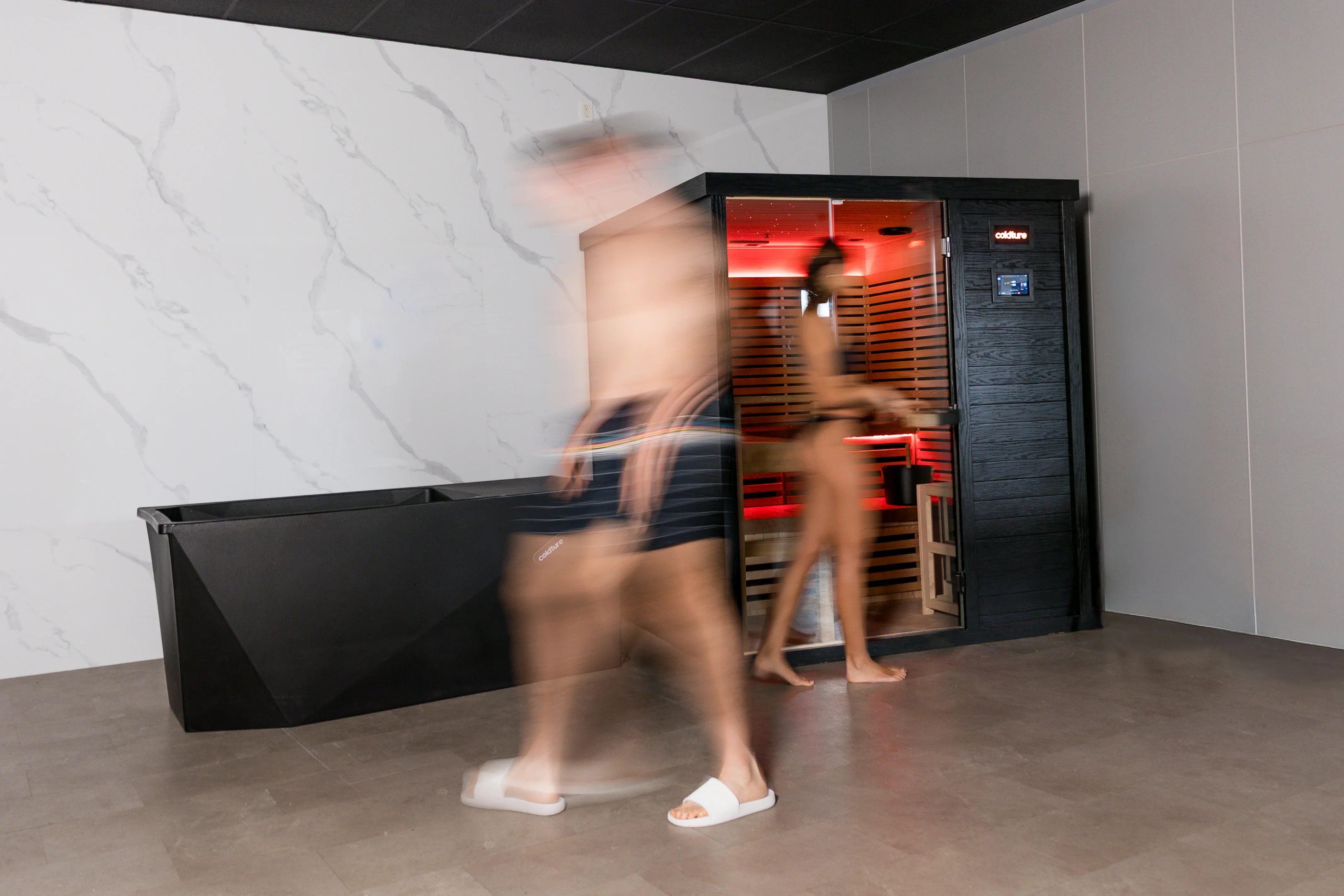
most recovery tools do one thing. contrast therapy does several, simultaneously, by exploiting the most basic response your body has to temperature change.
the principle is simple: heat opens your blood vessels. cold slams them shut. repeating the cycle creates a pumping action that moves blood, lymph, and metabolic waste through your body in a way that no single modality can match. it's the reason athletes have used hot-cold protocols for decades. and the research behind it has gotten more interesting.
here's what's actually happening when you go from sauna to cold water, and why the combination is greater than the sum of its parts.
blood vessels pump open and shut
when you sit in a sauna, your blood vessels dilate (vasodilation). blood flow increases to the skin and extremities as your body works to cool itself. circulation to muscles and tissues expands, delivering oxygen and nutrients while flushing metabolic byproducts.
when you step into cold water, the opposite happens instantly. blood vessels constrict (vasoconstriction). blood flow redirects away from the surface and toward vital organs. swelling compresses. inflammation reduces at the peripheral level.
this isn't subtle. a study measuring blood flow in the legs of athletes during contrast water therapy found that arterial blood flow increased by 200-300% above control levels during the warm phase, then dropped to 30-40% below control levels during the subsequent cold phase. repeating this cycle over 20 minutes created pronounced, rhythmic fluctuations in tissue perfusion.

a study using near-infrared spectroscopy (NIRS) to monitor intramuscular hemodynamics confirmed that contrast baths increased intramuscular oxygenated blood volume and tissue oxygen saturation compared to baseline. the hot phase drove oxygen and blood in. the cold phase pushed metabolic waste out. the net effect: tissue that's been flushed and resupplied.
a meta-analysis published in PLOS ONE pooling data from 13 studies found that contrast water therapy resulted in significantly greater improvements in muscle soreness at every follow-up time point (under 6 hours, 24, 48, 72, and 96 hours) compared to passive recovery. it also significantly reduced muscle strength loss at every follow-up interval. the vascular pumping mechanism is the leading proposed explanation.
this is the "flush" people describe after a contrast session. it's not a feeling. it's a measurable change in how blood moves through your tissue.
lymphatic drainage activates
your lymphatic system is your body's waste removal network. it transports cellular debris, inflammatory byproducts, and excess fluid away from tissues and toward lymph nodes where they're processed and eliminated. it's essential for immune function and recovery.
but unlike your circulatory system, the lymphatic system has no central pump. it relies on muscle contraction, breathing, and external pressure changes to move lymph through its vessels. when you're sedentary, recovering from training, or dealing with inflammation, lymphatic flow slows down. waste accumulates. swelling persists.
contrast therapy forces lymphatic movement through the same vasoconstriction-vasodilation cycle that drives blood flow. when blood vessels constrict and dilate rhythmically, the surrounding tissue pressure changes create a pumping effect on adjacent lymphatic vessels. the lymphatic system gets manually driven without you contracting a single muscle.

this is why contrast therapy is used in clinical rehabilitation for edema reduction, and why athletes report feeling "lighter" after contrast sessions. the stagnant fluid that contributes to puffiness, soreness, and that heavy, inflamed feeling gets mechanically flushed.
heart rate variability improves
heart rate variability (HRV) measures the variation in time between heartbeats. it's one of the most reliable biomarkers of autonomic nervous system function and recovery readiness. higher HRV indicates a nervous system that can shift efficiently between activation (sympathetic) and recovery (parasympathetic). lower HRV indicates a system that's stuck in stress mode.
contrast therapy trains this shift directly. when you enter hot, your sympathetic system activates moderately (heart rate rises, blood flow redirects). when you enter cold, the sympathetic response fires sharply (vasoconstriction, norepinephrine release, heightened alertness). when you exit cold and begin warming, your parasympathetic system takes over to restore baseline. each cycle is a complete round trip through activation and recovery.

over time, this training effect improves how quickly and efficiently your nervous system transitions between states. research on cold exposure and autonomic function has shown that regular practice improves vagal tone (the strength of parasympathetic signaling) and increases baseline HRV. sauna use independently has been shown to shift the autonomic balance toward parasympathetic dominance post-session. combining both modalities amplifies and accelerates the adaptation.
the practical result: you don't just recover better from workouts. you recover better from everything. stress at work, poor sleep nights, travel fatigue, emotional strain. a well-trained autonomic nervous system handles all of it with less residual impact.
stress tolerance builds
this is the long-game benefit, and it's the one that changes how you move through your day.
every contrast session is a voluntary exposure to controlled discomfort. heat pushes you to your thermoregulatory edge. cold pushes further. the transition between extremes demands that your body mobilize a stress response and then recover from it, repeatedly, in a compressed timeframe.
this is hormesis in its most concentrated form. your body treats the thermal stress as a challenge, adapts to it, and becomes more resilient as a result. the stress response still fires, but the recovery window shortens. after weeks of consistent practice, the things that used to rattle you, physically and psychologically, simply don't hit the same way.

research on cold exposure has shown that regular practice reduces cortisol reactivity to stressors and improves emotional regulation. sauna use independently has been linked to reduced anxiety and improved mood. the combination compounds both effects: you're training the stress response from both directions (heat and cold), building tolerance across a wider range of stimuli, and reinforcing the recovery pathway between them.
athletes describe this as "getting harder to break." the nervous system equivalent of building a thicker callus. you're not avoiding stress. you're training the system that processes it.
the protocol
contrast therapy is straightforward, but the details matter.
order: always start with heat, end with cold. heat primes the vasodilation response and warms the tissue. cold provides the constriction that drives the pumping effect and finishes the session in a recovery-promoting state.
timing: 15-20 minutes of heat, 2-5 minutes of cold. this ratio produces the strongest vascular response. shorter cold exposures (1-2 minutes) work well for beginners. extend to 3-5 minutes as tolerance builds.
cycles: 2-4 rounds for maximum effect. each transition amplifies the pumping action. more cycles generally produce stronger responses, but even a single round of heat-to-cold produces measurable benefits.
temperature: 80-100°C for traditional sauna, 45-65°C for infrared. 3-15°C for cold plunge. the greater the temperature differential, the stronger the vascular response. but start where you're comfortable and build.
frequency: 3-5 sessions per week. the autonomic training effect and HRV improvements are dose-dependent and compound with consistency.
the setup matters
the biggest barrier to consistent contrast therapy is logistics. if your sauna and cold plunge aren't in the same space, or if either one requires significant prep time, the friction will eventually win.
Coldture builds both sides of the contrast therapy equation, and they're designed to work together.
for heat: the hybrid sauna gives you both traditional high heat (6 kW heater, up to 90°C) and infrared (2,920W independent panels) in one system. the pod infrared sauna fits a compact footprint with 360° red light therapy coverage. the outdoor sauna pro delivers authentic finnish heat up to 110°C with wi-fi control for remote preheating.
for cold: the pro plunge holds exact temperature from 3°C to 40°C with wi-fi control and continuous filtration. the classic and barrel bundles pair a portable insulated tub with the water chiller pro for the same precision on a standard outlet. set your temperature, let the system hold it, and it's ready every time you step out of the heat.
for the full contrast setup: the xtreme dual contrast plunge runs independent hot and cold zones simultaneously, so both are always at temperature with zero wait time between transitions. instant contrast, no compromises.
that's not a spa routine. that's a vascular workout.
contrast therapy works because it exploits the most fundamental response your body has to its environment: adapt or fail. heat opens. cold closes. the cycle repeats. and every system that depends on circulation, lymphatic flow, nervous system flexibility, and stress resilience benefits from the repetition.
it's not complicated. it's not luxurious. it's a systematic, research-backed protocol that trains your body to recover faster, respond better, and handle more.
explore Coldture's full lineup for contrast therapy: saunas and cold plunges, all built with the precision and consistency that a daily contrast protocol demands. shop all.
Share:
sauna and sleep: what happens when you stop trying to relax and start engineering recovery
Why Invest in Recovery: Boost Health and Performance