

Most people assume cold plunges are about toughening up the body. Push through the discomfort, get out, feel accomplished. But the real transformation happens somewhere deeper. The psychological shift that occurs when you voluntarily enter cold water and choose to stay calm is arguably more powerful than any physiological adaptation. Research confirms that cold exposure drives neurochemical increases that reshape alertness, mood, and how you handle stress. This article breaks down exactly how cold exposure rewires your mental state, how to practice it strategically, and what the research actually supports versus where conventional wisdom gets it wrong.
Table of Contents
- The science: How cold exposure alters your brain and mood
- Mindset in the cold: Training resilience and mental flexibility
- Key protocols: How to practice cold exposure for mindset
- Risks, limits, and individual variability
- Our take: What most mindset guides miss about the cold
- Next steps: Explore cold plunges for your mindset journey
- Frequently asked questions
Key Takeaways
| Point | Details |
|---|---|
| Neurochemical boost | Cold exposure rapidly increases norepinephrine and dopamine, supporting alertness, focus, and resilience. |
| Mindset training | Facing controlled cold teaches your brain to regulate stress, making you more adaptable in daily life. |
| Protocol matters | Consistent, short bouts—about 11 minutes a week—provide maximum mental benefits with minimal risk. |
| Know your limits | Certain health risks and individual variability mean safety, moderation, and supervision are essential. |
| Intention is key | Pairing cold with self-reflection maximizes mindset gains beyond physical adaptation. |
The science: How cold exposure alters your brain and mood
The moment your body hits cold water, your brain does not simply register discomfort and wait for it to pass. It launches a cascade of neurochemical changes that directly affect how you think, feel, and respond to stress. Understanding this cascade is what separates people who experience brief physical novelty from those who achieve lasting mental change.
Cold exposure triggers norepinephrine release by 200 to 530%, dopamine by up to 250%, and epinephrine simultaneously, which together sharpen alertness, elevate mood, and build the neurochemical foundation for mental resilience. These are not small shifts. A 250% dopamine increase surpasses the effect of many stimulants, yet cold water produces it without dependence or crash.
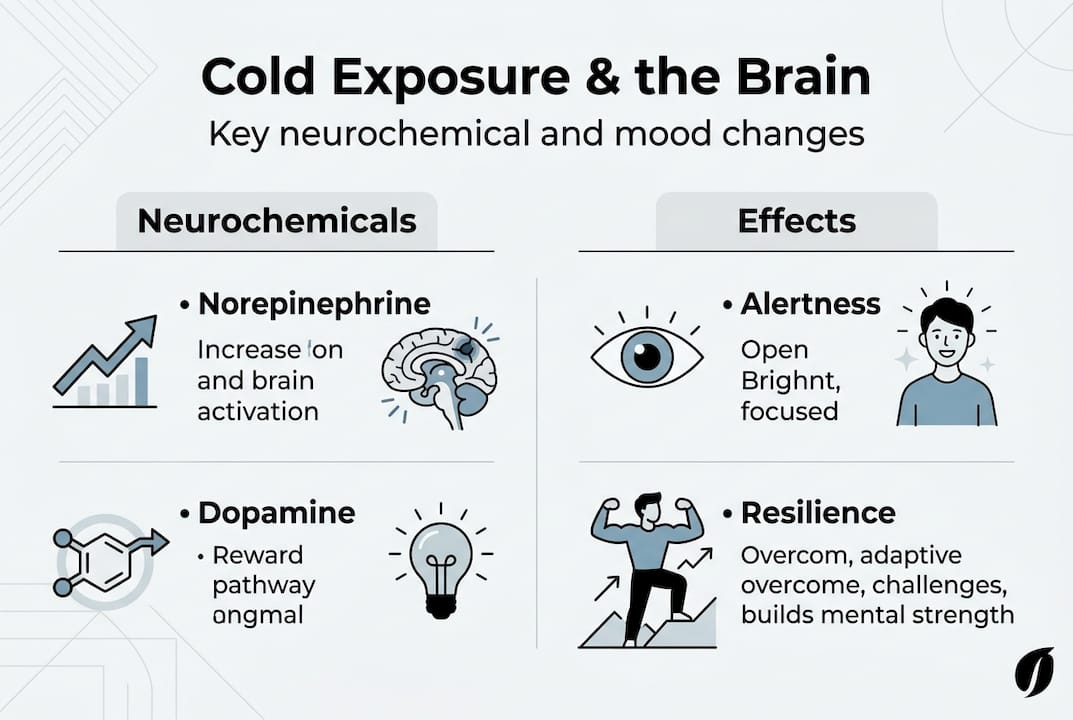
Beyond the immediate chemical surge, cold activates the vagus nerve and promotes synaptic plasticity in the prefrontal cortex, the part of your brain responsible for deliberate decision-making and emotional regulation. This matters because stress and anxiety often pull activity away from the prefrontal cortex and toward reactive brain regions. Cold exposure, practiced correctly, strengthens your capacity to stay in executive control.
Here is a quick snapshot of what shifts neurochemically during a typical cold plunge:
| Neurochemical | Change during cold exposure | Mental effect |
|---|---|---|
| Norepinephrine | 200 to 530% increase | Alertness, focus, energy |
| Dopamine | Up to 250% increase | Motivation, mood elevation |
| Epinephrine | Sharp acute rise | Stress activation, then recovery |
| Cortisol | Temporary spike, then drop | Stress regulation practice |
The sequence matters. You spike cortisol acutely, then your body learns to bring it down. Over repeated sessions, your nervous system becomes better calibrated for that pattern, making you faster at downregulating stress outside the cold too.
For those practicing deliberate cold exposure as a regular protocol, the neurochemical effects compound. Your baseline norepinephrine and dopamine levels can stabilize higher, which explains the sharper mental clarity many practitioners report even on non-plunge days.
“The psychological and physiological adaptations from cold exposure are not separated. The brain changes, and those changes alter daily stress response, attention, and mood regulation long after the session ends.”
Key mental effects supported by research:
- Improved sustained attention and focus
- Reduced perception of fatigue after stressful tasks
- Greater emotional stability under pressure
- Faster recovery from negative emotional states
Mindset in the cold: Training resilience and mental flexibility
Understanding the brain science sets the stage for the bigger impact. Let’s look at how braving the cold directly trains your mindset, not as a metaphor but as a measurable psychological process.
When you step into cold water, your instinct is to panic, pull back, and breathe fast. Every primitive survival signal fires at once. What you practice instead is the entire point. By consciously slowing your breath, anchoring your attention, and choosing to stay despite the discomfort, you are actively widening what psychologists call the stimulus-response gap. That is the space between an uncomfortable trigger and your reaction to it.
Building resilience through cold exposure means regularly practicing stress regulation under real physiological pressure, not simulated discomfort. The transfer effect is well documented: people who train regulation under acute cold stress report improved responses to challenging work situations, difficult conversations, and unexpected life stressors.

This is why ice baths and mental toughness are increasingly linked in performance psychology, not because cold makes you emotionally numb, but because it trains the exact neural circuits used for deliberate emotional control.
The mindset resilience benefits also compound with breathwork. Controlled nasal breathing during a plunge signals safety to your nervous system, activating the parasympathetic response while you are still in the acute stressor. That dual-signal training, stress plus calm, is uniquely powerful.
“Cold plunging combined with intentional attention and breathwork trains the prefrontal cortex to maintain executive function under pressure, a skill that directly transfers to high-performance contexts.”
Practical mindset shifts cold exposure trains:
- Moving from reactive to deliberate response
- Staying present under physical and emotional pressure
- Building tolerance for ambiguity and discomfort
- Accelerating recovery from setbacks and frustration
For performance and recovery goals, this training effect is the hidden advantage most athletes and biohackers underestimate. Physical recovery is the entry point. Mental conditioning is the real upgrade.
Pro Tip: Pair each cold session with 60 seconds of slow nasal breathing before you enter the water. This primes your parasympathetic system and makes it far easier to stay controlled once the cold hits.
Key protocols: How to practice cold exposure for mindset
Curious how to apply this in your own life? Here is evidence-based guidance for practicing cold exposure to transform your mindset, not just your physique.
The most cited protocol recommends 11 minutes weekly, split across two to four sessions of one to five minutes each, in water between 50 and 59 degrees Fahrenheit. Consistency beats intensity. Two minutes daily across the week outperforms one long session on the weekend for neurochemical and mindset outcomes.
Here is a simple step-by-step weekly protocol to get started:
- Choose your sessions. Aim for three sessions per week, each two to four minutes.
- Set your water temperature. Start at 59 degrees Fahrenheit and move lower as you adapt.
- Prepare your breath. Take slow nasal breaths for 60 seconds before entering.
- Use a mental anchor. Count your breaths or focus on a single fixed point during the plunge.
- Exit deliberately. Do not rush out. Step out slowly and continue nasal breathing.
- Reflect immediately. Note your mental state for 30 seconds before moving on.
For those who want to compare entry points, here is a breakdown across experience levels:
| Level | Water temp | Duration | Weekly sessions | Mental focus tool |
|---|---|---|---|---|
| Beginner | 59 to 65°F | 1 to 2 minutes | 2 to 3 | Counting breaths |
| Intermediate | 50 to 59°F | 2 to 4 minutes | 3 | Fixed visual focus |
| Advanced | Below 50°F | 4 to 5 minutes | 3 to 4 | Body scan or mantra |
Check the cold plunge temperature guidelines before adjusting your protocol if you are unsure where to start. The data suggests that the mental benefits plateau quickly once you exceed the recommended weekly volume, so more is not always better.
Pro Tip: Use a specific mental anchor like counting each exhale from one to ten during every session. Over time, this anchor becomes a rapid stress regulation tool you can deploy anywhere, not just in cold water.
Safety note: Always enter cold water gradually, especially early in your practice. Never practice alone in deep water, and stop immediately if you feel chest tightness, dizziness, or numbness beyond normal cold sensation.
Risks, limits, and individual variability
Effective routines deliver results, but safety and individual differences are key. Let’s clarify limitations and risks before you scale your practice.
The primary risks of cold exposure include cardiovascular strain, hyperventilation, and hypothermia. For most healthy adults following sensible protocols, these risks are manageable. For specific populations, cold exposure is contraindicated and should be avoided without physician clearance.
Who should not practice cold exposure without medical approval:
- People with heart disease or arrhythmia
- Those with high blood pressure currently uncontrolled
- Individuals with Raynaud’s disease or cold urticaria
- Pregnant women
- Anyone with severe anxiety disorders
There is also a nuance that many wellness guides skip: individual variability is high. For some people, the acute sympathetic activation from cold exposure mimics the physical sensations of panic, which can worsen anxiety rather than train resilience. This does not mean cold exposure is wrong for these individuals permanently. It means starting slower, with shorter durations and warmer temperatures, while working with a mental health professional if anxiety is a concern.
Research on clinical anxiety and cold exposure suggests caution is warranted for anyone with an existing diagnosis. The data is still early, and cold should not be positioned as a replacement for established clinical treatment.
Meta-analyses show that significant stress reduction is measurable at 12 hours post-exposure, with improvements in sleep and quality of life reported across studies. However, no significant immediate changes in stress, mood, or immunity appear consistently, which means results require patience and an effective cold plunge routine over weeks, not a single dramatic session.
Long-term adaptation also shifts the experience. Early sessions feel intensely stressful. After four to six weeks of consistent practice, most practitioners report that the same cold temperature feels manageable, and the post-plunge mental clarity sharpens noticeably.
Our take: What most mindset guides miss about the cold
Here is what most articles will not tell you: the people who experience genuine mindset transformation from cold exposure are not the ones who push hardest or go coldest. They are the ones who show up with intention, reflect honestly after each session, and apply what they practice in the cold to the rest of their day.
Endurance is not the goal. Self-awareness is. Sitting in 50-degree water while mentally screaming and counting the seconds does not build resilience. Noticing your reaction, choosing a different response, and then observing how that choice echoes into the rest of your week does.
We believe the real ROI of deliberate intent in cold exposure comes from integrating three elements: intention before you enter, focused presence during, and brief reflection after. Skip the reflection and you collect the neurochemical benefit but miss the cognitive growth.
Pro Tip: Keep a dedicated journal for cold sessions. Write two sentences before you enter, describing your current stress level. Write two sentences after. Within 30 days, the pattern of before-and-after shifts will show you exactly how your stress response is changing, and that visibility accelerates the growth.
Next steps: Explore cold plunges for your mindset journey
Ready to turn insight into practice? The right equipment makes a measurable difference in whether cold exposure becomes a sustainable habit or an inconsistent experiment.
At Coldture, our cold plunge collection is designed for people who take their mental and physical performance seriously. From professional-grade home setups to our portable cold plunges for flexible routines, every product is built to support consistent practice without the friction. Explore the range, match a setup to your lifestyle, and take the first concrete step toward a practice that builds real mental resilience over time.
Frequently asked questions
What are the mental benefits of cold exposure?
Cold exposure boosts alertness, mood, focus, and stress regulation by driving sharp increases in norepinephrine, dopamine, and epinephrine. These neurochemical changes train the brain to regulate stress more efficiently over time.
How often should I do cold exposure for mindset benefits?
Research recommends 11 minutes weekly, divided into two to four shorter sessions, as the effective dose for mental and resilience gains without excessive risk.
Who should avoid cold exposure?
People with heart disease, uncontrolled high blood pressure, Raynaud’s disease, pregnancy, or severe anxiety should consult a physician before starting. Cold exposure contraindications are well documented for these populations.
Do the mental effects of cold exposure last?
Stress reduction effects are measurable up to 12 hours post-session, but sustained mindset change requires regular, consistent practice across weeks rather than relying on any single session.
Is cold exposure a substitute for therapy or medication?
No. Cold exposure can support mood and focus as a complementary practice, but evidence for clinical use remains preliminary and does not replace professional mental health treatment.
Share:
Why Invest in Recovery: Boost Health and Performance
How to Improve Recovery: Advanced Techniques for Athletes