


Most people step into cold water and immediately lose control of their breath. The gasp reflex kicks in, panic follows, and the benefits they came for get buried under pure survival instinct. Breathwork for cold exposure changes that equation entirely. When you control your breath before, during, and after a plunge, you regulate your nervous system instead of fighting it. The result is faster recovery, sharper mental clarity, and a practice that actually feels sustainable. This guide breaks down exactly how to use breathwork to get more from every cold exposure session.
Key takeaways
| Point | Details |
|---|---|
| Breathwork reshapes cold shock | Controlled breathing before immersion blunts the gasp reflex and lowers initial cold stress intensity. |
| Technique matters more than duration | Using the right breathing protocol at the right phase of your plunge determines your results. |
| Never hyperventilate near water | Hyperventilation breathwork must only be practiced on dry land to avoid blackout risk. |
| Combine breathwork phases | Pre-immersion, during, and post-immersion breathing serve different physiological purposes. |
| Progress is measurable | Heart rate variability and self-reported energy improvements track your adaptation over time. |
Breathwork for cold exposure: what’s happening in your body
The moment cold water hits your skin, your sympathetic nervous system fires hard. Your heart rate spikes, your blood vessels constrict, and your body triggers a cold shock response that drives that involuntary gasp. What most people do not realize is that breathwork activates overlapping physiological pathways that can blunt this response before you even touch the water.
Wim Hof breathing induces adrenaline levels three to four times higher than baseline and reduces pro-inflammatory cytokines. That adrenaline surge is not a side effect. It is the mechanism. When your body already has elevated adrenaline from breathwork, the additional stress of cold water produces a smaller relative spike. You step in primed rather than blindsided.
The synergy runs deeper than adrenaline alone. Cold exposure alone raises norepinephrine by 200 to 300 percent, but combining it with breathwork produces stronger anti-inflammatory effects than either approach alone. This is not additive. It is genuinely synergistic.
Safety first: The physiology here is real, but so are the risks. Breathwork that induces hyperventilation raises blood pH and can temporarily suppress your urge to breathe. Combined with cold-induced stress, this creates conditions for dizziness, fainting, or worse if you are not careful about where and how you practice.
Key physiological effects of combined breathwork and cold exposure:
- Vagus nerve stimulation from controlled breathing shifts you toward parasympathetic dominance
- Breathwork-induced alkalosis buffers the acidosis from cold shock, making the initial plunge less intense
- Rhythmic breathing during immersion keeps cortisol from spiking uncontrollably
- Post-immersion breathing accelerates the return to baseline heart rate
Pre-immersion breathing techniques that work
Preparation is where most people skip ahead, and where most of the gains are lost. The two to three minutes before you step in are not downtime. They are where you set your nervous system up for what is coming. Here are the most effective breathing exercises for cold exposure preparation.
The Wim Hof Method protocol (for dry land only)
- Find a comfortable seated or lying position on dry land, away from water.
- Take 30 to 40 deep, powerful breaths: breathe in fully through the nose or mouth, then release without forcing the exhale.
- After the last exhale, hold your breath with empty lungs for as long as comfortable. This is the retention phase.
- When you feel the urge to breathe, take one deep recovery breath and hold it for 15 seconds, then release.
- Repeat two to three rounds before approaching the cold water.
The O2 saturation can drop to 50 to 70 percent during the breath hold in trained practitioners. This sounds alarming, but it is the mechanism behind the method’s effects on red blood cell production and mitochondrial efficiency. Do not rush through the rounds, and never do this protocol standing up or near water.
Box breathing for beginners
Box breathing is simpler and safer for anyone new to cold therapy breathing. Inhale for four counts, hold for four counts, exhale for four counts, hold for four counts. Repeat for three to five minutes. Box breathing improves parasympathetic tone and raises heart rate variability, which directly calms the gasp reflex before immersion. If the Wim Hof protocol feels too intense for your current level, box breathing delivers real preparation benefits without the hyperventilation component.
The 3-inhale calm method
This is a quick pre-immersion technique you can use right at the edge of the tub. Take three slow nasal inhales, each followed by a controlled mouth exhale, over 30 to 90 seconds. The 3-inhale calm method improves heart rate variability by 10 to 25 percent and measurably blunts the cold shock response. It works because slow nasal breathing activates the vagus nerve and raises your parasympathetic tone right before the stressor hits.
Pro Tip: Practice your pre-immersion breathing while sitting next to your cold plunge tub before you ever get in. Your body will start associating that breath pattern with the cold, and the transition becomes smoother every session.
For breathwork for winter wellness that extends beyond the tub, nasal breathing with a light scarf during cold air exposure creates a warm microclimate that reduces bronchoconstriction and throat irritation. The principles carry over across all cold environments.
Breath control during and after immersion
What you do once you are in the water is entirely different from your preparation protocol. The rules change the moment you are submerged.
During immersion, these principles apply:
- Breathe in through the nose slowly and exhale through pursed lips or mouth in a controlled, extended pattern. Aim for a four-second inhale and a six-second exhale.
- Never hold your breath while in the water. Hyperventilation breathwork near water creates a documented syncope risk because suppressed CO2 removes your urge to breathe before oxygen runs out.
- Keep your focus on the exhale. Lengthening the out-breath activates the parasympathetic system and counteracts the stress response happening in your body.
- If you feel panic rising, slow everything down. One slow nasal inhale followed by a long exhale often resets the spiral within a few breath cycles.
- Talk yourself through it with a mental anchor. Many practitioners count breath cycles: “one in, two out” repeated quietly keeps the mind occupied and the breath rhythmic.
Post-immersion recovery breathing:
When you step out, your body will want to shiver and your breathing will naturally speed up. Let it happen for the first 30 seconds, then consciously return to slow diaphragmatic breathing. Inhale for four seconds, exhale for six to eight seconds. This signals your nervous system to shift out of stress mode and accelerates your return to a resting heart rate.
Pro Tip: After exiting the cold, resist the urge to bundle up immediately. Spend two to three minutes in controlled breathing before adding layers. This allows your body to reheat from the inside out, which trains thermogenic adaptation over time.
Post-immersion breathwork reduces shivering duration, lowers residual cortisol, and improves how clearly you feel mentally in the minutes after. That post-plunge sharpness many practitioners describe is not random. It is a direct result of the norepinephrine and hormetic stress responses that breathwork and cold exposure trigger together, including red blood cell production and mitochondrial efficiency.
Common mistakes that undermine your practice
Cold adaptation techniques only work when they are applied correctly. These are the mistakes that consistently derail results or create real danger.
Critical warning: Never practice Wim Hof breathwork or any hyperventilation protocol in water, near water, in the bathtub, or in a pool. Shallow water blackout can occur without any warning. This is the single most important safety rule in breathwork and cold water practice.
Mistakes to watch for:
- Doing aggressive breathwork standing up. Practice breathwork seated or lying down on dry land to prevent falls from lightheadedness. Standing during hyperventilation rounds has caused injuries.
- Pushing breath holds too long, too soon. Trained practitioners can tolerate significant drops in oxygen saturation, but beginners should start with short, comfortable holds and build gradually over weeks.
- Skipping the preparation phase. Jumping straight into cold water without breathwork preparation is not tougher. It just removes the tool that makes cold exposure manageable and effective.
- Breathing too fast during immersion. Rapid, shallow breathing during the plunge amplifies anxiety and makes the cold feel worse. Slow the exhale, not the inhale.
- Ignoring dizziness signals. Lightheadedness during breathwork is your body telling you to stop. Lie down, breathe normally, and wait for it to pass before continuing.
If you have cardiovascular conditions, epilepsy, or a history of fainting, consult a physician before combining breathwork with any form of cold exposure. The physiological demands are real.
Tracking progress and expected benefits
Knowing what to measure keeps your practice honest. When breathwork and cold exposure are combined consistently, the results are trackable.
| Marker | What to expect | How to measure |
|---|---|---|
| Heart rate variability (HRV) | Gradual increase over 4 to 8 weeks | Wearable tracker or HRV app |
| Time in cold water | Longer comfortable stays over time | Simple stopwatch, logged daily |
| Post-plunge recovery speed | Faster return to resting heart rate | Wearable or manual pulse check |
| Mental clarity rating | Subjective improvement within 2 to 4 weeks | Daily 1 to 10 journal entry |
| Stress resilience | Reduced reactivity to daily stressors | Self-reported; partner feedback |
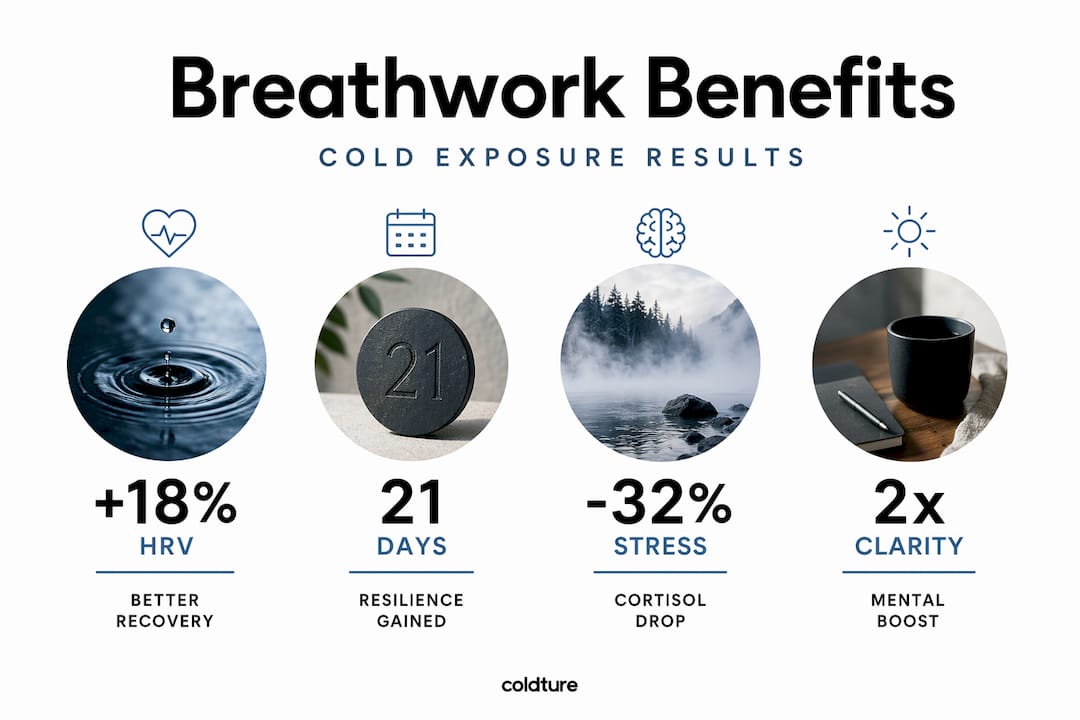
A 404-person study over 29 days found that combining breathwork with cold immersion produced greater self-reported improvements in energy, mental clarity, and stress resilience than mindfulness meditation alone. That is a meaningful benchmark. If you are four weeks in and not noticing any shift in your energy or focus, your breathing technique, water temperature, or immersion duration likely needs adjustment. Cold exposure benefits begin around 60°F (15°C) and increase at lower temperatures or longer durations, so gradual progression matters.
For improving resilience with breathwork long-term, consistency beats intensity. Three shorter sessions per week with deliberate breath control will outperform one long, chaotic plunge. If you want a structured starting point for cold plunge recovery protocols, Coldture’s blog offers athlete-focused routines that integrate breathwork from the first session.
What I’ve learned from combining breathwork with cold exposure
I came to cold exposure through injury. Not through curiosity or a YouTube video. Through a knee rehab process that felt like it was going nowhere, and a desperation to find something that actually worked. Breathwork found me around the same time, and what I discovered when I put them together changed how I think about recovery completely.
My honest take: most people are underestimating what breath control does to the experience. They treat it as a warm-up routine or a calming trick. It is neither. Breathwork primes your body with an adrenaline state that makes cold stress feel like something you are walking into on purpose rather than something happening to you. That distinction changes everything about your tolerance and your willingness to show up the next day.
The mistake I made early was treating the Wim Hof protocol as something to do right before getting in. I would do the rounds, still buzzing, and step into the tub while hyperventilated. That is backwards and genuinely risky. You do the aggressive breathwork on dry land, let it settle for a few minutes, and then use calm controlled breathing to enter the water. The preparation and the immersion phases require completely different nervous system states.
What changed my mental toughness was not the cold itself. It was learning to use breath as a tool that I controlled rather than a reaction I was managing. The moment you can breathe slowly and deliberately while your body is screaming to do the opposite, you have built something that transfers to everything else in your life.
Start simple. Box breathing before your first few plunges. Add the Wim Hof protocol on dry land once you understand the risks. Build progressively. The practice rewards patience in a way that very few things do.
— Daniel
Your cold plunge setup should match your practice
If you are doing breathwork before every session, you deserve a setup that does not fight you. A cheap inflatable tub that deflates mid-session or can’t hold a consistent temperature undermines the entire ritual you’re building.

Coldture’s Xtreme Outdoor Cold Plunge is built for serious, consistent use. It holds temperature reliably, has a design that supports safe entry and exit, and is trusted by professional athletes and Olympic teams for exactly the kind of deliberate practice this article is about. Pair it with Coldture’s dry mat accessory for a non-slip surface where you can safely do your pre-immersion breathwork right next to the tub. And if you want the full contrast therapy cycle, Coldture’s outdoor sauna line completes the equation. The gear should work as hard as you do.
FAQ
What is the best breathwork technique before a cold plunge?
Box breathing (4-4-4-4) and the 3-inhale calm method are the most accessible pre-immersion options. The Wim Hof Method is more powerful but must be done on dry land only, never immediately before entering water.
Can you hold your breath during cold water immersion?
No. Breath holds during immersion carry a documented syncope risk because low CO2 from prior hyperventilation removes your urge to breathe before oxygen runs out. Keep breathing continuously while in the water.
How long does it take to see results from breathwork and cold exposure?
A 29-day study of 404 adults found measurable improvements in energy and stress resilience. Most practitioners report noticeable mental clarity improvements within two to four weeks of consistent practice.
Is breathwork safe for cold exposure beginners?
Box breathing and diaphragmatic breathing are safe for beginners. Aggressive hyperventilation protocols require learning proper technique on dry land first. Anyone with cardiovascular conditions should consult a physician before starting.
Does breathwork actually change how cold exposure feels?
Yes. Breathwork-induced alkalosis buffers cold-shock acidosis, and the adrenaline priming from protocols like the Wim Hof Method makes the initial cold shock measurably less intense, not just psychologically easier.
Share:
What Is Cold Adaptation: Science and Practice Guide
Your Energy Recovery Checklist for Peak Performance