


Cold adaptation is one of the most misunderstood processes in health and performance. Most people assume it means getting tougher mentally or simply surviving the initial shock of an ice bath. The reality goes much deeper. What is cold adaptation at its core? It’s a set of measurable, physiological changes your body makes over time in response to repeated cold exposure, from shifts at the cellular level all the way up to your cardiovascular and nervous systems. This article breaks down the science clearly and shows you how to apply it safely.
Key Takeaways
| Point | Details |
|---|---|
| Cold adaptation is physiological | Your body makes real, measurable biological changes, not just mental toughness gains, from repeated cold exposure. |
| Three distinct types exist | Acclimatization, acclimation, and habituation are separate processes with different triggers and outcomes. |
| Brown fat is central | Brown adipose tissue (BAT) activation is one of the most significant long-term metabolic outcomes of cold adaptation. |
| Gradual progression beats intensity | Starting mild and building consistently produces better adaptation than extreme exposures done infrequently. |
| Recovery benefits are real but nuanced | Cold immersion cuts post-exercise soreness, though timing matters for athletes focused on muscle growth. |
What is cold adaptation, exactly
The first thing worth clearing up is the terminology. People use “cold adaptation” loosely, but researchers break it into three distinct categories. Three separate processes define the field: acclimatization refers to adaptive changes from natural environmental cold exposure, acclimation describes changes from controlled settings like ice baths or cold chambers, and habituation means your nervous system simply reduces its response to a familiar stimulus over time.
Why does this distinction matter? Because the outcomes differ. Acclimatization builds deep metabolic changes that take weeks of real-world cold living. Acclimation, which is what most people practice with cold plunges, can produce measurable physiological results faster. Habituation, by contrast, may make cold feel less shocking without necessarily improving your thermoregulatory capacity.
The core physiological responses break down into three categories:
- Metabolic adaptation. Your body increases heat production through brown adipose tissue and non-shivering thermogenesis rather than relying on shivering alone.
- Insulative adaptation. Subcutaneous fat and vascular adjustments reduce heat loss from the skin surface over time.
- Habituation. The nervous system dampens the cold shock response, lowering the intensity of the initial reflex reactions.
Short-term cold exposure raises both metabolic rate and heart rate immediately. Long-term adaptation shifts that pattern, raising resting metabolic rate through brown fat activity while resting heart rate may actually decrease, reflecting improved cardiac efficiency.
Pro Tip: If you want to measure your actual adaptation progress, track your resting heart rate over weeks of consistent cold exposure. A downward trend is a strong signal that your cardiovascular system is adapting, not just tolerating.
The cellular science behind cold tolerance
The most fascinating part of cold adaptation happens at a scale you cannot feel. Your cells have cold-sensing machinery that detects temperature drops and triggers a cascade of biological responses.

Here is a quick breakdown of the key molecular players:
| Mechanism | What It Does | Outcome |
|---|---|---|
| TRPM8/TRPA1 channels | Detect cold and trigger calcium signaling | Activates BAT thermogenesis and fat burning |
| Brown adipose tissue (BAT) | Burns calories to generate heat without shivering | Metabolic rate increase, glucose regulation |
| CIRBP and RBM3 proteins | Cold-induced RNA-binding proteins that protect cells | Neuroprotection, metabolic modulation |
| Epigenetic modifications | Gene expression changes from repeated cold exposure | Long-term cellular adaptation |
TRPM8 activation enhances fat burning and glucose metabolism, contributing to metabolic balance that goes well beyond temperature regulation. This is why cold exposure research keeps showing up in metabolic health contexts, not just athletic recovery.
“Mammalian cells use a layered system of cold-sensing channels, RNA-binding proteins, and epigenetic modifications to mount a coordinated cold adaptation response at the cellular level.”
The RNA-binding proteins CIRBP and RBM3 are particularly underappreciated in popular discussions of cold therapy. These proteins activate during cold exposure and provide neuroprotective effects, which may explain why cold exposure research keeps intersecting with brain health and mood regulation.
Pro Tip: Brown adipose tissue is more active in people who regularly expose themselves to mild cold. You do not need extreme temperatures to stimulate BAT. Consistent exposure at moderately cold temperatures, around 50 to 59 degrees Fahrenheit, is enough to drive meaningful activation over weeks.
Physiological and psychological effects
Cold adaptation does not just change your internal thermostat. It reshapes multiple body systems simultaneously, and the mental effects are just as real as the physical ones.
On the physiological side, the changes accumulate over time with consistent practice:
- Vascular tone improves as blood vessels become more efficient at redirecting blood flow away from extremities during cold exposure.
- Adrenocorticotropic hormone secretion increases with repeated cold exposure, enhancing the body’s ability to cope with cold stress over time.
- Metabolic efficiency improves as BAT takes over more of the thermogenic load from shivering muscle tissue.
- Cold water immersion reduces post-exercise muscle soreness by approximately 20%, making it a practical recovery tool for athletes.
The psychological picture is more nuanced. Long-term cold-water swimming may reduce anxiety through vagal tone enhancement, and many people report improved mood, sharper focus, and greater stress resilience with regular cold practice. The mechanisms likely involve both the direct activation of the sympathetic nervous system and downstream neuroendocrine effects.
That said, the mental health benefits are not universal. Cold exposure’s psychological effects vary significantly between individuals, and some people with anxiety disorders or stress sensitivity may find cold exposure counterproductive without proper guidance. The interplay between stress response systems and cold adaptation is real, but it requires an individualized approach. Jumping into aggressive cold protocols without understanding your baseline stress load can backfire.
For most people, the sweet spot is using cold exposure as a regulated stressor, something that activates your stress response in a controlled, predictable way that builds resilience over time rather than depleting it.
How to build cold adaptation safely
This is where most people get it wrong. Cold adaptation is built through consistency and progression, not through dramatic feats of cold endurance.
- Start with cool, not cold. Begin with cool showers at around 65 to 70 degrees Fahrenheit for 30 to 60 seconds. This primes your nervous system without triggering a full cold shock response.
- Control your breathing first. The cold shock response causes involuntary gasping. Learning to control your breath before full immersion is the most critical skill. Controlled breathing manages the cold shock response and enables longer cold exposure tolerance over time.
- Use contrast therapy as a bridge. Contrast therapy combining hot and cold exposure improves circulation and eases the transition into longer cold exposures without burnout. Starting with a sauna followed by a brief cold plunge is one of the most approachable entry points.
- Progress the temperature gradually. Drop water temperature by a few degrees every one to two weeks rather than jumping straight into 40-degree water.
- Prioritize frequency over duration. Three to four short cold sessions per week build cold tolerance more effectively than one extreme session.
- Time your sessions strategically. If you are focused on muscle growth, avoid cold immersion immediately after resistance training. Cold immersion after resistance training may impair muscle growth adaptations, though the effects on endurance training are less clear.
Pro Tip: For recovery-focused cold plunges, aim for 10 to 15 minutes at 50 to 59 degrees Fahrenheit. For nervous system and mood benefits, even two to five minutes produces meaningful results. You do not need to suffer for an hour to get a return.
Athletes looking for a structured approach can explore a cold plunge recovery routine built specifically around performance demands.
How animals and humans adapt differently
Understanding cold tolerance in organisms across the animal kingdom puts human adaptation into sharp perspective. And it reveals why you cannot just borrow strategies from nature wholesale.
| Adaptation Type | Animals | Humans |
|---|---|---|
| Metabolic | Torpor, hibernation, extreme BAT usage | BAT activation, elevated metabolic rate |
| Insulative | Blubber, dense fur, counter-current heat exchange | Subcutaneous fat, vascular adjustment |
| Behavioral | Migration, denning, huddling | Clothing, shelter, deliberate cold practice |
| Molecular | Antifreeze proteins in some species | TRPM8/TRPA1 channels, CIRBP/RBM3 proteins |
How animals adapt to cold is a study in biological extremes. Arctic mammals like seals and polar bears use thick blubber and counter-current heat exchange in their circulatory systems to maintain core temperature without significant energy expenditure. Some fish produce actual antifreeze proteins that prevent ice crystal formation in their blood.
Humans lack those tools. Cold adaptation in humans relies far more on behavioral strategies and metabolic adjustments, particularly brown fat activation, than on structural insulation. We share the BAT mechanism with other mammals, including hibernating species, but our version is far less developed at baseline. The good news is that BAT activity in humans can be significantly increased through consistent cold exposure, effectively closing part of that gap.
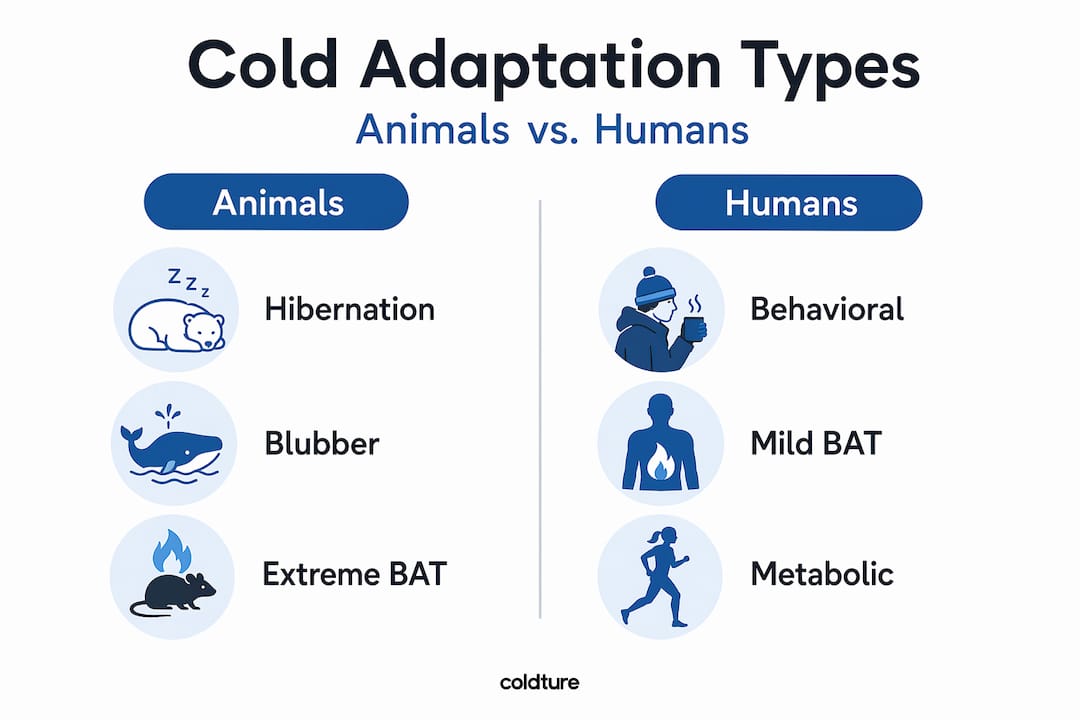
The lesson from animal models is clear: physiology matters, but behavior and consistency are where human cold adaptation is actually built.
My take on cold adaptation and what most people miss
I got into cold exposure because of a knee injury, and the honest truth is that the first few months felt like chaos. I kept reading about people who seemed to breeze through ice baths like it was nothing, and I kept gasping and cutting sessions short. What changed everything was shifting my focus from toughness to regulation.
The science backs this up completely. Your nervous system needs to learn the cold is safe before it will adapt to it. Willpower alone does not retrain the cold shock response. Breath does. The moment I started treating breath control as the core skill and cold as the practice environment, my adaptation curve changed dramatically.
I also want to be honest about the athletic side. If you are chasing muscle gains and doing cold immersion immediately after every strength session, you may be working against yourself. The evidence on that is real enough to take seriously. Cold for recovery and cold for athletic adaptation are not always the same protocol. Knowing the difference matters.
The broader point is this: cold adaptation rewards patience and regularity in a way that almost no other health practice does. You cannot fake it with occasional extreme exposure. The body needs repeated, manageable signals over time. That is what actually changes your physiology at the cellular level.
— Daniel
Build your cold practice with Coldture

If you are ready to move from theory to practice, the tools you use matter. Coldture’s Xtreme Outdoor Cold Plunge is built for exactly this kind of consistent, long-term cold practice. It holds precise temperatures, handles year-round outdoor use, and is the unit trusted by NHL organizations, Olympic teams, and F45 studios across North America. For those building a contrast therapy practice, pair it with Coldture’s outdoor saunas to complete the hot-cold cycle that research consistently supports. And if you want your setup safe and practical from day one, the dry mat for cold plunges is a small addition that makes a real difference in your daily routine.
FAQ
What is cold adaptation in simple terms?
Cold adaptation is the process by which your body makes measurable physiological changes in response to repeated cold exposure, including shifts in metabolism, cardiovascular function, and cellular biology. It is not just a mental toughness response.
How long does cold adaptation take?
Noticeable physiological changes can begin within two to four weeks of consistent cold exposure. Full metabolic and cardiovascular adaptation typically develops over several months of regular practice.
What is thermal acclimatization?
Thermal acclimatization refers to the adaptive changes that occur when the body is exposed to natural environmental cold over an extended period, as distinct from controlled laboratory or plunge settings.
Can cold adaptation improve mental health?
Research shows that long-term cold-water exposure may reduce anxiety through vagal tone enhancement and improve mood, but effects vary significantly between individuals and are not guaranteed for everyone.
Is cold water immersion good for athletic recovery?
Cold water immersion reduces post-exercise muscle soreness by approximately 20%, making it useful for recovery. However, using it immediately after resistance training may limit muscle growth adaptations, so timing and context matter.
Share:
Benefits of heat exposure: A guide for recovery and wellness
Breathwork for Cold Exposure: Optimize Every Plunge