


Most people treat a sauna like a luxury, not a tool. That’s a costly mistake. The benefits of heat exposure go far beyond relaxation. Research shows that sauna use linked to 50% lower fatal cardiovascular risk when practiced four to seven times per week. That’s not a rounding error. That’s a number that should make every athlete and health-conscious person rethink what belongs in their weekly routine. This guide breaks down what heat actually does to your body, why the science is compelling, and how to use it intelligently.
Key Takeaways
| Point | Details |
|---|---|
| Cardiovascular protection | Frequent heat exposure significantly lowers risks of fatal heart disease and sudden cardiac death. |
| Performance enhancement | Heat increases plasma volume and oxygen delivery, boosting endurance and recovery for athletes. |
| Mental well-being | Heat triggers hormone changes that reduce depression symptoms and support brain health. |
| Safe usage | Optimal benefits come from 15-20 minute sessions 4-7 times weekly with gradual tolerance building. |
| Complement to exercise | Heat exposure provides unique benefits that complement but do not replace physical exercise. |
How heat exposure benefits your heart and circulatory system
Your heart doesn’t know the difference between a hill sprint and a sauna session. Both raise your heart rate, dilate your blood vessels, and push your cardiovascular system to adapt. But heat does something exercise alone can’t: it creates a passive cardiovascular stress that specifically targets vascular function.
When you sit in a sauna, your core temperature rises and your body responds by redirecting blood toward the skin to cool down. Blood vessels dilate, blood pressure drops, and cardiac output increases. Over time, this repeated stimulus improves endothelial function, which is the ability of your blood vessel walls to expand and contract efficiently. It also improves arterial compliance, meaning your arteries become more flexible and less prone to the stiffness associated with aging and disease.
The data on this is hard to ignore. Frequent sauna use is linked to a 50% lower risk of fatal cardiovascular disease and a 63% reduction in sudden cardiac death risk. These numbers come from large-scale Finnish population studies tracking thousands of participants over decades. This is not a small trial. It’s some of the most robust observational data in preventive cardiology.
Key cardiovascular benefits of regular heat exposure:
- Lowers resting blood pressure over time
- Reduces systemic inflammation markers, including C-reactive protein
- Improves heart rate variability (HRV), a marker of cardiovascular resilience
- Supports sauna and immune health by reducing chronic low-grade inflammation
- Enhances circulation to peripheral tissues, which matters for joint health and wound recovery
The dose-response relationship matters here. More sessions per week and longer session durations produce greater benefits, but even two to three sessions weekly provides measurable improvements.
| Sauna frequency | Cardiovascular risk reduction |
|---|---|
| 1 session/week | Moderate improvement |
| 2 to 3 sessions/week | Significant improvement |
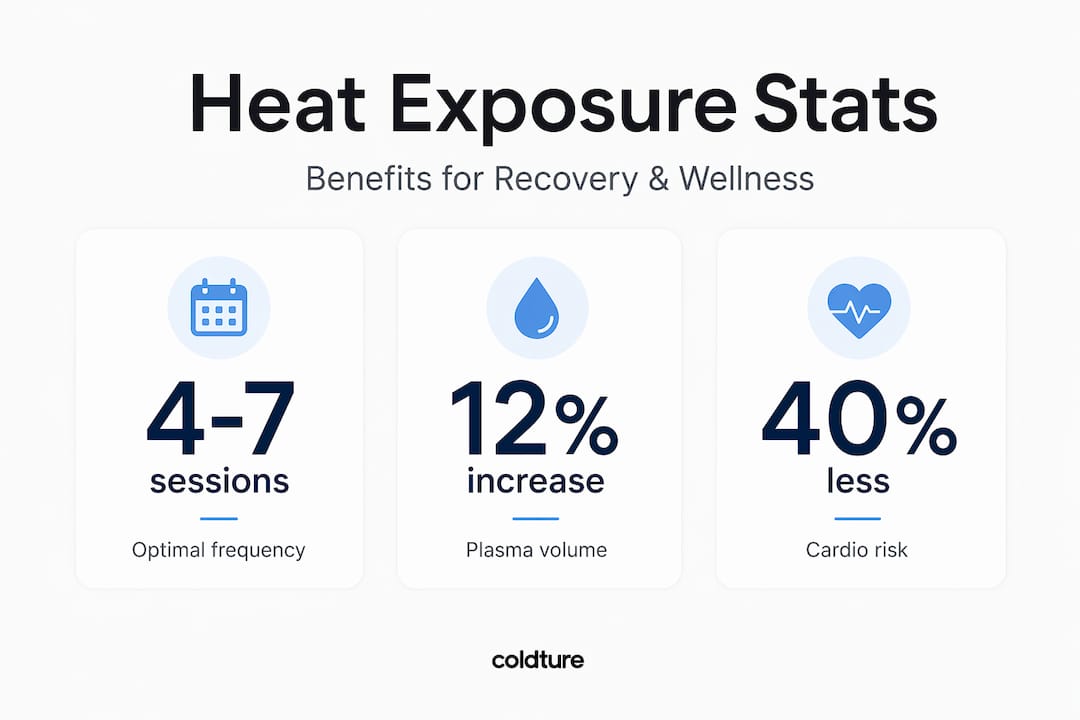
| 4 to 7 sessions/week | Up to 50% lower fatal CV risk |
Pro Tip: You don’t need 30-minute sessions to see cardiovascular gains. Even 15-minute sessions at moderate heat create a meaningful training effect on your vascular system. Consistency beats duration when you’re starting out.
Enhancing athletic performance and recovery with regular heat exposure
Heat acclimation is one of the most underutilized performance tools in endurance sports. The mechanism is straightforward: when you expose your body to heat repeatedly, it adapts by expanding your plasma volume, which is the liquid portion of your blood. More plasma means more efficient oxygen and nutrient delivery to working muscles.

Repeated heat exposure increases plasma volume by up to 12% after five to ten days of consistent sessions. That’s comparable to altitude training for some athletes, and it happens at sea level with zero travel required. For runners, cyclists, and triathletes, that kind of adaptation translates directly to lower heart rates at a given pace and better performance in the heat.
The recovery angle is equally strong. Post-exercise heat therapy significantly improves VO2max and lactate threshold, two key markers of aerobic fitness. This is partly because heat accelerates glycogen resynthesis and blood flow to damaged muscle tissue, and partly because it triggers the release of growth hormone, which supports muscle repair.
How to structure heat exposure for fitness gains:
- Wait 10 to 20 minutes post-workout before entering the sauna. Give your heart rate time to settle.
- Start with 10 to 15 minute sessions at 170 to 185°F (77 to 85°C). Focus on controlled breathing.
- Exit and cool down for 5 to 10 minutes between rounds. Two to three rounds is standard for athletes.
- Rehydrate aggressively. You lose 0.5 to 1 liter of sweat per 10 minutes in a hot sauna.
- Build toward 20-minute sessions over two to three weeks as your tolerance increases.
The sauna benefits for athletes extend beyond endurance. Strength athletes benefit from improved blood flow and faster clearance of metabolic waste products like lactate and hydrogen ions. Think of the post-workout sauna as your second recovery tool, not an afterthought.
Pro Tip: If you are training for a hot-weather race or competition, a two-week heat acclimation block using daily sauna sessions can be more practical and safer than training outdoors in extreme heat. Use a sauna recovery checklist to track hydration and session metrics during this block.
Mental health and longevity benefits from heat exposure you might not expect
This is where heat exposure surprises most people. The physical benefits are expected. The mental health and longevity data is something else entirely.
At the cellular level, heat activates heat shock proteins (HSPs), molecular chaperones that repair misfolded proteins and protect DNA integrity. Think of them as your body’s internal quality-control system. Every time you heat up, you are triggering a repair cascade that helps your cells function longer and more accurately. This is one reason heat exposure is increasingly studied in the context of aging.
Heat exposure activates heat shock proteins for DNA repair, increases growth hormone secretion, and reduces cortisol, producing a measurable lift in mood and stress resilience. Growth hormone spikes of 200 to 500% have been observed after sauna sessions. Cortisol, the primary stress hormone, drops. The result is a post-sauna window of calm that feels similar to meditation, but driven by hormonal shifts rather than willpower alone.
The longevity data is just as striking. Regular sauna use is linked to lower risk of Alzheimer’s disease, reduced rates of depression, and longer overall lifespan. The Alzheimer’s connection is thought to be partly vascular (better blood flow to the brain) and partly cellular (HSP activation protecting neurons from oxidative damage).
“The evidence connecting regular sauna use to reduced dementia risk and longer lifespan is among the most compelling in lifestyle medicine. It deserves far more clinical attention than it currently receives.” — Paraphrasing the research perspective of Dr. Christopher Minson, University of Oregon
Brain and longevity benefits of consistent heat therapy:
- Triggers dynorphin release, which later causes an upregulation of endorphin receptors, improving baseline mood
- Reduces symptoms of major depression comparably to some antidepressant interventions in early research
- Lowers risk of neurodegenerative disease through improved cerebral blood flow
- Activates autophagy, the cellular “clean-up” process that removes damaged cell components
You can explore more about the heat therapy and mental health benefits connection if you want to go deeper on the neuroscience.
Safe and effective ways to incorporate heat exposure into your wellness routine
The biggest mistake people make is going too hard too fast. A beginner who jumps straight into a 200°F Finnish sauna for 30 minutes is not being disciplined. They’re being reckless. Gradual tolerance building is key to avoiding early fatigue and getting the most from each session.
Here is a practical framework to get started and progress safely:
- Weeks 1 to 2: Two to three sessions per week, 10 to 12 minutes each, at 150 to 165°F (66 to 74°C). Focus on breathing and staying comfortable.
- Weeks 3 to 4: Increase to 15-minute sessions. Add a third or fourth weekly session if recovery feels good.
- Month 2 and beyond: Work toward 15 to 20-minute sessions at 170 to 185°F. Frequency of four to five sessions weekly is the sweet spot for most people.
- Hydration: Drink 16 to 24 ounces of water before each session and replace electrolytes lost through sweat after.
- Exit signals to respect: Dizziness, nausea, or heart pounding uncomfortably are your body telling you to get out. Always listen.
Longer sessions over 19 minutes and higher weekly frequency yield the best long-term health outcomes. But that threshold is a destination, not a starting point.
| Experience level | Temperature | Session length | Frequency |
|---|---|---|---|
| Beginner | 150 to 165°F | 10 to 12 minutes | 2 to 3x/week |
| Intermediate | 165 to 180°F | 15 to 20 minutes | 3 to 5x/week |
| Advanced | 180 to 195°F | 20 to 30 minutes | 4 to 7x/week |
Review credible sauna usage guidelines and keep a simple heat exposure checklist to track your progress. Small improvements in tolerance compound quickly.
Pro Tip: Ending your sauna session with a cold shower or cold plunge amplifies the recovery effect. The contrast between heat and cold creates a powerful circulation response and accelerates the clearance of metabolic byproducts.
Rethinking heat exposure: Why it’s not just a recovery tool but a vital health practice
Here’s an uncomfortable truth in the wellness world: heat exposure gets filed under “nice to have” while cold plunging, zone-2 cardio, and strength training get the spotlight. That hierarchy is backwards, or at least badly calibrated.
Heat exposure is not simply a recovery modality. It is a physiological stressor with its own distinct pathways. Heat acts as an acute stressor similar to exercise but uniquely calms the nervous system afterward, improving cardiovascular markers in ways that are additive to, not redundant with, exercise.
Exercise makes you stronger, denser in bone, and metabolically fitter. Heat does something different: it trains your vascular system, activates cellular repair programs, and modulates your hormonal environment in ways that exercise cannot fully replicate. The person who exercises five days per week and never uses heat is leaving a significant piece of their health potential on the table.
The mental health dimension is where the underestimation is most glaring. Therapists and psychiatrists rarely prescribe sauna use, yet the evidence connecting regular heat therapy to reduced depression and anxiety is serious enough to warrant clinical attention. The dynorphin-to-endorphin feedback loop triggered by heat stress is genuinely mood-altering over time. It’s not a placebo. It’s biology.
Combining heat exposure with your existing training is where things get interesting. The athlete who lifts, runs, and uses heat regularly is not just recovering faster. They are adapting differently at the cellular level. More heat shock proteins. Better vascular tone. Lower baseline inflammation. For anyone interested in the science behind this combination, the heat exposure biohacking insights from Coldture’s research team are worth your time.
The goal is not to swap your workout for a sauna. The goal is to treat heat as a non-negotiable pillar of your weekly routine, the same way you treat sleep and nutrition. It is that important.
Explore Coldture Wellness solutions to optimize your heat exposure routine
Knowing the science is one thing. Having the right equipment to act on it consistently is another.
Coldture designs premium outdoor saunas built for real use, not occasional indulgence. Every unit is engineered for consistent heat distribution, durability in North American climates, and the kind of session quality that actually produces the health outcomes described in this article. If you want flexibility between indoor and outdoor setups, explore indoor and outdoor sauna options that fit both home and commercial spaces. And if you’re ready to add contrast therapy to your recovery stack, Coldture’s portable cold plunges for recovery pair directly with sauna sessions to amplify the cardiovascular and hormonal benefits. Professional-grade heat and cold therapy, designed for everyday life.
Frequently asked questions about heat exposure benefits
How often should I use a sauna to get significant health benefits?
Research shows that four to seven sessions per week, each lasting at least 15 minutes, are linked to the most substantial cardiovascular and longevity benefits, though even two to three sessions weekly produces measurable gains.
Can heat exposure replace exercise for improving fitness?
Heat exposure mimics some exercise-like effects including elevated heart rate and improved circulation, but it does not replace the strength, bone density, and metabolic adaptations that physical training produces. Think of them as partners, not substitutes.
Is post-exercise sauna use safe and effective for recovery?
Yes, sessions of 20 to 30 minutes after moderate-intensity workouts are both safe and effective when you stay hydrated and respect temperature limits. Post-exercise heat therapy has been shown to significantly improve VO2max and lactate threshold over time.
Are there risks associated with heat exposure?
Heat exposure is safe for most healthy individuals, but people who are pregnant, have cardiovascular conditions, or heat sensitivity should consult a physician first. Gradual acclimation and hydration are the two most important safety factors regardless of fitness level.
Share:
Contrast therapy explained: Boost recovery and wellness safely
What Is Cold Adaptation: Science and Practice Guide