


TL;DR:
- Contrast therapy enhances recovery by promoting circulation, reducing inflammation, and speeding muscle repair.
- Proper setup includes controlled temperatures, timely transitions, and safety measures tailored to individual needs.
- Using 3 to 5 cycles of heat (100-104°F) for 3-5 minutes and cold (50-59°F) for 1-3 minutes optimizes benefits.
You finish a hard training session and your legs feel like concrete. Your shoulders ache, your focus is shot, and the idea of doing it all again tomorrow feels impossible. That soreness is your body signaling it needs more than rest. Contrast therapy, the practice of alternating heat and cold exposure, has gained serious traction among athletes and wellness-focused individuals for exactly this reason. Research confirms it creates a vascular pumping effect that speeds up muscle repair, reduces inflammation, and sharpens mental resilience. This guide walks you through every step, from the science to the setup to a personalized protocol you can start this week.
Table of Contents
- Understanding heat and cold therapy: The basics and science
- Setting up for success: What you need before starting
- Step-by-step guide: How to combine heat and cold therapy effectively
- Adapting protocols for your goals: Recovery, injury, and resilience
- What most guides miss about combining heat and cold therapy
- Support your journey with the right tools
- Frequently asked questions
Key Takeaways
| Point | Details |
|---|---|
| Contrast therapy boosts recovery | Alternating heat and cold improves circulation, reduces inflammation, and speeds muscle repair. |
| Follow proven protocols | Use 3-5 minutes of heat and 1-3 minutes of cold per cycle, repeating 3-5 times for effective results. |
| Customize for your needs | Adjust time, temperature, and cycles based on your goals, injury status, and personal response. |
| Prioritize safety always | Hydrate, avoid therapy with certain health conditions, and monitor your body for warning signs. |
Understanding heat and cold therapy: The basics and science
Before you start jumping between a sauna and an ice bath, it helps to understand what each stimulus actually does to your body and why using them together creates something greater than either alone.
Heat therapy works by triggering vasodilation, the widening of blood vessels. When your body temperature rises, blood rushes to your muscles and connective tissue, delivering oxygen and nutrients while flushing out metabolic waste. Your muscles relax, your range of motion improves, and tissue repair accelerates. This is why a warm soak after a long run feels so effective.
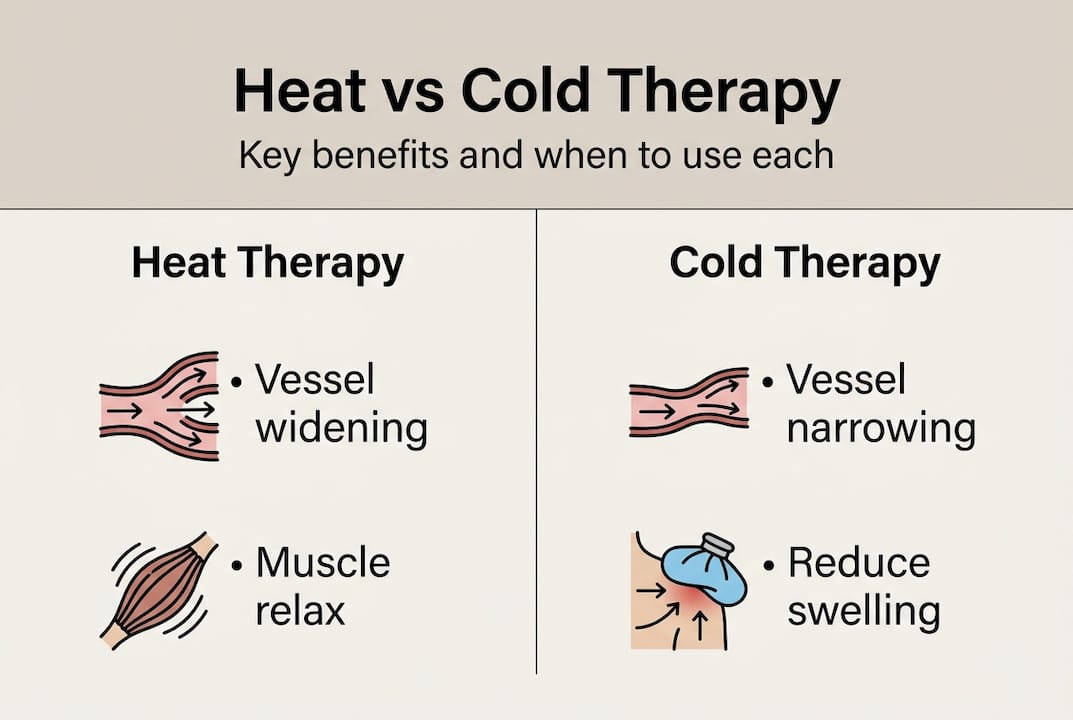
Cold therapy does the opposite. It causes vasoconstriction, narrowing blood vessels and slowing nerve conduction. This numbs pain signals, reduces swelling, and limits the inflammatory response that causes secondary tissue damage after intense exercise. A cold plunge after heavy lifting can noticeably cut the soreness you feel the next morning.
When you alternate between the two, something powerful happens. Contrast therapy creates a vascular pumping effect by repeatedly dilating and constricting blood vessels. Think of it like squeezing a sponge over and over. Each cycle pushes fresh, oxygenated blood into the tissue and pulls out waste products far more efficiently than passive rest. According to contrast therapy guidelines, this mechanism is what makes the combined approach particularly effective for recovery and inflammation control.
Here is a quick comparison to put it in perspective:
| Therapy | Primary effect | Best for | Key benefit |
|---|---|---|---|
| Heat | Vasodilation, relaxation | Stiffness, chronic soreness | Increases blood flow, flexibility |
| Cold | Vasoconstriction, numbing | Acute swelling, inflammation | Reduces pain, limits damage |
| Contrast | Vascular pumping | Post-workout recovery, resilience | Combines both, enhances circulation |
Who benefits most? Athletes dealing with delayed onset muscle soreness (DOMS) see the clearest gains. But people managing chronic pain, desk workers with tight hips and shoulders, and anyone building a serious wellness practice also report meaningful results.
Key benefits of contrast therapy include:
- Faster clearance of lactic acid and metabolic byproducts
- Reduced muscle swelling and tenderness
- Improved mood and mental sharpness post-session
- Enhanced parasympathetic recovery (rest-and-digest mode)
Contrast therapy alternates heat and cold to create a vascular pumping effect that enhances circulation, reduces inflammation, and aids recovery, making it one of the most efficient tools in a serious recovery toolkit.
Setting up for success: What you need before starting
Understanding the science is only the start. Here is what you will need to combine heat and cold therapy safely and efficiently.
You do not need a professional sports facility. A well-equipped home setup works just as well if you have the right pieces in place.
Essential equipment:
- Heat source: sauna, hot tub, or warm bath (target 100 to 104°F)
- Cold source: ice bath, cold plunge tub, or cold shower (target 50 to 59°F)
- A reliable thermometer for both environments
- A timer or stopwatch
- Towels and a dry change of clothes nearby
- Water bottle within reach
Safe temperature and time ranges:
| Phase | Temperature range | Duration per cycle | Notes |
|---|---|---|---|
| Heat | 100 to 104°F (38 to 40°C) | 3 to 5 minutes | Avoid exceeding 106°F |
| Cold | 50 to 59°F (10 to 15°C) | 1 to 3 minutes | Beginners start at 59°F |
| Total session | N/A | 20 to 40 minutes | 3 to 5 full cycles |
Your space matters too. Make sure you have privacy, non-slip surfaces near any water source, and a clear path between your heat and cold stations. The faster you can transition between the two, the better the vascular response.
Pro Tip: Drink 16 to 20 ounces of water before your session and keep a bottle nearby. Heat exposure increases fluid loss fast, and dehydration will blunt your recovery gains and increase the risk of dizziness.
Safety is non-negotiable. Standard protocols recommend 3 to 5 minutes of heat, 1 to 3 minutes of cold, repeated for 3 to 5 cycles totaling 20 to 40 minutes. But certain individuals need to skip contrast therapy entirely or get medical clearance first.
Avoid contrast therapy if you have: cardiovascular disease, Raynaud’s syndrome, open wounds, are pregnant, or have impaired sensation in your limbs. When in doubt, consult your doctor before starting. Your thermal therapy routine tips should always begin with a safety check.
Step-by-step guide: How to combine heat and cold therapy effectively
With your setup ready, follow these steps for a proven contrast therapy routine that maximizes gains and minimizes risk.
- Pre-warm your body (5 minutes). Do light movement, dynamic stretching, or a short walk before entering the heat. This primes your cardiovascular system and makes the initial heat exposure more effective.
- Heat immersion (3 to 5 minutes). Enter your sauna, hot tub, or warm bath. Breathe slowly and let your muscles fully relax. You should feel a deep, spreading warmth, not discomfort or dizziness.
- Quick transition (under 60 seconds). Move directly to your cold source. Speed matters here. A slow transition reduces the vascular pumping effect that makes contrast therapy so effective.
- Cold immersion (1 to 3 minutes). Submerge as much of your body as possible. Control your breathing. The cold shock response fades within 30 to 60 seconds. Stay calm and focused.
- Repeat cycles (3 to 5 total). Return to heat and repeat the sequence. Each cycle builds on the last. Most athletes find cycles 3 and 4 feel the most powerful as the vascular response deepens.
- Cool down and rehydrate. After your final cold phase, rest for 5 to 10 minutes at room temperature. Drink water or an electrolyte drink. Avoid intense activity for at least 30 minutes.
example: A competitive athlete finishes a heavy deadlift session at 6 p.m. Spends 4 minutes in a 165°F sauna, transitions in 45 seconds to a 40°F cold plunge for 2 minutes, and repeats 4 cycles. Total session time: 28 minutes. By morning, grip strength and lower back soreness are noticeably better than after passive rest alone.

For how contrast therapy works in different athletic contexts, the principle stays the same but the ratio shifts. More heat favors relaxation and tissue repair. More cold favors inflammation control and mental sharpness.
Pro Tip: Always end your session with cold. Finishing cold locks in reduced inflammation, gives you an energy boost from norepinephrine release, and leaves your nervous system in a more alert, recovered state. Standard protocols consistently support this finish-cold approach for both recovery and energy.
Adapting protocols for your goals: Recovery, injury, and resilience
Once you have mastered the basics, fine-tune your approach by adapting proven protocols to match your unique goals and circumstances.
Not every session should look the same. Your body’s needs shift depending on training load, injury status, and what you are trying to achieve that week. Here is how to adjust:
- Post-workout recovery: Use longer heat phases (4 to 5 minutes) to maximize blood flow and nutrient delivery. Follow with standard cold intervals. This combination supports cold plunge routine guidance for athletes training 4 or more days per week.
- Ongoing soreness and tightness: Prioritize heat-dominant sessions with 3 to 4 cycles. Cold still plays a role but shorter intervals (1 minute) are enough.
- Mental resilience training: End every session with a full cold immersion and practice controlled breathing. The discomfort is the point. Sitting with it builds real psychological toughness over time.
- Energy boost before performance: Shorter sessions (2 to 3 cycles) ending with cold activate the sympathetic nervous system and sharpen focus.
- Pain relief and chronic inflammation: Consistent contrast sessions 3 to 4 times per week show cumulative benefits. Check cold therapy performance tips for frequency guidance.
For acute injuries, the rule is simple: cold only for the first 48 to 72 hours. Ice reduces swelling and limits secondary damage. Introducing heat too early can increase blood flow to an already inflamed area and worsen swelling. Once the acute phase passes, contrast therapy can accelerate the next stage of healing.
Pro Tip: Start with 3 cycles at conservative temperatures (102°F heat, 59°F cold) for your first two weeks. Your tolerance will build faster than you expect, and starting conservatively prevents the discouragement that comes from an overwhelming first session.
Emerging research adds an important nuance. Some studies show that heat alone outperforms cold alone for preserving explosive force production after muscle-damaging exercise. This does not mean contrast therapy is wrong. It means your goal determines your tool. If maintaining power output the next day is the priority, lean heat-heavy. If reducing soreness and inflammation is the goal, contrast wins. Understanding the importance of recovery means knowing which lever to pull and when. For broader athlete recovery insights, context always drives the protocol.
What most guides miss about combining heat and cold therapy
Most articles give you a protocol and send you on your way. That is useful, but it misses the bigger picture.
The truth is that contrast therapy is sometimes overrated as a universal solution. Individual response varies significantly, and what works brilliantly for one athlete may underperform for another. Stricter, longer, and colder is not always better. We have seen people push extreme cold durations in pursuit of toughness and end up overtaxing their nervous systems instead of recovering.
The real skill is learning to read your own data. Track your sleep quality, next-day soreness, mood, and performance after each session. Over a few weeks, patterns emerge. Maybe you recover best with 4 cycles ending cold. Maybe 3 cycles with a longer heat phase suits your body better.
Mental resilience is built through consistent, intentional exposure, not through suffering. Showing up three times a week with focus and purpose builds far more toughness than one brutal session every two weeks. Pair your protocol with good sleep, nutrition, and stress management, and the results compound fast. Visit peak performance and resilience for a broader framework on building sustainable habits around recovery.
Support your journey with the right tools
A solid protocol is only as good as the equipment behind it. Inconsistent temperatures, unreliable heat sources, and makeshift cold setups introduce variables that slow your progress and reduce safety.
Investing in a dedicated cold plunge and a quality outdoor sauna removes the guesswork. You get precise, repeatable temperatures every session, which means your data is cleaner and your results are more consistent. Coldture designs cold plunges and saunas built specifically for serious recovery, with the durability and ease of use that makes showing up daily feel effortless. If you want to layer in additional recovery benefits, red light therapy pairs exceptionally well with contrast sessions to support tissue repair and reduce inflammation further. Explore Coldture’s full lineup and build the recovery setup your training deserves.
Frequently asked questions
What is the ideal order for heat and cold therapy?
Standard contrast routines start with heat to relax muscles and open blood vessels, then end with cold to reduce inflammation and deliver an energy boost.
How often should you use contrast therapy for best results?
Most people see strong results with 2 to 4 sessions per week. Each session typically runs 3 to 5 cycles totaling 20 to 40 minutes, adjusted to your training load and recovery needs.
Are there risks or conditions where you should avoid combining heat and cold?
Yes. Contraindications include cardiovascular disease, Raynaud’s syndrome, open wounds, pregnancy, and impaired sensation. Always consult a doctor if you have any of these conditions before starting.
Can I do contrast therapy after an acute injury?
Not immediately. Use cold only for the first 48 to 72 hours after an acute injury to control swelling, then introduce contrast therapy once the initial inflammation settles.
How long should you spend in each phase of heat and cold?
Standard protocols use 3 to 5 minutes of heat followed by 1 to 3 minutes of cold per cycle, repeated 3 to 5 times for a complete session.
Share:
Active Recovery: Boost Wellness and Speed Muscle Repair
Top Recovery Therapies: Boost Performance & Wellness