

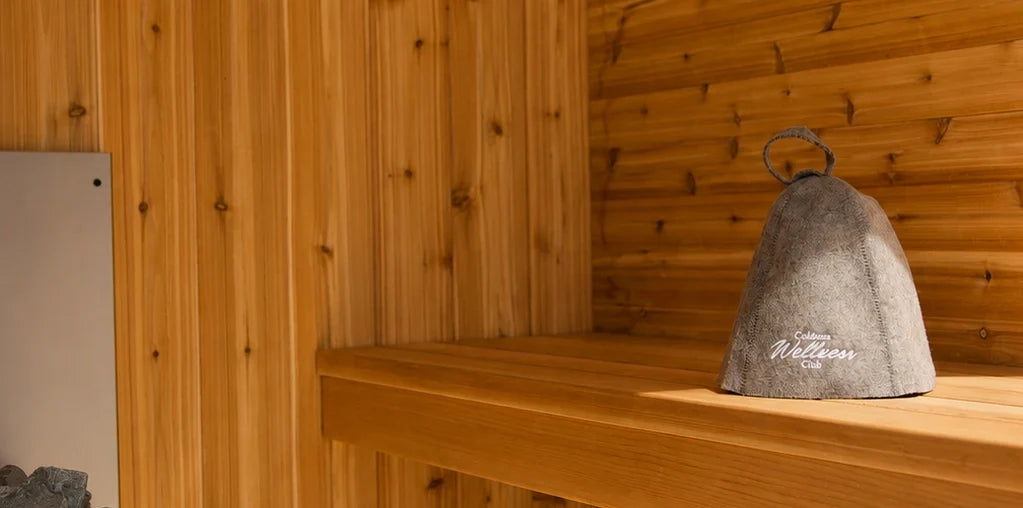
If you're shopping for a sauna, you've probably seen "cedar" listed as the interior wood on most of the options you're considering. That single word does a lot of heavy lifting, because it covers at least three distinct materials with meaningfully different properties.
Western red clear cedar, western red knotty cedar, and eastern white cedar are the three you'll encounter most often. They differ in species, grade, density, aroma, appearance, and how they handle the specific demands of a sauna environment: sustained heat, repeated moisture cycling, and years of skin contact at elevated temperatures.
This isn't a cosmetic choice. The wood inside your sauna determines how the enclosure ages, how it feels against your skin, what you're breathing at 65-90°C (149-194°F), and whether the structure holds up through thousands of heating cycles without warping, cracking, or developing mould.
Here's what each type actually is, what the research says about their properties, and where the differences matter most.
Western Red Cedar (Thuja plicata)
Western red cedar is the species most associated with premium sauna construction, and for good reason. It's a softwood native to the Pacific Northwest coast of North America, and its heartwood has a combination of properties that are unusually well-suited to high-heat, high-moisture environments.
Decay resistance. Western red cedar heartwood is classified as "durable to very durable" in regard to decay resistance, placing it in the highest natural durability category for North American softwoods. This resistance comes from a family of compounds called thujaplicins, particularly beta-thujaplicin (also known as hinokitiol), which are naturally occurring tropolone derivatives with documented antimicrobial and antifungal activity. These compounds are concentrated in the heartwood and act as the tree's built-in defence against fungal colonization.
In a sauna, where warm moisture creates conditions that would accelerate rot in most woods, this natural resistance is not a minor advantage. It is the primary structural argument for the species.
Thermal conductivity. Western red cedar has a thermal conductivity of approximately 0.11 W/mK, which is among the lowest of any commercially available softwood. For context, that means the wood transfers heat roughly 145 times more slowly than stainless steel. In practical terms, cedar benches and backrests at 80°C (176°F) remain comfortable against bare skin, where denser hardwoods at the same air temperature would be painfully hot to sit on.
Dimensional stability. Western red cedar has one of the lowest shrinkage factors of any coniferous wood. Data from the Western Red Cedar Lumber Association shows shrinkage of just 0.96-1.2% radially and 2.0-2.6% tangentially from green to kiln-dried. Its specific gravity of 0.32 (approximately 21 lbs per cubic foot) makes it one of the lightest commercial softwoods, which contributes to both its insulating properties and its resistance to warping and checking through repeated heat and moisture cycles.
That last point matters more than most people realize. A sauna heats to 65-100°C (149-212°F), cools down, absorbs airborne moisture, dries out, and repeats this cycle hundreds or thousands of times over its lifespan. Wood that swells and contracts significantly through those cycles will eventually crack, warp, or separate at joints. Cedar's minimal dimensional change under moisture fluctuation is a structural reliability advantage that compounds over time.
Aroma. Western red cedar's scent is warm, rich, and distinctly woodsy. The aromatic compounds responsible for the smell are the same terpenes and tropolones that provide the wood's natural decay resistance. The scent is strongest when the wood is new and intensifies briefly when heated, which is why most cedar sauna owners describe the aroma as one of the defining sensory elements of their sessions.
Clear Cedar vs. Knotty Cedar: Same Species, Different Grade
This is where the confusion starts. "Clear cedar" and "knotty cedar" are not different species. They are grading classifications applied to the same tree: western red cedar (Thuja plicata).
Clear cedar refers to boards milled from the outer heartwood with few or no visible knots. It has a uniform appearance, consistent colour (warm reddish-brown tones that silver over time if left untreated), and a smooth, even grain pattern. Because knot-free sections make up a relatively small portion of each log, clear cedar is the more expensive grade.
Knotty cedar comes from the same tree but includes the natural knots where branches once grew. It has the same species-level properties: the same thujaplicin content, the same thermal conductivity, the same decay resistance. The knots add visual character and a more rustic appearance, and the boards are more affordable because they represent a larger yield from each log.
So why does the grade matter for saunas?
The practical difference is structural, not chemical. Knots are areas where the grain direction changes. Under repeated thermal cycling, that grain disruption can become a stress point. Over years of heating and cooling, knots are more likely to loosen, crack, or develop rough spots on bench surfaces. In a high-end sauna built for daily use over a decade or more, clear cedar offers a smoother, more consistent surface that ages more predictably.
For sauna interiors specifically, clear cedar also tends to produce a more even heat distribution across bench and backrest surfaces, because the uniform grain means uniform density, which means consistent thermal conductivity from one part of the board to the next.
Coldture's Outdoor Sauna Pro and Outdoor Sauna Xtreme use western red cedar interiors. Both are built in Canada, where the species grows natively and where the lumber supply chain allows for consistent grade selection.
Eastern White Cedar (Thuja occidentalis)
Eastern white cedar is a different species entirely. Despite sharing the common name "cedar," it belongs to a different branch of the Thuja genus and grows primarily in northeastern North America, from southeastern Canada through the Great Lakes region and into the Appalachian highlands.
Its heartwood is also classified as "durable to very durable" for decay resistance, and it shares some of the natural preservative chemistry found in western red cedar. But the two species differ in several properties that are relevant to sauna use.
Density and weight. Eastern white cedar is even lighter than western red cedar, with a specific gravity of approximately 0.31. It is one of the softest and lightest commercial woods available in North America. That extreme softness makes it easier to dent and mark, which can be a consideration for sauna benches that see daily bare-skin contact.
Colour and appearance. Eastern white cedar heartwood is pale tan to light brown, significantly lighter than western red cedar's warm reddish-brown. The grain is generally fine and even. Over time, it lightens further rather than developing the silver-grey patina that western red cedar takes on.
Aroma. Eastern white cedar has a lighter, sharper scent compared to western red cedar's richer, warmer aroma. Both are pleasant, but they are noticeably different. Some people prefer one over the other, which is entirely a matter of personal preference.
Dimensional stability. Eastern white cedar has good dimensional stability for its weight class, though its slightly higher shrinkage coefficients compared to western red cedar mean it is marginally less stable through aggressive heat cycling. For occasional sauna use, this difference is negligible. For daily, high-temperature use over many years, it can become visible in joint gaps and surface checking.
Where it's most commonly used. Eastern white cedar is more common in lower-cost sauna kits and in regions where it's the locally available species. It's a perfectly functional sauna wood. The primary trade-off versus western red cedar is in long-term surface durability and structural stability under aggressive daily heat cycling.
Canadian Hemlock: The Other Sauna Wood
While this piece focuses on cedar types, it's worth briefly mentioning Canadian hemlock (Tsuga canadensis), because it appears frequently in indoor infrared saunas and is sometimes presented alongside cedar options.
Hemlock is a lighter-coloured wood with minimal natural aroma and a fine, even grain. It does not have the same natural decay resistance as cedar, which makes it less suitable for outdoor or high-humidity traditional sauna environments. However, in a controlled indoor setting where moisture exposure is lower (infrared saunas operate at 45-65°C / 113-149°F with less steam), hemlock performs well and offers a clean, neutral aesthetic.
Coldture uses Canadian hemlock interiors in its indoor infrared models, including the Pod and Corner Pod, specifically because the controlled indoor environment plays to hemlock's strengths while its lower decay resistance is not a limiting factor.
What the Wood Tells You About the Build
The species and grade of wood inside a sauna is one of the most reliable signals of overall build quality, because wood selection is upstream of almost every other construction decision.
A manufacturer that specifies the species (not just "cedar"), the grade (clear vs. knotty), and the source region is telling you they've thought carefully about material selection. A listing that says only "cedar" or "natural wood" without further detail is often leaving room for the cheapest available option, which may be a lower grade of knotty cedar, an entirely different species sold under the common name, or in some cases a cedar-look laminate.
Similarly, what the wood is attached with matters as much as the wood itself. At sauna temperatures, chemical adhesives and synthetic finishes release volatile organic compounds (VOCs) at higher rates. If a manufacturer does not specify non-toxic adhesives and finishes, that's usually because they haven't addressed it. What you breathe at 65-90°C (149-194°F) matters, and the adhesive and finish chemistry is part of the air quality equation alongside the wood itself.
Choosing Based on How You'll Use It
The right cedar type depends less on which is "best" in the abstract and more on how you plan to use your sauna.
Outdoor, traditional, daily use. Western red clear cedar is the strongest choice. The combination of natural decay resistance, low thermal conductivity, minimal shrinkage, and structural consistency under repeated thermal cycling makes it the most durable option for high-heat, all-weather use over many years. Coldture's Outdoor Sauna Pro and Outdoor Sauna Xtreme are built with this in mind: western red cedar interiors, hurricane-rated construction, built in Canada for permanent year-round installation.
Outdoor, woodburning. Same logic applies. The XTREME Woodburning Sauna uses cedar interiors and is designed for the higher temperature swings that come with a live fire heat source, where dimensional stability under extreme thermal cycling is even more critical.
Indoor, infrared. The lower operating temperatures and controlled humidity of an indoor infrared sauna open the door to woods that wouldn't hold up outdoors. Canadian hemlock works well here, offering a clean, neutral interior without the decay-resistance demands of an outdoor build.
Budget-conscious builds. Knotty cedar delivers the same species-level properties as clear cedar at a lower cost. For a cabin or cottage sauna that sees weekend use rather than daily sessions, knotty cedar is a practical and honest choice.
The Short Version
Cedar is not one material. It is a common name applied to multiple species and grades with meaningfully different properties. Western red clear cedar offers the highest combination of decay resistance, thermal stability, dimensional stability, and long-term structural reliability for sauna use. Knotty cedar delivers the same chemistry at a lower grade and price point. Eastern white cedar is a lighter, softer alternative that works well for moderate use but trades some long-term durability. And hemlock, while not a cedar at all, has its place in controlled indoor environments.
The wood inside your sauna is the material you breathe around, sit against, and trust to hold together through years of extreme temperature swings. It's worth knowing what it is.
Explore Coldture's full sauna lineup: indoor infrared, hybrid, and outdoor traditional models, all built with natural wood interiors and non-toxic materials. Shop saunas.
Sources
- Western Red Cedar. The Wood Database.
- Northern White Cedar. The Wood Database.
- Fotopoulou T, et al. "Antimicrobial/Antibiofilm Activity and Cytotoxic Studies of Beta-Thujaplicin Derivatives." Archiv der Pharmazie, 2016; 349(10).
- Characteristics and Properties of Western Red Cedar. Western Red Cedar Lumber Association / Real Cedar.
- Sauna Wood Thermal Conductivity: Why Cedar Feels Cool at 90°C. ThermalFinn.
- Freitag CM, Morrell JJ. "Durability of a Changing Western Redcedar Resource." Wood and Fiber Science, 2001; 33(1):69-75.
Share:
adding 15 minutes of sauna after your workout doubled the cardiovascular gain in an 8-week trial
The Definitive Guide to Premium Cold Plunges: Benefits, Luxury Home Gym Options, and Material Comparisons