

Red Light Inside an Infrared Sauna: What the Evidence Actually Says
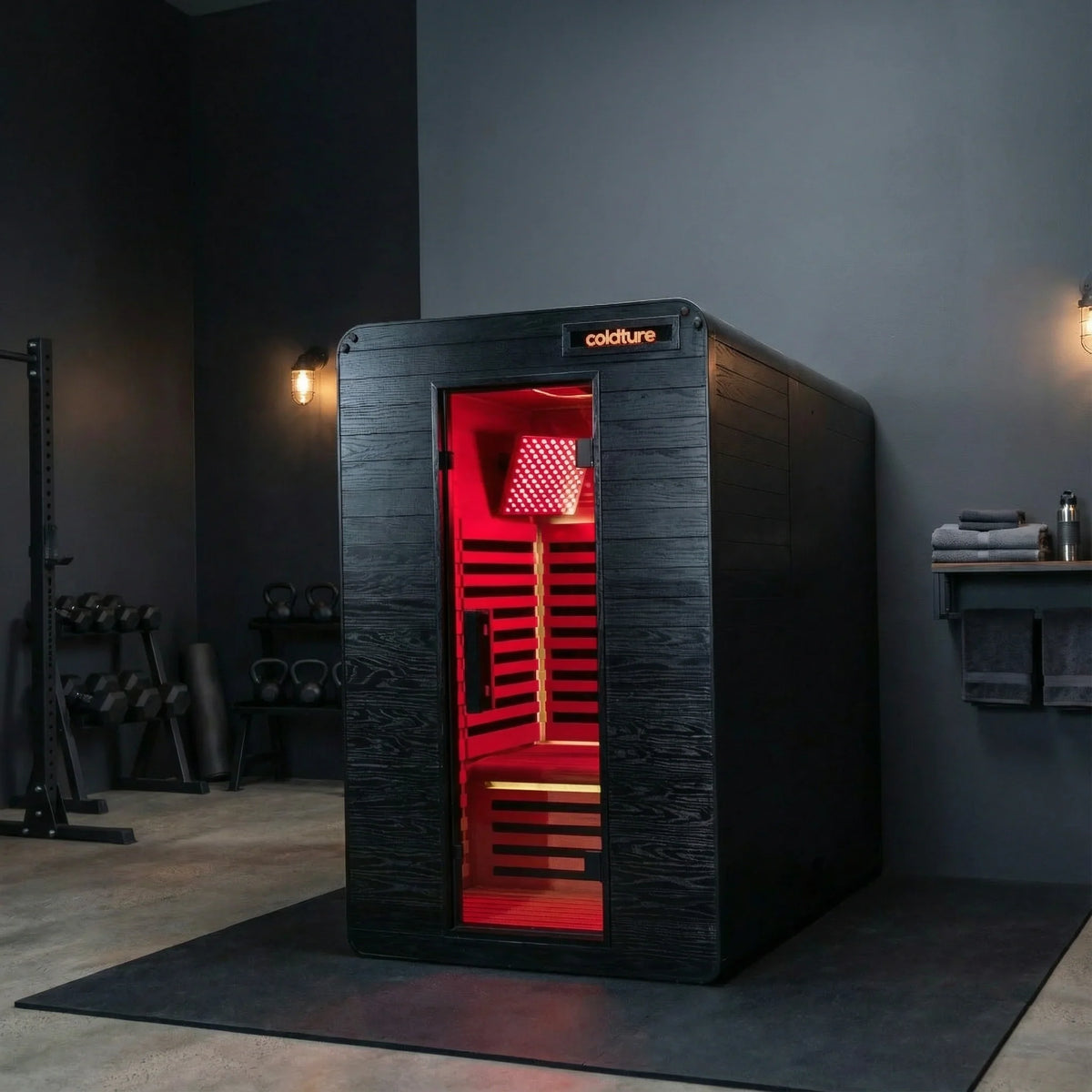
A physician came to see our indoor Pod sauna and paused at the red light panels mounted inside the cabin. Fair question: what is the light doing in there, and is it actually evidence-based?
That hesitation is worth taking seriously. Most red light marketing is vague, and most sauna marketing layers heat and light into a single "treatment" that sounds like more than the science supports. Here is the honest, research-grounded answer, with clear lines drawn between what is well-established, what is plausible, and where the evidence ends.
They are two different mechanisms, and that is the point
The first thing to understand is that infrared heat and red light therapy are not one treatment. They are two separate modalities that happen to share a cabin.
Infrared heat works through thermoregulation. The far-infrared wavelengths (roughly 5,000 to 15,000 nm) raise your core body temperature, triggering a cardiovascular response: increased heart rate, vasodilation, sweating, and heat-shock protein expression. This is the sauna mechanism people have studied for decades.
Red light therapy works through photobiomodulation (PBM), a non-thermal cellular process. Red and near-infrared wavelengths (roughly 630 to 850 nm) interact with cells at the mitochondrial level. The light does not generate heat. It does not raise your core temperature. It operates through an entirely different pathway.
Treating them as one combined "super-treatment" is where marketing gets ahead of the research. The honest framing: two separate tools, one space. Each has its own evidence base, and combining them is a matter of convenience and plausible mechanism, not a proven multiplier.
What red light actually does at the cellular level
Photobiomodulation is not a marketing abstraction. It is a described biochemical pathway with primary literature going back more than two decades.
Red and near-infrared light is absorbed by cytochrome c oxidase, an enzyme in the mitochondrial electron transport chain (Complex IV). This has been established through absorption spectrum and action spectrum studies, most notably by Wong-Riley et al., whose work demonstrated that the action spectrum for LED stimulation of cytochrome c oxidase activity parallels the absorption spectrum for the enzyme itself. That parallel is strong evidence that cytochrome c oxidase is a primary photoacceptor for red-to-near-infrared light.
When the enzyme absorbs photons at these wavelengths, three things happen:
- Mitochondrial membrane potential increases and electron transport accelerates, leading to enhanced ATP production. More cellular energy means the tissue has more resources for repair and maintenance.
- Downstream signaling is triggered in pathways involved in cell survival, proliferation, and tissue repair, including anti-inflammatory and antioxidant responses.
- Pro-inflammatory cytokine activity is modulated, which is why PBM appears in the literature for conditions driven by chronic inflammation.
This is not a single study's finding. It is a described mechanism confirmed across multiple research groups and reviewed extensively. A 2025 umbrella review of randomized clinical trials published in Systematic Reviews evaluated PBM across multiple health outcomes and confirmed both efficacy and a strong safety profile across a broad range of clinical applications.
Where the evidence is strongest
The most mature PBM evidence is in skin and localized superficial tissue, which is also where the mechanism is most straightforward: the wavelengths penetrate skin readily, and the target cells are close to the surface.
The anchor study for skin outcomes is a 2014 randomized controlled trial by Wunsch and Matuschka, published in Photomedicine and Laser Surgery. The trial treated 136 volunteers with polychromatic red and red/near-infrared light (611 to 650 nm and 570 to 850 nm, respectively) and measured outcomes against untreated controls. The results were significant: improved skin complexion, reduced skin roughness, and, critically, increased intradermal collagen density as measured by ultrasound. This was not a subjective survey. It was an objective, instrument-measured outcome.
Beyond skin, PBM evidence has expanded into musculoskeletal pain. A 2026 systematic review pooling 53 clinical studies and roughly 2,800 patients found a 32% average reduction in pain scores across knee osteoarthritis, tendinopathies, low back pain, and post-surgical recovery. Coldture's standalone red light therapy panels hold a Health Canada Class II medical device licence (Licence 116136) specifically for pain relief based on this class of evidence.
An important note on evidence grading: a finding from a localized LED study does not automatically transfer to a whole-body cabin, and a heat study does not establish a light benefit. Read the evidence by study type and modality. That discipline is what separates a credible claim from a marketing one.
Why the pairing makes physiological sense
Given that heat and light are separate mechanisms, why deliver them together?
The answer is in what the heat does to blood vessels. Infrared heat causes vasodilation: wider, more perfused blood vessels throughout the body. That dilation increases blood flow to superficial and deeper tissues, creating better pathways for light energy to reach target cells. In a warm, vasodilated state, the tissue the light acts on is primed with increased oxygen and circulation.
This is a plausible physiological mechanism, not a proven outcome. It makes sense at the cellular level: more blood flow means more chromophore-bearing molecules (like cytochrome c oxidase) are cycling through the treatment field, and the tissue is in a state that plausibly favors photon absorption and downstream signaling.
But that word, "plausibly," matters. No controlled trial has yet isolated simultaneous delivery of heat and PBM and compared it against delivering each separately, with the heat-primed vasodilation as the variable. The mechanism logic is sound. The controlled evidence for the combination as a multiplier does not yet exist.
The honest limit
This is the section most marketing would skip. We would rather include it.
No controlled trial has proven that delivering infrared heat and red light simultaneously outperforms delivering each modality separately. The combination is a reasonable, mechanistically sound convenience. It is not a proven multiplier.
Anyone claiming a guaranteed synergy is ahead of the data. We would rather tell you where the evidence ends than pretend it goes further than it does.
What we can say is this: you are getting two modalities, each with its own evidence base, in one session, in a physiological state (warm, vasodilated) that is plausibly favorable for light therapy. Nothing about the combination introduces additional risk. And the convenience is real: two mechanisms working while you sit still, nothing extra to buy, plug in, or schedule separately.
That is the honest case.
Safety
Safety concerns tend to sit underneath the hesitation, even when the question is framed differently. Here is what the evidence says.
Red light is non-thermal. It adds no heat stress to the sauna environment. Your body is managing the heat load from the infrared panels; the red light panels contribute no additional thermal burden. This is a fundamental property of photobiomodulation as a modality.
PBM has a strong safety profile. Major safety reviews and clinical studies on photobiomodulation consistently rate it as low-risk within recommended parameters. The 2025 umbrella review in Systematic Reviews, which evaluated PBM across multiple clinical domains, confirmed this safety profile across a broad range of applications.
Practical considerations:
Eye exposure. The guidance is straightforward: do not stare directly into bright LEDs at close range. Protective eyewear is available, and simply closing your eyes or looking away from the panel is sufficient. Most sauna users have their eyes closed and relaxed anyway, so in practice this is rarely a concern.
Photosensitizing medication. Some antibiotics (tetracyclines, fluoroquinolones), certain diuretics, retinoids, and other drugs increase light sensitivity. If you take medication regularly, consult your physician before starting red light therapy.
Conservative caution. No evidence suggests PBM promotes malignancy, but a conservative approach avoids direct illumination of known tumors pending further research.
Standard sauna contraindications still apply. Pregnancy, active cardiovascular conditions, recent alcohol use, and dehydration are all reasons to consult a physician before sauna use, with or without red light.
Device quality matters. Low-quality products may emit inappropriate wavelengths or insufficient power density to reach target tissue. The Pod's red light panels deliver 660 nm and 850 nm at measured irradiances (up to ~71 mW/cm² at 6 inches for the large front panel), which is consistent with the wavelengths and power densities used in the clinical literature.
FAQ
What is red light therapy, and how is it different from the infrared heat in the sauna? Infrared heat raises your core body temperature through thermal energy (wavelengths roughly 5,000 to 15,000 nm). Red light therapy uses visible red and near-infrared wavelengths (660 nm and 850 nm in the Pod) at low power densities to trigger a non-thermal cellular response called photobiomodulation. The light is absorbed by mitochondria and enhances ATP production and repair signaling. They are two separate mechanisms.
Is red light therapy actually evidence-based, or is it wellness hype? The mechanism is real and well-characterized. Cytochrome c oxidase has been identified as the primary photoacceptor, and the downstream effects (ATP production, anti-inflammatory signaling, tissue repair) are documented across multiple research groups. The strongest evidence is in skin and localized tissue, including a 136-person RCT showing instrument-measured collagen density increases. Musculoskeletal pain evidence is also substantial, with a 53-study systematic review reporting a 32% reduction in pain scores. The research is real. The key is reading it at the right level: whole-body cabin claims are less proven than localized LED studies.
Do I have to sit with my eyes closed the whole session? No. The guidance is simply to avoid staring directly into bright LEDs at close range. In practice, most people in a sauna have their eyes closed and relaxed. If you prefer to keep your eyes open, face away from the panel or use the goggles included with Coldture red light products. It is not a significant constraint on the experience.
I feel like I am paying extra for something I did not ask for. Is the red light worth it? The red light panels are not a gimmick bolted on to justify a price increase. They deliver a second, genuinely evidence-backed modality in the same footprint and the same session time. A standalone quality red light panel is a separate purchase, a separate piece of equipment, and a separate slot in your routine. Here, it is integrated. Nothing extra to buy, plug in, or make time for. The framing is not "extra you did not want" but "two tools, one footprint, one 20-minute session."
Is it safe to combine heat and light in one session? Yes, for most healthy adults. Red light is non-thermal, so it adds no heat stress to the sauna environment. PBM safety reviews rate the therapy as low-risk across clinical applications. Standard sauna contraindications (pregnancy, cardiovascular conditions, photosensitizing medication, dehydration) still apply. When in doubt, consult your physician.
Does combining them actually work better than doing each separately? No controlled trial has proven that simultaneous delivery outperforms separate use. The combination is mechanistically sound: infrared heat dilates blood vessels, which plausibly creates a better environment for light absorption. But that is a plausible mechanism, not a proven outcome. We state this plainly because honesty about the evidence is more useful to you than an overclaim.
Why the Pod is built this way
The Pod infrared sauna delivers full-spectrum near and far infrared heat (18 to 65°C / 65 to 150°F) alongside integrated red light panels at 660 nm and 850 nm. It runs on a standard 120V / 20A household outlet, seats 1 to 2 people, and is controlled through a touchscreen and the Coldture app. The Corner Pod offers the same pairing in a space-saving footprint with six red light panels for broader coverage.
The design logic is straightforward: two evidence-backed modalities, delivered in one sitting, in a warm state that plausibly favors light absorption, with no added risk from the light itself. One session, roughly 20 minutes. Two mechanisms working while you sit still.
That is not a miracle box. It is a sensible, research-grounded pairing that respects both what the science supports and where it is still forming.
For those already using standalone red light therapy, the red light protocol page covers session timing and sequencing across Coldture's panel lineup.
Browse all Coldture infrared saunas to find the right fit for your space.
This content is educational information, not medical advice. Consult your physician regarding your individual circumstances, especially if you take photosensitizing medication, have a relevant medical condition, are pregnant, or have cardiovascular concerns. Red light therapy and sauna use are complementary wellness practices, not treatments for any disease.
Share:
The Most Proven Use of Red Light Therapy Is Not the One It's Known For
30 Studies Tested Cold Plunging After Exercise. The Timing Changes Everything.