

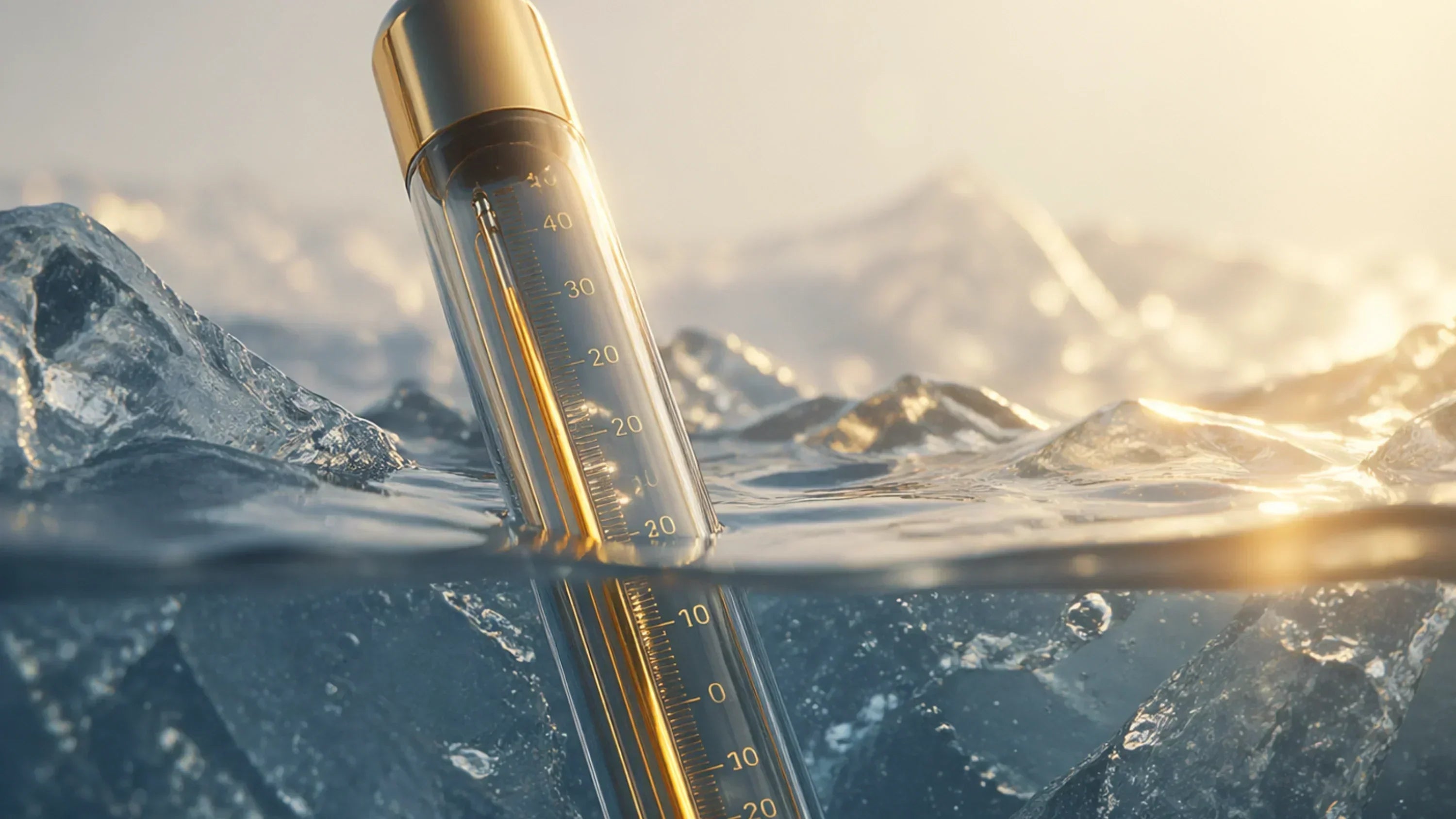
there's a number that shows up everywhere in cold plunge content: 530% norepinephrine spike. it's become one of the most cited stats in the wellness space, shared by podcasters, biohackers, and product brands as proof that cold water immersion produces a massive neurochemical response.
what most people don't mention is the temperature.
it wasn't 2°C. it wasn't 5°C. it wasn't "the coldest you can stand."
it was 14°C. that's 57°F. warmer than most people think counts.
the study behind the number
the data comes from a 2000 study by Šrámek and colleagues, published in the European Journal of Applied Physiology. researchers immersed healthy young men in water at three different temperatures (32°C, 20°C, and 14°C) and measured hormonal and cardiovascular responses.
at 14°C, the results were dramatic: plasma norepinephrine (noradrenaline) concentrations increased by 530% above baseline. plasma dopamine concentrations increased by 250% above baseline. metabolic rate increased by 350%. plasma cortisol actually tended to decrease.
these numbers have become the foundation of virtually every dopamine and norepinephrine claim in the cold plunge space. and they were produced at 14°C, a temperature that most experienced cold plungers would describe as moderate.
there's an important caveat: the immersion duration was one hour, which is far longer than the 2-5 minute sessions most people do. a 1996 study by the same research group (Janský et al.) using the same 14°C, 1-hour protocol found a four-fold increase in norepinephrine but no significant dopamine increase, meaning the exact 250% dopamine figure is one result from one trial in roughly ten people. the norepinephrine response, however, has been replicated consistently across multiple studies and durations, including shorter exposures.
the takeaway isn't that you need an hour in 14°C water. it's that the neurochemical response is triggered by moderate cold, not extreme cold. and that changes how you should think about temperature.
the range that actually works
the majority of cold water research clusters between 10°C and 15°C (50-59°F). this is the temperature band where the evidence is strongest for three key responses:
norepinephrine surge. the neurotransmitter behind alertness, focus, and the sharp, awake feeling after a plunge. consistently documented at 200-530% above baseline in the 10-15°C range, depending on duration and individual variation.
dopamine elevation. the neurotransmitter behind motivation, reward, and sustained well-being. the Søberg et al. 2021 study (Cell Reports Medicine) using 14°C water across an 11-session protocol over five weeks documented sustained dopamine elevation lasting 1-3 hours post-immersion, unlike the spike-and-crash pattern of stimulants.
anti-inflammatory effect. cold-induced vasoconstriction reduces blood flow to damaged tissue, limiting the secondary inflammatory cascade. a 2025 network meta-analysis of 55 RCTs found that immersion at 11-15°C for 10-15 minutes demonstrated the best efficacy for reducing delayed-onset muscle soreness, with a large and statistically significant effect size.
10-15°C is cold enough to trigger the full neurochemical and recovery response. you don't need to go colder to get the benefit. you need to get in the right range and stay long enough.
why colder is not better
this is the part the culture gets wrong.
below 10°C, the neurochemical benefits don't meaningfully increase, but the risks do. the cold shock response intensifies: involuntary gasping, hyperventilation, tachycardia, and the risk of cardiac arrhythmia all climb with lower temperatures. the safety margin narrows significantly.
a review by Tipton et al. (2017) published in Experimental Physiology documented the physiology of cold shock in detail. the authors noted that the initial cardiorespiratory response to cold immersion (the gasp reflex, uncontrolled hyperventilation, and sympathetic activation) is the primary cause of cold-water drowning and cardiac events in otherwise healthy individuals. this response is most dangerous in the first 1-3 minutes of immersion and is more severe in colder water.
past a certain threshold, colder just means more risk and more pain, not more result. the neurochemical response at 8°C is not meaningfully larger than at 12°C, but the cardiovascular strain is substantially higher. the dose-response curve flattens while the risk curve steepens.
this doesn't mean sub-10°C immersion is worthless. experienced cold plungers who have built tolerance over months can use colder water safely and may prefer the intensity. but for the vast majority of people, particularly beginners, 10-15°C delivers the full benefit with a far wider safety margin.
temperature is a dial, not a number
the most useful way to think about cold plunge temperature is as a tool you set to your goal, not a bragging number.
recovery and neurochemical benefits (10-15°C / 50-59°F). this is the research-supported sweet spot. cold enough to trigger the full norepinephrine and dopamine response, the vascular pumping effect, and the anti-inflammatory cascade. warm enough to sustain a 2-5 minute session safely and consistently.
beginners building tolerance (14-15°C / 57-59°F). start at the warmer end of the effective range and work down over weeks. 14°C is the exact temperature that produced the most cited results in the literature. there is nothing wrong with staying there permanently.
calm and wind-down (15-18°C / 59-64°F). slightly warmer water still triggers a meaningful autonomic response but with less sympathetic activation. useful for evening sessions where you want the thermoregulatory cooling benefit for sleep without an aggressive stress response before bed.
maximum intensity (5-10°C / 41-50°F). for experienced practitioners who have built tolerance over months and want a stronger stimulus. shorter sessions (30-90 seconds) are appropriate at these temperatures. not recommended for beginners, anyone with cardiovascular conditions, or anyone plunging alone.
the temperature your plunge is set to should reflect what you're trying to achieve, not what looks impressive on social media. Coldture's cold plunge protocol breaks this down further with exact temperature, duration, and frequency for each goal (recovery, mood, immunity, metabolic adaptation), sourced to the primary study behind every number.
what actually matters most: total cold dose
here's where the research has gotten most interesting in recent years.
dr. Susanna Søberg's research at the Søberg Institute, published in Cell Reports Medicine (2021) and popularized through her collaboration with Stanford's Andrew Huberman, introduced a concept that's reshaped how practitioners think about cold exposure: total cold dose.
total cold dose is temperature multiplied by duration, accumulated over a week. the minimum effective threshold from Søberg's research: 11 minutes of total cold exposure per week, split across 2-4 sessions, at temperatures of 10-15°C. this produced measurable improvements in brown fat activation, insulin sensitivity, and cold-induced thermogenesis in healthy winter swimmers.
the implication is profound: consistency and accumulated dose matter more than any single session. a controlled 3 minutes at 12°C, done four times per week, beats a panicked 30 seconds at 2°C done once. the body adapts to the total stimulus over time. the temperature needs to be cold enough to trigger the response (10-15°C clears that bar), but beyond that threshold, duration and frequency are the variables that drive long-term adaptation.
Huberman's synthesis of this research into a practical protocol: 11 minutes total per week, split into 2-4 sessions of 2-5 minutes each, at a temperature that feels "uncomfortably cold but safe to stay in." not extreme. not heroic. consistent and controlled.
Coldture built this research into a structured resource: the cold plunge protocol breaks the evidence into goal-specific doses (recovery, mood, immunity, metabolic adaptation) with the exact temperature, duration, frequency, and study behind every number. it also includes a 4-week ramp-up for beginners that starts at 15°C and works down to the full research window by week four. if the science on this page resonates and you want to know exactly how to apply it, that's the place to start.
if you're new to cold plunging, the Coldture cold plunge protocol includes a 4-week ramp-up that starts at 15°C for 60-90 seconds and builds to the full 11-12°C research window by week four. it also covers the five foundational rules that sit under every goal-specific dose: temperature accuracy, duration, breath control, knowing when to get out, and passive rewarming.
why temperature control matters
the research consistently uses controlled, constant water temperatures. 14°C means 14°C for the entire session. not 14°C when you get in and 18°C by the time you get out.
ice baths are inherently inconsistent. ice melts at different rates depending on ambient temperature, water volume, and how long you've been in. the temperature you start at is not the temperature you finish at. that variability makes it harder to find your effective range, harder to track adaptation, and harder to replicate the conditions that produced results in the studies.
Coldture cold plunge systems hold exact temperature from 3°C to 40°C via app control. if your protocol calls for 14°C, you set 14°C and that's what you get. every session. the pro plunge adds wi-fi control and continuous filtration for permanent installation. the classic and barrel bundles pair a portable, insulated tub with the water chiller pro for the same precision on a standard 110V outlet.
the ability to set a specific temperature and know it will hold there, session after session, week after week, is what allows you to build a protocol rather than guess at one.
colder is not the flex. controlled and consistent is.
the foundational cold plunge study used 14°C water and produced the neurochemical response that launched an entire industry. most cold water research sits between 10°C and 15°C. the minimum effective weekly dose is 11 minutes, accumulated across multiple sessions. and the dose-response relationship rewards consistency far more than intensity.
the best temperature is the one you'll actually get into, again and again. set it. hold it. show up. let the total dose compound.
general wellness information, not medical advice. cold immersion carries risks. if you have any cardiovascular condition or are pregnant, consult your doctor first. never plunge alone when starting out.
Coldture cold plunge systems hold exact temperature from 3°C to 40°C via app control. set your target. the chiller holds it. every session, every week. read the full cold plunge protocol for exact doses by goal, or shop cold plunges.
sources
-
- Šrámek P, Šimečková M, Janský L, Šavlíková J, Vybíral S. "Human Physiological Responses to Immersion into Water of Different Temperatures." European Journal of Applied Physiology, 2000; 81(5):436-442.
- Janský L, Šrámek P, Šavlíková J, Uličný B, Janáková H, Horký K. "Change in Sympathetic Activity, Cardiovascular Functions and Plasma Hormone Concentrations Due to Cold Water Immersion in Men." European Journal of Applied Physiology, 1996.
- Søberg S, Löfgren J, Philipsen FE, et al. "Altered Brown Fat Thermoregulation and Enhanced Cold-Induced Thermogenesis in Young, Healthy, Winter-Swimming Men." Cell Reports Medicine, 2021; 2(10):100408.
- Wang S et al. "Impact of Different Doses of Cold Water Immersion on Recovery from Acute Exercise-Induced Muscle Damage: A Network Meta-Analysis." Frontiers in Physiology, 2025.
- Tipton MJ, Collier N, Massey H, Corbett J, Harper M. "Cold Water Immersion: Kill or Cure?" Experimental Physiology, 2017; 102(11):1335-1355.
- Huberman A. "The Science and Use of Cold Exposure for Health and Performance." Huberman Lab Newsletter, 2022.
Share:
the viral 86% microplastic claim, what the research actually supports, and what your sweat is quietly carrying out
adding 15 minutes of sauna after your workout doubled the cardiovascular gain in an 8-week trial