


TL;DR:
- Cold exposure activates brown fat and enhances metabolic health similar to caloric restriction.
- In animals, cold exposure has been shown to extend lifespan by 10-30 percent.
- Human benefits include improved insulin sensitivity, reduced inflammation, and faster recovery, but lifespan extension remains unproven.
Cold therapy has long been the go-to tool for sore muscles and post-workout recovery. But a growing body of research now connects deliberate cold exposure to something far more significant: the biological pathways that govern how we age. From activating metabolically active fat tissue to triggering cellular cleanup processes, cold exposure touches systems that longevity scientists care deeply about. This guide breaks down the actual mechanisms, separates animal data from human evidence, and gives you a clear, safety-first protocol so you can decide how cold therapy fits into your long-term wellness stack.
Table of Contents
- How cold therapy works in the body
- Evidence from longevity research: What the science says
- Healthspan benefits: Metabolic, inflammatory, and recovery effects
- How to apply cold therapy safely: Protocols and risks
- A fresh perspective: Why cold therapy’s promise for longevity shouldn’t be overstated
- Enhance your wellness journey with cold therapy solutions
- Frequently asked questions
Key Takeaways
| Point | Details |
|---|---|
| Metabolic boost | Cold therapy activates brown fat, raising energy use and improving glucose management. |
| Inflammation reduction | Consistent cold exposure decreases inflammatory markers and enhances recovery. |
| Longevity science gap | While animal studies show lifespan extension, human evidence is limited to improved healthspan. |
| Safety first | Cold therapy carries risks for certain groups; start slowly and individualize protocols. |
| Practical integration | You can harness cold therapy’s benefits with thoughtful, evidence-based routines at home. |
How cold therapy works in the body
To understand why cold exposure might matter for longevity, you need to understand what it actually does inside your cells and tissues. The effects go well beyond numbing soreness.
Brown adipose tissue (BAT) is the first major player. Unlike white fat, which stores energy, BAT burns it to generate heat. Cold exposure activates brown adipose tissue, improving metabolic health and energy expenditure in ways that mirror what we see with caloric restriction, one of the most studied longevity interventions. When BAT activity increases, so does insulin sensitivity and glucose control.
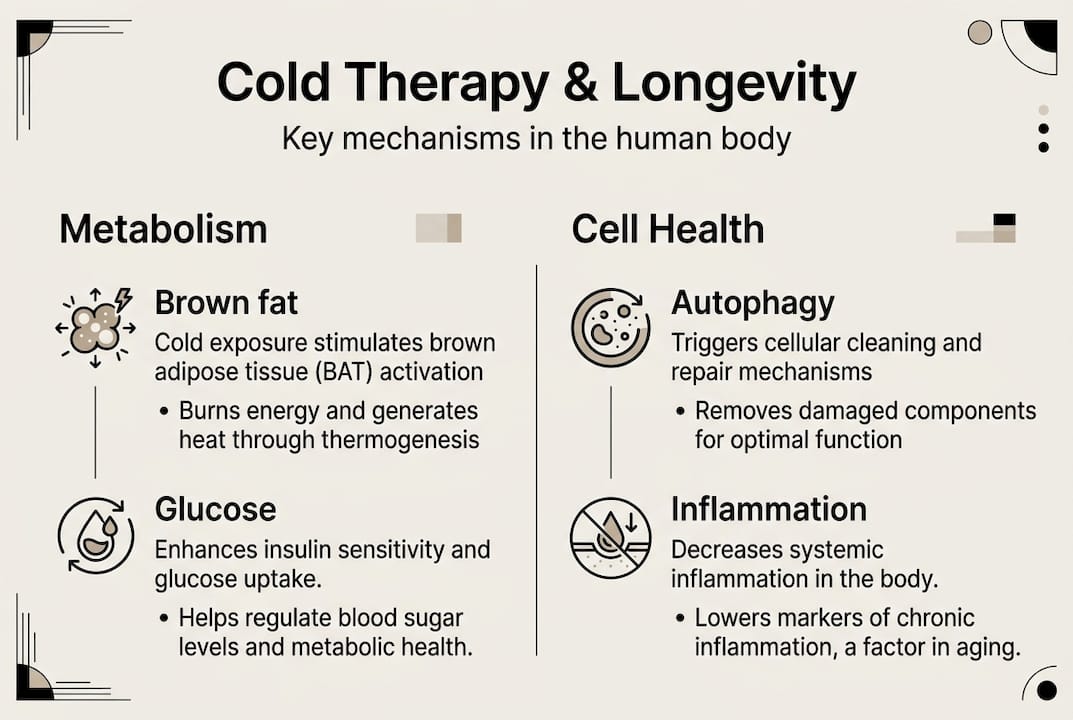
Cold also triggers non-shivering thermogenesis, a process where your body ramps up calorie burn without muscle contractions. This metabolic shift is subtle but consistent, and it compounds over repeated exposures.
The mechanisms of cold therapy also include a meaningful impact on inflammation. Cold modulates cytokine balance, boosting anti-inflammatory IL-10 while suppressing pro-inflammatory signals like IL-1β and TNF-alpha. Chronic low-grade inflammation is one of the central drivers of biological aging, so this effect matters.
Finally, short-term cold exposure appears to upregulate autophagy, your cells’ internal recycling system. Autophagy clears out damaged proteins and organelles, and its decline is closely linked to aging-related disease.
Here’s a quick summary of the core mechanisms:
| Mechanism | Effect on the body | Longevity relevance |
|---|---|---|
| BAT activation | Increases energy burn, improves insulin sensitivity | Mirrors caloric restriction benefits |
| Non-shivering thermogenesis | Raises metabolic rate | Supports metabolic health |
| Cytokine modulation | Reduces inflammatory markers | Combats inflammaging |
| Autophagy upregulation | Clears damaged cellular components | Slows cellular aging |
Key physiological responses to cold exposure:
- Norepinephrine release (up to 300% increase)
- Improved mitochondrial efficiency
- Reduced oxidative stress markers
- Enhanced vascular tone and circulation
“Cold exposure is one of the few non-pharmacological tools that simultaneously targets metabolism, inflammation, and cellular maintenance, three pillars of the aging process.” — Longevity researcher perspective, 2025
Choosing the right ideal cold plunge temperatures is part of making these mechanisms work for you rather than against you.
Evidence from longevity research: What the science says
Now that we know how cold therapy acts on the body, what can we actually prove about its effects on aging and longevity?
The honest answer is: it depends on which organism you’re studying. The evidence splits sharply between animal models and human trials, and conflating the two is one of the most common mistakes in wellness media.
In model organisms, the data is striking. Lifespan extension via cold exposure has been documented in worms, flies, and rodents, with increases ranging from 10 to 30%. The mechanisms include reduced metabolic rate, lower oxidative stress, and activation of protective pathways like FOXO and AMPK signaling. These are the same pathways that caloric restriction and certain longevity drugs target.
In humans, the picture is more nuanced. Cold water immersion improves autophagic function, and short-term studies consistently show improvements in metabolic markers, inflammation, and recovery. But no human trial has demonstrated a direct increase in lifespan from cold exposure. The leap from “improves health markers” to “extends life” is significant, and the science hasn’t made it yet.
| Evidence type | Lifespan effect | Health markers | Key risks |
|---|---|---|---|
| Animal studies | 10-30% extension documented | Strong improvements | Not directly applicable to humans |
| Human studies | Not confirmed | Measurable improvements | Cardiovascular stress, hypothermia |
What the scientific consensus currently supports:
- Cold exposure reliably activates BAT and improves insulin sensitivity in humans
- Inflammation markers improve with regular sessions
- Autophagy is upregulated after cold water immersion
- Longevity pathways (AMPK, FOXO) are activated, but outcomes are unproven
- Direct lifespan extension in humans remains unconfirmed
For athletes and biohackers, this distinction matters. The cold exposure and resilience benefits are real and well-supported. The longevity angle is promising but still theoretical in humans. Both are worth knowing.
Healthspan benefits: Metabolic, inflammatory, and recovery effects
Even if lifespan extension hasn’t been shown in humans yet, cold therapy delivers measurable healthspan and recovery improvements that are worth taking seriously.
The inflammation data is particularly compelling. Cold therapy reduces markers of inflammation and improves recovery for athletes, according to a recent meta-analysis. Specifically, regular cold exposure lowers IL-1β and other pro-inflammatory cytokines while raising IL-10, an anti-inflammatory signal. This cytokine shift is exactly what you want if your goal is to reduce the low-grade chronic inflammation that accelerates biological aging.

On the metabolic side, repeated cold exposure improves glucose control and insulin sensitivity, particularly in people who have acclimated over several weeks. Some research also points to modest fat loss, driven by BAT activation and increased calorie burn. These are not dramatic effects, but they are consistent and clinically meaningful.
For physical recovery, the benefits are well established. Less muscle soreness, faster return to baseline performance, and reduced perceived fatigue are all documented outcomes of regular cold water immersion. This is why cold plunge routines for athletes have become standard practice at the elite level.
Key health benefits of regular cold therapy:
- Reduced delayed onset muscle soreness (DOMS)
- Improved insulin sensitivity and glucose metabolism
- Lower systemic inflammation markers
- Enhanced mood and mental resilience via norepinephrine release
- Better sleep quality reported in several observational studies
- Faster recovery between training sessions
Pro Tip: Personalize your protocol based on your primary goal. If recovery is the priority, aim for 50 to 59°F for 5 to 10 minutes post-training. If metabolic health is the focus, morning sessions before eating may amplify BAT activation.
How to apply cold therapy safely: Protocols and risks
Optimizing healthspan is about balance. Here’s how you can harness the benefits of cold exposure while minimizing its risks.
A practical starting protocol:
- Start mild: Begin at 60 to 65°F for 2 to 3 minutes, 2 to 3 times per week
- Acclimate gradually: Drop temperature by 2 to 3°F each week as your body adapts
- Target range: Work toward 50 to 59°F for 5 to 10 minutes per session
- Warm up naturally: Allow your body to rewarm on its own rather than jumping into a hot shower immediately after
- Track your response: Note energy, mood, and recovery quality to gauge what works for you
Not everyone should be in a cold plunge. Cold therapy can induce cardiovascular stress and is contraindicated for people with heart disease or Raynaud’s syndrome. The sudden drop in skin temperature causes vasoconstriction and a spike in blood pressure, which is manageable for healthy individuals but genuinely dangerous for vulnerable populations.
Epidemiological data also shows that cold climates correlate with higher cardiovascular mortality in older adults and those with pre-existing conditions, a reminder that cold exposure is a stressor, not a universal good.
Contraindications to be aware of:
- Heart disease or arrhythmia
- Raynaud’s syndrome or cold urticaria
- Uncontrolled hypertension
- Peripheral vascular disease
- Pregnancy (consult your provider)
For a full breakdown of safety considerations, are cold plunges safe covers the evidence in detail. You can also review cold plunge methods across different protocols to find what fits your situation.
Pro Tip: If you have any cardiovascular history or take blood pressure medication, get medical clearance before starting cold therapy. The benefits are real, but they are not worth gambling your heart health over.
A fresh perspective: Why cold therapy’s promise for longevity shouldn’t be overstated
Here’s the honest take that most cold therapy content skips: the longevity narrative around cold exposure is running ahead of the evidence.
Most biohackers and performance-focused athletes now use cold therapy for a competitive edge, and that’s completely valid. The metabolic, inflammatory, and recovery benefits are well-documented. But the jump to “cold therapy extends human lifespan” is a story built on animal data and mechanistic plausibility, not human trials. That gap matters.
What we’ve learned from working with serious wellness practitioners is that the people who benefit most from cold therapy are those who treat it as one tool in a larger system, not a silver bullet. They pair it with quality sleep, sound nutrition, and stress management. They respect their individual risk factors. They focus on how they feel and perform over months, not on abstract longevity metrics.
The strongest case for deliberate cold exposure is healthspan, not lifespan. More energy, better recovery, sharper mental clarity, and reduced inflammation. Those outcomes are achievable and measurable right now.
“The goal isn’t just more years. It’s better years. Cold therapy, used wisely, contributes to the quality of life that makes longevity worth pursuing.” — Coldture Wellness Team
Chase the healthspan wins. Let the lifespan data catch up.
Enhance your wellness journey with cold therapy solutions
If you’re ready to experiment with cold therapy safely and effectively, the right equipment makes a real difference in consistency and results.
At Coldture, we design cold plunges built for people who take their recovery and longevity seriously. Whether you want a permanent home setup or something more flexible, you can shop cold plunges across a range of sizes and configurations. If space or portability is a factor, our portable cold plunge options bring the same evidence-based experience without the footprint. Every product is designed to make precise temperature control easy, so your protocol stays consistent and your results stay measurable.
Frequently asked questions
What is the safest way to start cold therapy?
Begin with short exposures at mild temperatures and slowly increase duration as tolerated, stopping if you feel discomfort or numbness. Gradual acclimation to cold reduces risk and maximizes benefit over time.
Can cold therapy actually make you live longer?
There’s promising data from animal studies, but no human trials have shown direct lifespan extension from cold exposure. Cold exposure extends lifespan in model organisms like worms and rodents, but this has not been confirmed in humans.
How often should you do cold therapy for benefits?
Studies support 2 to 4 sessions per week for improved inflammation, recovery, and metabolic health. Regular cold water immersion shows measurable healthspan improvements when practiced consistently.
Who should avoid cold therapy?
People with heart disease, Raynaud’s syndrome, or known cold allergies should not try cold therapy without medical supervision. Contraindications include heart disease and Raynaud’s phenomenon, where cold exposure poses genuine cardiovascular risk.
Are cold plunges or cryotherapy safer?
Both can be safe when protocols are followed, but cold plunges allow more control over temperature and duration. Cold plunges at 50 to 59°F are well-studied and offer more precise adjustment than whole-body cryotherapy chambers.
Share:
Why muscle recovery matters: boost performance & prevent injuries
Active Recovery: Boost Wellness and Speed Muscle Repair