

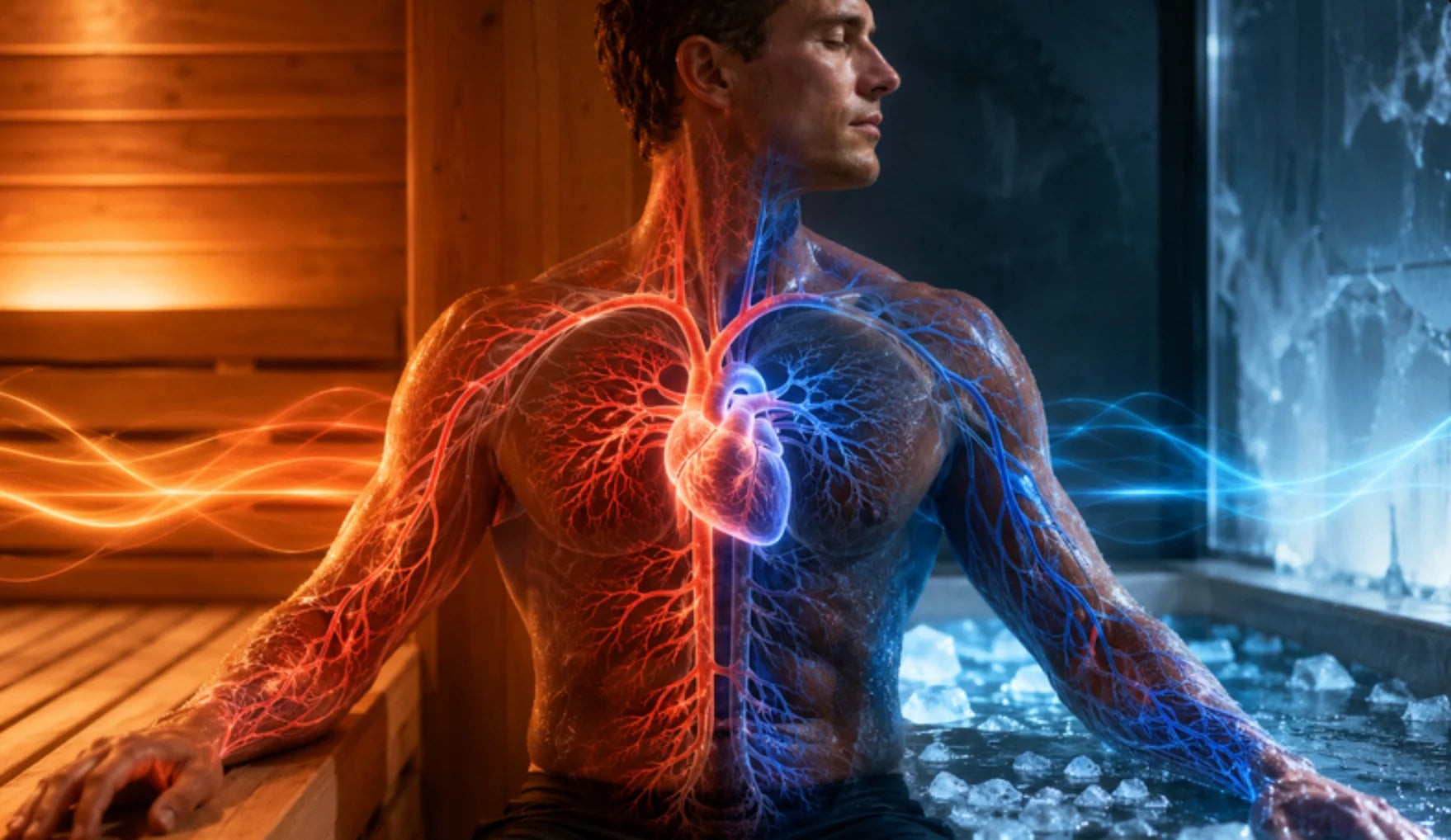
you've probably seen the clips. an athlete steps out of a sauna, walks ten feet, and drops into a cold plunge. climbs out. goes back to the sauna. repeats.
it looks extreme. maybe performative. but the reason elite athletes have built their entire recovery infrastructure around this cycle isn't aesthetic. it's physiological. and the research behind it has reached a level of depth and replication that makes contrast therapy one of the most evidence-supported recovery protocols available.
here's what's actually happening when you alternate between heat and cold, what the peer-reviewed research says about who benefits, and why this protocol is increasingly being adopted by people who have never set foot on a professional playing field.
what contrast therapy is
contrast therapy is the deliberate alternation between heat exposure and cold exposure in a single session. the most common format is moving between a sauna (80-100°C traditional or 45-65°C infrared) and a cold plunge (5-15°C), typically for 2-4 cycles.
the concept is ancient. finnish sauna culture has included cold water immersion between sauna rounds for centuries. japanese onsen traditions alternate between hot and cold pools. russian banya involves birch branch stimulation and cold water plunges between steam rounds. what modern research has done is explain why these cultures landed on the same protocol independently: because the vascular, neurological, and inflammatory responses to alternating thermal extremes produce measurable recovery benefits that neither heat nor cold achieves alone.
 the vascular pump: what happens in your blood vessels
the primary mechanism of contrast therapy is the vasoconstriction-vasodilation cycle.
when you sit in a sauna, your blood vessels dilate. blood flow increases to the skin and extremities. circulation expands. tissues receive more oxygen and nutrients while metabolic waste products are mobilized for clearance.
when you step into cold water, the opposite happens instantly. blood vessels constrict. blood flow redirects away from the surface toward vital organs. inflammation compresses. edema reduces.
repeating this cycle creates a rhythmic pumping action in your vascular system. a study measuring blood flow during contrast therapy found that arterial blood flow increased by 200-300% above baseline during the warm phase, then dropped to 30-40% below baseline during the cold phase. each transition amplifies the pump.
dr. babak shadgan, professor of orthopaedics at the University of British Columbia and chair of United World Wrestling's Medical Commission, describes it as a "vascular pumping effect" in which the alternating temperatures flush metabolic waste while simultaneously delivering oxygen and nutrients to fatigued muscles. his research published in the Journal of Athletic Training confirmed the physiological basis and called for continued investigation into optimal protocols.
the net result: tissue that's been flushed and resupplied. reduced swelling. faster clearance of the inflammatory byproducts that cause soreness. it's a mechanical recovery process driven by temperature, not supplements.
the meta-analytic evidence
the clinical evidence for contrast therapy has matured beyond individual studies into systematic reviews and meta-analyses, the highest tier of evidence-based assessment.
a systematic review and meta-analysis published in PLOS ONE (Bieuzen et al., 2013) examined the effect of contrast water therapy on recovery from exercise-induced muscle damage across 13 studies. the pooled analysis found that contrast therapy produced significantly greater reductions in muscle soreness at every follow-up time point (under 6 hours, 24, 48, 72, and 96 hours) compared to passive recovery. it also significantly reduced muscle strength loss at every follow-up interval.
a systematic review and meta-analysis in the Journal of Strength and Conditioning Research (Higgins et al., 2017) focused specifically on recovery from team sport. the researchers found that both cold water immersion and contrast therapy significantly reduced DOMS, cleared blood lactate, lowered serum creatine kinase levels (a direct blood marker of muscle damage), and helped preserve VO2 max compared to active recovery and control groups.
a 2018 systematic review in Frontiers in Physiology provided an evidence-based framework for choosing post-exercise recovery techniques. the researchers recommended a periodized approach using cooling first (to limit secondary inflammatory damage) followed by heating (once the inflammatory cascade diminishes), recognizing that the timeline and functional properties of the inflammatory response make contrast therapy an appropriate strategy to navigate both phases.
who uses it: from professional locker rooms to home setups
contrast therapy has been standard practice in professional sports recovery suites for decades. but what's changed in the last few years is accessibility. the same protocol that used to require a $200,000 facility installation now fits in a spare room or backyard.
in professional sport: NBA teams have made contrast therapy a post-game standard. golden state warriors players have been documented cycling through 3-minute cold plunges at 4-6°C alternating with 15-minute infrared sauna sessions across multiple rounds. lebron james reportedly invests approximately $1.5 million annually in recovery infrastructure, with contrast therapy as a core protocol. cristiano ronaldo's recovery routine famously includes late-night ice bath and sauna cycles. NFL teams like the patriots and seahawks have built comprehensive recovery suites with contrast therapy as a centerpiece. professional rugby, particularly in new zealand and the english premiership, has standardized alternating cold and hot immersion as post-match protocol.
the common pattern across these athletes and organizations: 10-15 minutes in the cold plunge + 15-20 minutes in the sauna, repeated for 2-3 cycles, multiple times per week. this aligns closely with the protocols used in the clinical research.
for everyday people: you don't need to be a professional athlete to benefit from contrast therapy. the vascular pumping mechanism, the inflammatory modulation, and the autonomic nervous system training work the same way regardless of whether the exercise stress came from an NFL game or a morning gym session.
the person who trains 4-5 days per week, sits at a desk all day, sleeps poorly in the summer heat, and carries chronic tension in their shoulders and lower back is dealing with the same physiological challenges as a professional athlete, just at a different scale. the recovery tools that work for elite performers work for everyone. the only difference is accessibility.
 beyond soreness: what else contrast therapy does
the vascular pump and DOMS reduction are the most studied outcomes. but contrast therapy produces several additional effects that compound with consistent use.
lymphatic drainage. your lymphatic system, the body's waste removal network, has no central pump. it relies on muscle contraction, breathing, and external pressure changes to move lymph through its vessels. the rhythmic vasoconstriction-vasodilation cycle of contrast therapy creates pressure changes in surrounding tissues that mechanically drive lymphatic flow without requiring active movement. this is why people describe feeling "lighter" and less puffy after contrast sessions.
heart rate variability (HRV). HRV is one of the strongest biomarkers of recovery readiness and autonomic nervous system flexibility. contrast therapy trains the autonomic transition directly: heat activates the sympathetic branch, cold triggers a sharp sympathetic response followed by parasympathetic recovery, and each cycle is a complete round trip through activation and recovery. over time, this training effect improves how quickly and efficiently your nervous system shifts between states. research on regular cold exposure has shown improved vagal tone and increased baseline HRV, and sauna use independently shifts autonomic balance toward parasympathetic dominance post-session. combining both modalities accelerates the adaptation.
stress resilience. every contrast session is a voluntary exposure to controlled discomfort. heat pushes your thermoregulatory system. cold pushes further. the transition between extremes demands that your body mobilize a stress response and recover from it, repeatedly. this is hormesis: the adaptive response to repeated controlled stress that leaves the system more resilient. after weeks of consistent practice, the stress response still fires, but recovery is faster. people describe this as becoming "harder to rattle."
sleep quality. the core temperature drop after a contrast session (particularly when ending with cold) mirrors the thermoregulatory signal the brain uses to initiate deep sleep. timing a contrast session 1-2 hours before bed amplifies the natural temperature decline that triggers melatonin production and slow-wave sleep onset.
the protocol
contrast therapy is straightforward, but the details determine whether you get clinical-grade results or a pleasant but ineffective experience.
order: start with heat, end with cold. heat primes the vasodilation response, warms tissue, and mobilizes blood flow. cold provides the constriction that drives the pumping effect and finishes the session in a recovery-promoting state. ending with cold also supports the core temperature drop that benefits sleep when sessions are done in the evening.
heat phase: 15-20 minutes. this is the standard sauna session length supported by the cardiovascular and endocrine research. 80-100°C for traditional finnish heat. 45-65°C for infrared. both raise core temperature effectively.
cold phase: 2-5 minutes. 10-15°C is the range most consistently supported by the meta-analyses for soreness reduction and inflammatory modulation. shorter sessions (1-2 minutes) work well for beginners. extend to 3-5 minutes as tolerance builds.
cycles: 2-4 rounds. each transition amplifies the vascular pumping effect. the research and professional protocols both converge on 2-3 full rounds as the sweet spot.
frequency: 3-5 sessions per week. the autonomic training, HRV improvement, and stress resilience benefits are dose-dependent and compound with consistency.
 why having both at home changes everything
the biggest barrier to consistent contrast therapy isn't willpower. it's logistics.
if your sauna and cold plunge aren't in the same space, or if either one requires significant prep time, the friction wins. the protocol requires moving between hot and cold quickly, ideally within the same minute. driving to a gym or spa eliminates the seamlessness that makes the cycle work.
this is why having both sides of the equation at home, ready at temperature and a few steps apart, is what turns contrast therapy from something you try occasionally into something you do daily.
the Coldture contrast recovery bundle puts both halves of the contrast cycle in one setup: the pod lite infrared sauna (full-spectrum infrared up to 65°C, canadian hemlock, low-EMF, touchscreen and app control) paired with the classic cold plunge bundle (chiller pro holds 3°C to 40°C continuously, app controlled, 400L capacity, outdoor rated to -10°C). both run on standard 120V outlets. no electrician. no dedicated circuits. no installation. the bundle is $5,999, which is $2,000 less than buying them separately. available in natural wood or black sauna finish.
the point isn't the savings, though. it's the seamlessness. two units, a few steps apart, both holding temperature around the clock. step out of the sauna, step into the plunge, and repeat. no ice runs, no long preheat, no barriers between you and the protocol.
that's not a spa routine. that's a vascular workout.
contrast therapy works because it exploits the most fundamental vascular response your body has. heat opens. cold closes. the cycle repeats. and every system that depends on circulation, lymphatic flow, nervous system flexibility, and stress resilience benefits from the repetition.
it's used by the highest-performing athletes on the planet because it works. and it's increasingly used by everyday people because the barrier to access has dropped. the research is there. the protocol is simple. and the tools are finally accessible enough to make it a daily habit.

the Coldture contrast recovery bundle pairs the pod lite infrared sauna with the classic cold plunge bundle for $5,999 (save $2,000). both run on standard 120V outlets. available in natural wood or black. shop the bundle.
sources
- Bieuzen F, Bleakley CM, Costello JT. "Contrast Water Therapy and Exercise Induced Muscle Damage: A Systematic Review and Meta-Analysis." PLOS ONE, 2013.
- Higgins TR, Greene DA, Baker MK. "Effects of Cold Water Immersion and Contrast Water Therapy for Recovery from Team Sport: A Systematic Review and Meta-Analysis." Journal of Strength and Conditioning Research, 2017.
- Dupuy O et al. "An Evidence-Based Approach for Choosing Post-Exercise Recovery Techniques to Reduce Markers of Muscle Damage, Soreness, Fatigue, and Inflammation: A Systematic Review With Meta-Analysis." Frontiers in Physiology, 2018.
- Shadgan B et al. "Contrast Baths, Intramuscular Hemodynamics, and Oxygenation." Journal of Athletic Training, 2018.
- Bleakley CM, Davison GW. "What Is the Biochemical and Physiological Rationale for Using Cold-Water Immersion in Sports Recovery?" British Journal of Sports Medicine, 2010.
- Laukkanen JA et al. "Cardiovascular and Other Health Benefits of Sauna Bathing: A Review of the Evidence." Mayo Clinic Proceedings, 2018.
Share:
PEMF therapy, explained: what pulsed electromagnetic fields actually do and what the research supports
the viral 86% microplastic claim, what the research actually supports, and what your sweat is quietly carrying out