


Most people assume the hospital is the safest place to recover. The equipment, the staff, the round-the-clock monitoring — it feels like the obvious choice. But the evidence tells a different story. Research increasingly shows that why choose at-home recovery is a question worth asking seriously, because home-based care can match or outperform traditional inpatient stays on outcomes that actually matter. For athletes managing overuse injuries, professionals squeezing rehab into packed schedules, and anyone trying to build a sustainable wellness practice, at-home recovery is not a compromise. It may be the smarter call.
Why at-home recovery deserves your serious consideration
At-home recovery is exactly what it sounds like: structured, supervised rehabilitation and recuperation carried out in your own living space rather than a clinical setting. What it is not is passive rest on the couch. Done right, it involves scheduled exercises, caregiver support, environmental adaptations, professional check-ins, and purpose-built tools that support the body’s natural repair process.
The benefits of home recovery go beyond comfort. A 2024 study in JAMA Network Open found that hospital-at-home patients had lower mortality (0.4% vs 3.6%) and fewer emergency department visits within 30 days of discharge (8.8% vs 10.0%). Those are not marginal differences. That is a meaningful safety signal pointing toward at-home care as a genuine clinical option, not just a convenience play.
Here is what the at-home recovery model actually delivers:
- Familiar environment: Your home reduces psychological stress, which directly supports immune function and sleep quality, two pillars of physical recovery
- Personalized pacing: Recovery sessions fit your energy levels, not a hospital shift schedule
- Greater activity: Patients recovering at home move more naturally throughout the day, which accelerates functional restoration
- Reduced exposure risk: Avoiding hospital settings lowers your contact with drug-resistant infections, a real and underappreciated risk during recovery
- Higher patient satisfaction: Studies consistently show people prefer home-based care and report better quality of life during recovery
Understanding why investing in recovery benefits your long-term performance is the first step to treating recovery as a discipline rather than a waiting period.
The role of caregivers and home environment in effective recovery
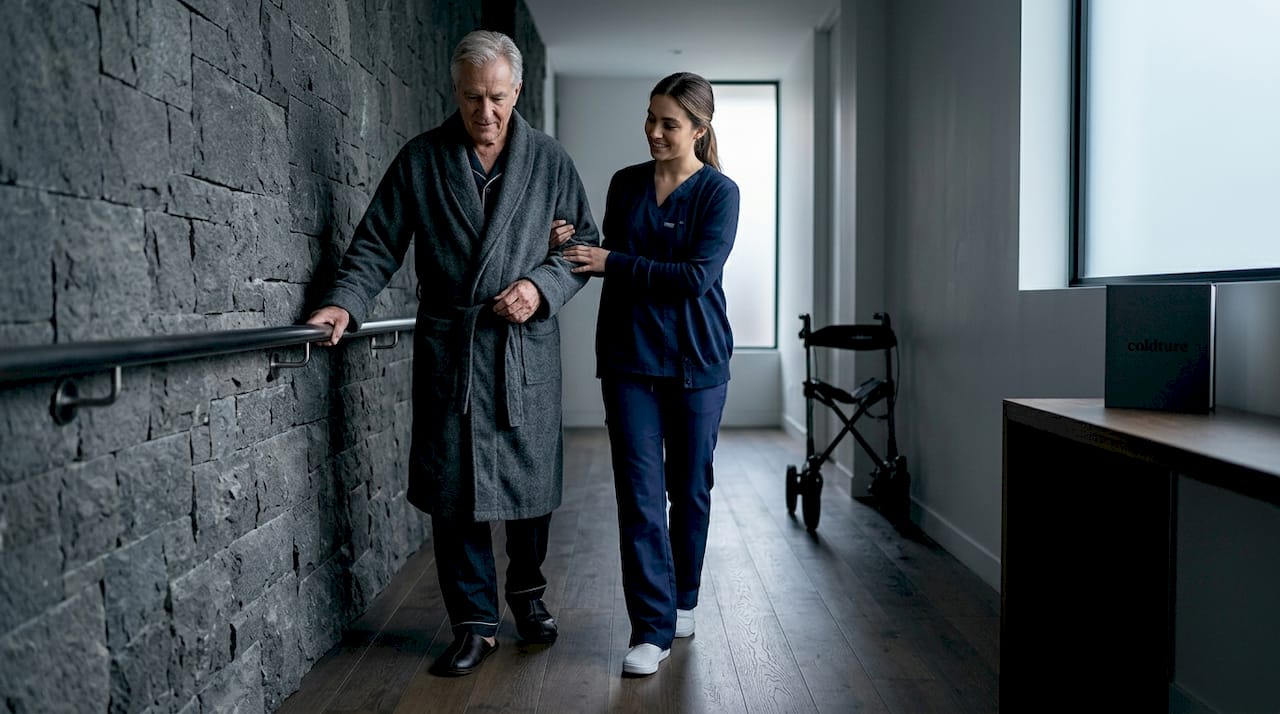
One of the most overlooked at-home recovery advantages is the human element. In a hospital, you interact with staff rotating through shifts. At home, you have a consistent person who knows your baseline, your habits, your pain tells. That consistency changes everything.
Caregivers in home recovery settings act as far more than helpers. They reinforce correct movement patterns, spot compensation habits before they become injuries, and keep motivation from collapsing during the hard middle weeks of rehab. As research from AARP confirms, caregivers help observe safety in real rooms, reinforcing technique and supporting earlier independence. That last phrase matters: earlier independence. The goal of recovery is not extended dependence on the system. It is returning to full function, fast.
The physical environment itself is a recovery tool. Moving furniture to clear a safe walking path, adding grab bars to the bathroom, adjusting bed height, repositioning everyday items within easy reach — these adaptations turn your home into a functional rehabilitation space that a hospital room can never replicate. Your home already reflects your daily life. Rehabbing in it means your progress directly transfers to the activities you actually need to perform.
Pro Tip: Before starting a home recovery program, do a room-by-room walkthrough with your caregiver or therapist. Identify three specific hazards and three specific improvements. This single step can prevent the setbacks that derail otherwise strong recovery timelines.
Pairing caregiver involvement with proven recovery strategies like contrast therapy and structured rest protocols gives you a framework that most people in traditional rehab never access.
Timing and implementation: When and how at-home recovery works best
The timing of your transition to home-based care has an outsized effect on outcomes. Early transfer home is where most of the benefit concentrates. The longer a patient stays in a hospital setting past the point of clinical necessity, the more they absorb institutional risks — interrupted sleep, sedentary behavior, and infections — without gaining proportional clinical benefit.
Here is how to structure at-home recovery for maximum effect:
- Start structured care immediately after transfer. The first 72 hours at home set the tone. Begin gentle movement, establish medication routines, and confirm your caregiver understands the care plan before the clinical team steps back.
- Schedule professional check-ins at fixed intervals. Whether telehealth or in-person visits, structured touchpoints prevent small problems from becoming readmissions.
- Maintain session intensity, not just frequency. A low-intensity exercise done daily is less effective than a properly loaded session done four times a week. Work with your clinician to calibrate effort levels.
- Track functional milestones, not just pain scores. Can you get off the floor unassisted? Walk to the mailbox? Climb stairs without holding the rail? These markers predict long-term independence better than pain ratings.
- Plan the taper. As you improve, the support structure should reduce in a deliberate sequence. Abrupt removal of caregiver support or professional oversight is a common cause of late-stage setbacks.
Research in JAMA Network Open shows that late transfer home attenuated outcomes, particularly in rural settings where logistics delayed program entry. The lesson is simple: the sooner you are in the program at full intensity, the better your results.
Pro Tip: If you are a coach or wellness professional setting up home recovery for a client, build the first session before they leave the clinical setting. Reviewing the exercises and environment together while professional support is still present dramatically improves early adherence.
For athletes and high-performers, advanced recovery techniques like cold exposure and breathwork can be layered into the home program once baseline function is restored.
Safety advantages and reduced setbacks during post-discharge recovery at home
The 30-day post-discharge window is the highest-risk period in any recovery. Roughly 15.3% of patients are readmitted within that window, and most of those readmissions are preventable.
That statistic should reframe how you think about going home. Discharge is not the finish line. It is the start of the most vulnerable stretch. At-home recovery programs are specifically designed to manage that window with the same clinical seriousness as inpatient care, but in an environment that actively supports healing rather than just monitoring it.
The at-home recovery advantages during this period are concrete:
- Medication management: A caregiver or home health professional verifying daily medications eliminates one of the most common preventable readmission causes
- Symptom monitoring: Daily check-ins catch early warning signs (unusual swelling, fever, changes in mobility) before they escalate
- Patient education in context: Teaching wound care or exercise technique in the actual home environment produces better retention than hospital-based instruction
- Reduced hospital-acquired complication risk: Every extra day in a hospital bed carries infection and deconditioning risk that home recovery eliminates
The same JAMA Network Open data confirms that home hospital patients used fewer emergency resources within 30 days, which is a direct measure of how well the recovery is holding.
| Recovery metric | Hospital-based care | At-home recovery |
|---|---|---|
| 30-day emergency dept. visits | 10.0% | 8.8% |
| In-hospital mortality rate | 3.6% | 0.4% |
| Patient activity levels | Lower (bed-based) | Higher (functional movement) |
| Infection exposure risk | Higher | Lower |
| Readmission due to preventable causes | Higher without support | Lower with structured homecare |
The data is not a close call. It points clearly toward why recovery drives long-term gym performance and daily function at every level.
Comparing at-home recovery with traditional hospital care: What to consider
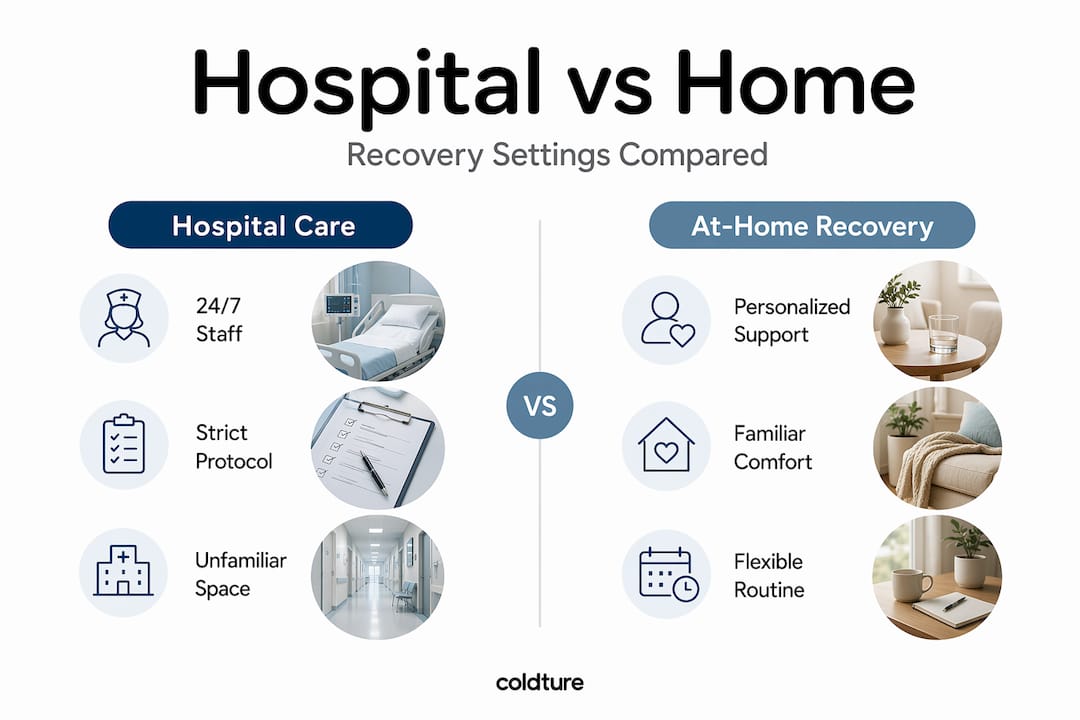
Is at-home recovery effective for everyone? No. But it works for a broader population than most people assume, and the home recovery vs hospital comparison is closer on almost every metric than the conventional wisdom suggests.
| Factor | Traditional hospital care | At-home recovery |
|---|---|---|
| Clinical supervision intensity | High (24/7 staff) | Scheduled (telehealth + visits) |
| Patient comfort and sleep quality | Lower | Higher |
| Infection and complication exposure | Higher | Lower |
| Functional activity levels | Restricted | Naturalistic and higher |
| 30-day readmission rates | Comparable | Comparable with structured programs |
| Cost | Comparable | Comparable depending on program design |
| Patient preference | Lower | Strongly favored |
Rural hospital-at-home trials showed no significant cost differences between models, but patient preference favored home care consistently. That preference is not trivial. Recovery outcomes are tied to psychological state, and people who want to be where they are heal faster.
What home recovery does not replace is acute care. Unstable cardiac events, post-surgical complications requiring constant IV management, or conditions requiring equipment that cannot be safely operated at home still belong in the hospital. Advantages of outpatient recovery apply to appropriately selected patients who have passed the acute phase.
The decision framework is simple: once clinical stability is established, the question becomes not “is the patient safe enough to go home?” but “is there a structured home program capable of continuing their care?” If yes, the evidence strongly supports going home. Explore effective recovery routines that athletes and wellness professionals use to stay ahead of setbacks.
A fresh perspective: Why at-home recovery is more than comfort — it’s a strategic wellness choice
Here is the uncomfortable truth most people miss. The reasons for home recovery that get cited most often — comfort, convenience, cost — are real but they are the least interesting ones. The real argument for at-home recovery is about agency. When you recover at home, you are the architect of your rehabilitation environment, not a passive occupant of someone else’s system.
In a hospital, recovery happens to you. At home, recovery happens with you. That shift in dynamic changes how your nervous system responds to the process. Your stress hormones drop. Your sleep improves. Your sense of control increases. These are not soft benefits. They directly modulate inflammation, immune response, and tissue repair.
As JAMA Network Open research demonstrates, “hospital-at-home can deliver comparable or better short-term outcomes” than traditional inpatient care, while improving lived experience. Notice the phrase “lived experience.” That is the clinical literature acknowledging that what it feels like to recover matters to how well you recover.
The wellness professionals we most respect understand this. They do not treat recovery as a break between training blocks. They treat it as a practice with its own methods, tools, and discipline. Why select home rehabilitation as part of that practice? Because it is the only model that integrates recovery into your actual life, in your actual space, at your actual pace.
What fails is not the concept. What fails is half-commitment. A late-stage home transfer with no structured program, no caregiver preparation, and no professional follow-up is not at-home recovery. It is early discharge. The distinction matters. Investing in recovery means investing in the structure that makes home recovery work, not just the location.
Explore wellness solutions to enhance your at-home recovery experience
At-home recovery becomes genuinely powerful when you pair smart program design with the right physical tools. That is exactly where Coldture comes in.

Cold exposure is one of the most evidence-supported recovery modalities available outside a clinical setting. Coldture’s Xtreme Outdoor Cold Plunge is built for serious use, from post-training recovery to full rehabilitation support. Complement it with access to Coldture’s indoor and outdoor saunas, which promote circulation and deep tissue relaxation as part of a contrast therapy protocol. For targeted tissue repair and soreness reduction, the red light therapy collection adds another clinical-grade modality to your home environment. These tools do not replace professional care. They extend it into every day of your recovery.
Frequently asked questions
What are the main benefits of at-home recovery compared to hospital care?
At-home recovery offers similar or better short-term outcomes, with added comfort, reduced emergency visits, and improved patient activity. Research confirms that home hospital patients had lower mortality and fewer emergency department visits within 30 days of discharge.
How important is caregiver involvement in at-home recovery?
Caregivers are essential. They reinforce therapy technique, observe safety, and sustain patient motivation, and caregiver support enables earlier independence through consistent, context-specific guidance that clinical staff cannot provide remotely.
Does at-home recovery cost more than traditional hospital stays?
Generally, no. Studies show no significant cost differences between home hospital and traditional hospital care, and early, well-structured home programs can further optimize expenditure by reducing readmissions.
Is at-home recovery suitable for everyone?
Not universally. It works best for clinically stable patients with adequate caregiver support and appropriate home setup. Research confirms comparable or better outcomes for appropriately selected patients who meet those criteria.
How does at-home recovery reduce hospital readmissions?
Through continuous monitoring, medication oversight, patient education in context, and early intervention. Given that 15.3% of patients are readmitted within 30 days, structured homecare directly addresses the preventable causes behind most of those returns.
Recommended
- Top wellness rituals for homeowners: Elevate recovery at home – Coldture Wellness
- Luxury home wellness: Elevate your living with recovery – Coldture Wellness
- Why Invest in Recovery: Boost Health and Performance – Coldture Wellness
- Effective Recovery Routines: Expert Examples for Athletes – Coldture Wellness
Share:
Guide to wellness modalities for recovery and well-being