


Most people assume the gap between average and elite comes down to how hard you train. Push more, sleep less, repeat. But the research tells a different story. Recovery isn’t the reward for hard work. It’s the mechanism that makes hard work count. Whether you’re an athlete chasing performance, a professional managing stress, or simply someone who wants to feel better longer, the return on investing in recovery is measurable, compounding, and often far greater than adding more reps or hours to your routine. This article breaks down the science, the strategy, and the practical tools that make recovery the smartest investment you can make in your health.
Table of Contents
- The science of recovery: ROI for body and mind
- From stress to strength: Mental recovery’s hidden power
- The recovery pyramid: Foundations before modalities
- Method vs. myth: What actually works for recovery
- Why recovery is the single most overlooked investment in wellness
- Experience the benefits of recovery with proven tools
- Frequently asked questions
Key Takeaways
| Point | Details |
|---|---|
| High ROI on recovery | Every dollar invested in recovery brings back multiple health and productivity benefits. |
| Mental and physical synergy | You can’t maximize physical gains without addressing mental wellness and resilience. |
| Prioritize basics first | Solid sleep, nutrition, and hydration form the foundation before adding advanced recovery treatments. |
| Science beats trends | Rely on methods backed by research, not myths—active recovery and cold therapy are proven winners. |
The science of recovery: ROI for body and mind
Every dollar you put into recovery gives you more than you expect. This isn’t motivational language. It’s economics backed by clinical data. Mental health recovery investment returns between $2.18 and $4 per dollar spent through reduced hospitalizations, higher productivity, and improved employment outcomes, with roughly 60% of individuals with serious conditions returning to meaningful work when properly supported. Scale that up, and scaling mental health interventions delivers a $4.4 trillion global economic boost, with some interventions returning $5 to $6 for every dollar invested.
Physical recovery compounds the case further. Athletes and active professionals who prioritize structured recovery experience fewer overuse injuries, faster return to full function, and more consistent performance over time. This isn’t a minor edge. It’s the difference between a career or wellness journey that lasts years versus one cut short by preventable breakdown.
Recovery ROI at a glance: Mental health recovery returns $2.18–$6 per dollar invested. Physical recovery reduces injury risk, cuts downtime, and supports consistent output. Together, they form the highest-yield investment in your wellness portfolio.
The two systems don’t operate in silos. Mental stress raises cortisol, which slows tissue repair, disrupts sleep, and amplifies pain perception. Poor physical recovery leaves you cognitively foggy, emotionally reactive, and more vulnerable to burnout. You can’t optimize one while ignoring the other.
The market is already catching on. Corporate wellness trends show organizations aggressively investing in recovery programs because the productivity math is undeniable. If you care about recovery for peak performance, the evidence is clear: recovery isn’t passive downtime, it’s active investment.
Key benefits of structured recovery investment:
- Reduced injury rates and faster return to training
- Higher cognitive performance and emotional regulation
- Improved sleep quality and hormonal balance
- Lower long-term medical costs
- Sustainable energy and performance output
From stress to strength: Mental recovery’s hidden power
Here’s something most fitness plans ignore entirely: your mental state directly controls how fast your body heals. Chronic psychological stress activates the same inflammatory pathways that slow physical recovery. That means skipping mental recovery isn’t just a mood issue. It’s a biological one.
CBT, mindfulness, and social support break the stress-pain loop by lowering cortisol, improving sleep architecture, and enhancing mood, all of which directly accelerate physical healing. This isn’t soft science. It’s a physiological feedback loop that elite practitioners have understood for years.
A more sophisticated framework confirms the impact. The Trait-Based Recovery Model cuts depression by 71.5% and anxiety by 58.5% while measurably boosting resilience and retention, outperforming traditional symptom-focused approaches by treating the whole person, not just the presenting problem.
Three steps to integrate mental recovery into your routine:
- Schedule cognitive resets. Use structured mindfulness or breathwork sessions after high-demand training blocks or stressful work periods, not just when you feel burned out.
- Add CBT-informed journaling. Identify stress patterns, challenge catastrophic thinking, and track emotional load alongside physical fatigue. Most people are surprised how much their mental state tracks their injury risk.
- Prioritize social connection. Isolated recovery is slower recovery. Regular, meaningful interaction with peers or a coach reduces psychological stress and reinforces motivation.
Pro Tip: Don’t wait for injury or burnout to start mental recovery routines. Build them into your weekly plan after high-stress events the way you’d schedule a rest day after heavy training.
Traditional vs. trait-based recovery: key differences
| Metric | Traditional approach | Trait-based model |
|---|---|---|
| Depression reduction | Moderate (30–40%) | High (71.5%) |
| Anxiety reduction | Moderate (25–35%) | High (58.5%) |
| Resilience improvement | Low to moderate | Significant |
| Long-term retention | Variable | Consistently higher |
Exploring top recovery methods that address both physical and mental dimensions gives you a meaningful edge over single-track approaches.
The recovery pyramid: Foundations before modalities
Before you invest in a cold plunge or red light therapy panel, get the fundamentals right. Advanced recovery tools amplify results only when they’re built on a solid base. Use them to patch poor sleep and you’re wasting potential.

The recovery pyramid places sleep, nutrition, and hydration at the foundation, with modalities like cold water immersion, compression, and light therapy stacked above. Miss the base, and the top layers underperform.
Recovery pyramid: layer by layer
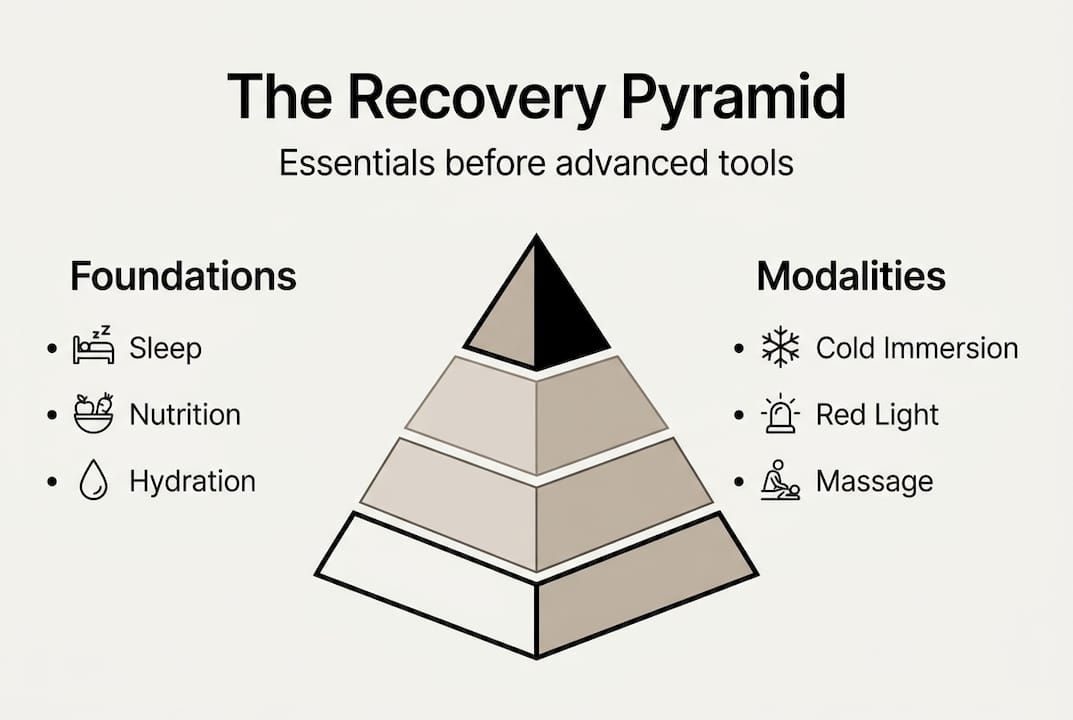
| Layer | Method | Why it matters |
|---|---|---|
| Foundation | 7–9 hours of quality sleep | Peak hormonal repair, memory consolidation |
| Foundation | Post-workout protein + carbs | Muscle protein synthesis, glycogen replenishment |
| Foundation | Proper hydration | Nutrient transport, inflammation control |
| Intermediate | Active recovery, mobility work | Blood flow, metabolic waste clearance |
| Advanced | Cold water immersion, compression | Accelerated inflammation reduction |
| Advanced | Red light therapy, massage | Cellular repair, parasympathetic activation |
The compounding effect of stacking these layers (often called multimodal recovery) consistently beats any single method used in isolation. Researchers and sports medicine professionals agree: no one tool replaces the whole system.
Core recovery practices that deliver outsized results:
- Sleep 7 to 9 hours consistently, not just on weekends
- Consume protein within 30 to 60 minutes post-training
- Drink enough fluid to maintain pale yellow urine throughout the day
- Schedule at least one active recovery session per training block
- Layer in advanced modalities after the foundations are locked in
Pro Tip: Periodize your recovery strategy to match fatigue type. Neuromuscular fatigue from heavy lifting responds well to cold and contrast therapy. Metabolic fatigue from endurance work responds better to sleep, carbohydrate intake, and compression.
If you want a structured framework for this, effective recovery routines from athletes who’ve done the work offer a useful starting point.
Method vs. myth: What actually works for recovery
Let’s clear the air on one of the most persistent recovery myths: static stretching. Most people believe it reduces soreness and speeds recovery. The data disagrees. Post-exercise stretching shows no significant impact on muscle soreness, strength, or flexibility compared to doing nothing at all. Mobility work and strength training deliver better results for long-term tissue health.
So what does work? Active recovery reduces soreness by 20 to 30% compared to complete rest. Cold and heat therapies aid further recovery, with massage showing the strongest effect when applied 24 or more hours after intense effort. These aren’t fringe claims. They’re consistent across peer-reviewed literature.
A science-backed muscle recovery routine:
- Active recovery (day after training): Light movement such as walking, cycling, or swimming at 30 to 40% effort clears metabolic waste without adding load.
- Cold water immersion: A 10 to 15 minute cold plunge reduces inflammation and signals the nervous system to shift into recovery mode. Cold therapy for recovery is one of the most evidence-supported advanced modalities available.
- Massage or compression therapy: Most effective at the 24 to 48 hour mark post-training. Targets lymphatic flow and reduces localized soreness.
- Sleep and nutrition lock-in: Return to the pyramid base. No modality compensates for missing this step.
“Overtraining isn’t a badge of honor. It’s a failure of planning. The athletes who last are the ones who treat recovery as a non-negotiable training variable, not an afterthought.”
Common recovery mistakes to avoid:
- Relying on stretching as your primary soreness strategy
- Skipping sleep to fit in extra training sessions
- Using cold therapy immediately after strength work when muscle adaptation is the goal
- Treating rest days as unproductive instead of purposefully restorative
- Ignoring mental fatigue until it forces a physical breakdown
For those serious about performance, ice baths for performance cover the specifics of cold immersion protocols worth understanding before you start.
Why recovery is the single most overlooked investment in wellness
Here’s the uncomfortable truth: most wellness plans are built backwards. People obsess over inputs, workouts, supplements, biohacks, and treat recovery as whatever’s left over after the real work is done. That’s a losing strategy disguised as discipline.
The highest-performing individuals and organizations we’ve seen don’t just train hard. They recover systematically. They track it, schedule it, and protect it the same way they protect performance time. Using proven recovery methods consistently is how compounding wellness gains actually happen.
A prevention-first mindset pays exponential dividends. Every injury avoided is months of progress saved. Every burnout prevented is a year of momentum protected. The math is simple, but the discipline to act on it requires flipping the mental model from “recovery is earned” to “recovery is required.”
Pro Tip: Track your recovery the way you track your training. Log sleep hours, soreness levels, mood, and readiness scores. Over time, you’ll spot the patterns that predict injury and burnout before they arrive.
Experience the benefits of recovery with proven tools
Understanding the science is the first step. The next is putting the right tools in your corner. At Coldture, we design recovery systems that make it easier to do this consistently, not just when you’re feeling motivated.
Our cold plunges bring professional-grade cold water immersion into your home or facility, and our red light therapy panels support cellular repair at depths no passive rest day can match. These aren’t luxury add-ons. They’re targeted tools built for people who take recovery seriously. If you’re ready to stop treating recovery as optional, explore how Coldture makes it practical, precise, and genuinely impactful.
Frequently asked questions
What is the financial return of investing in recovery?
Every $1 invested in recovery returns between $2 and $6 through gains in productivity, reduced medical costs, and improved long-term health outcomes.
Are physical and mental recovery equally important?
Yes. Neglected mental health raises physical healthcare costs by up to 75% and worsens recovery outcomes, making both dimensions equally critical to a complete wellness strategy.
Do trending recovery methods like stretching or cold plunges really work?
Active recovery and cold therapy meaningfully reduce soreness and speed recovery, while post-exercise stretching shows no significant advantage over doing nothing.
What recovery habits have the most impact?
The recovery pyramid is clear: sleep, nutrition, and hydration come first. Advanced tools like cold immersion and compression deliver the best results when built on top of those foundations.
Share:
contrast therapy, explained: what happens when you go from sauna to cold water
Cold exposure shapes your mindset for lasting resilience