

Cold plunges are everywhere right now, and for good reason. But if you’re relying only on cold water after a hard training session, you’re leaving serious recovery potential on the table. Contrast therapy alternates exposure to hot and cold temperatures in the same session, creating physiological effects that neither extreme achieves alone. This article walks you through the actual science, practical protocols used by professional sports clubs, real safety considerations, and how to build a personal approach that fits your recovery goals, whether you’re an athlete, a weekend warrior, or a dedicated biohacker.
Table of Contents
- What is contrast therapy and how does it work?
- Benefits and limitations: What does the evidence say?
- Risks and safety precautions for contrast therapy
- Contrast therapy protocols: Practical tips and examples
- Our take: Why contrast therapy works best as a personalized tool, not a magic bullet
- Explore recovery tools with Coldture Wellness
- Frequently asked questions
Key Takeaways
| Point | Details |
|---|---|
| Alternating hot and cold | Contrast therapy cycles hot and cold exposures, creating unique effects on blood flow and recovery. |
| Short-term symptom relief | Most evidence supports contrast therapy for short-term reduction in soreness and swelling. |
| Safety first | People with heart disease or arrhythmias should avoid or consult a doctor before trying contrast therapy. |
| Protocols vary | No standard guidelines exist; practical recommendations range in temperatures, durations, and cycle counts. |
| Personalization matters | Effectiveness depends on individual goals, health status, and careful experimentation. |
What is contrast therapy and how does it work?
At its core, contrast therapy is simple: you alternate between hot and cold exposures, typically using a sauna or hot bath followed by an ice bath or cold plunge, cycling between the two several times in one session. What makes it interesting is what happens inside your body with each switch.
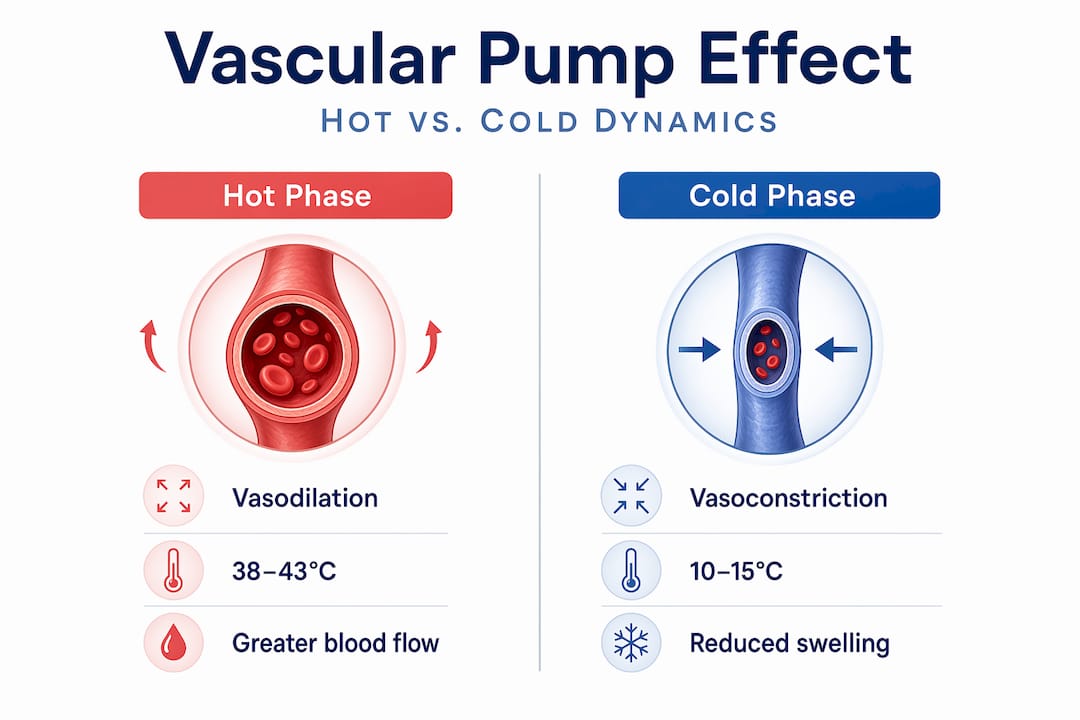
Contrast therapy acts like a vascular pump, alternating vasodilation when you’re exposed to heat and vasoconstriction when you hit the cold. Heat causes your blood vessels to widen, increasing circulation and drawing blood toward the skin and muscles. Cold causes them to narrow, reducing blood flow and potentially flushing out metabolic waste. Repeated cycling between these two states is thought to create a flushing effect through the tissues, which may reduce localized swelling and soreness after intense exercise.
Understanding contrast therapy basics also means knowing the typical parameters practitioners use. While protocols vary, the most common ranges look like this:
| Parameter | Hot phase | Cold phase |
|---|---|---|
| Temperature | 38–43°C (100–109°F) | 10–15°C (50–59°F) |
| Duration per cycle | 3–5 minutes | 1–2 minutes |
| Number of cycles | 3–5 rounds | 3–5 rounds |
| Session total time | Approximately 15–30 minutes | |
| Recommended timing | Within 2 hours post-exercise |
These ranges are not arbitrary. Going hotter than 43°C increases thermal stress without adding recovery benefit, and cold below 10°C can trigger strong cardiovascular responses that are hard to manage without experience.
Here’s a summary of what contrast therapy is most commonly used for:
- Delayed onset muscle soreness (DOMS) after heavy training
- Soft tissue swelling and minor inflammatory responses
- Post-competition recovery for team sport athletes
- General parasympathetic recovery and stress reduction
- Improving subjective feelings of readiness before the next session
“Think of contrast therapy as running your body’s circulatory system through a pump cycle. Each hot-to-cold switch is a rep for your vascular system.”
The vascular pump analogy is genuinely useful here. Your blood vessels are not passive tubes; they respond dynamically to temperature. By deliberately cycling through heat and cold, you’re essentially training your vasculature to react, which is part of why regular contrast therapy users often report improved tolerance to both temperature extremes over time.
Benefits and limitations: What does the evidence say?
With the basics in mind, let’s examine what the evidence truly supports regarding contrast therapy’s benefits and its limits. Because there’s a gap between what practitioners believe and what research consistently confirms.
The strongest, most consistent finding across the literature is short-term symptom relief. Strongest support tends toward short-term symptom outcomes rather than reliable performance changes. What that means practically: contrast therapy can reduce how sore you feel the next day and may decrease perceived fatigue, but it is not consistently shown to make you faster, stronger, or more powerful in a measurable way.
One important caveat is that the evidence base is limited and heterogeneous, and protocols vary so significantly across studies that comparing results is genuinely difficult. Some trials use three minutes hot and one minute cold for three rounds; others use five-minute intervals for six rounds. Some use 40°C heat; others use 42°C. The cold temperatures range from 8°C to 15°C across different research setups. That inconsistency makes it hard to say definitively which protocol works best.
What the evidence generally supports:
- Reduced muscle soreness 24 and 48 hours post-exercise compared to passive rest
- Lower ratings of perceived exertion after repeated training days
- Some reduction in markers of muscle damage (CK levels) in well-designed trials
- Favorable effects on perceived recovery in team sport athletes during congested schedules
What the evidence does not clearly support:
- Significant performance improvements over cold-only or heat-only protocols
- Long-term adaptation or structural changes from regular use
- Clear superiority over active recovery methods like walking or foam rolling
- Reliable benefit for every individual, regardless of fitness level or training type
Pro Tip: Track your own soreness and readiness scores for four weeks with contrast therapy and four weeks without. Personal data beats population averages every time.
To explore what other muscle recovery therapies exist alongside contrast therapy, including red light therapy and compression, it helps to build a broader recovery toolkit rather than relying on any single modality. And for those already at a high training level, pairing contrast therapy with other advanced athlete recovery strategies is where the real compounding effects tend to show up.
The honest bottom line: contrast therapy works best as part of a broader recovery system. It is not a standalone performance enhancer, but it is a legitimate tool for managing how you feel between training sessions.
Risks and safety precautions for contrast therapy
Given the evidence is mixed, it’s also crucial to understand the risks and safe practice tips for contrast therapy. Because for certain populations, this is not a benign wellness activity.

Cold-water and contrast approaches carry real risk for people with cardiovascular disease, arrhythmias, or other circulatory conditions. The rapid vascular changes triggered by hot-to-cold cycling can stress the heart significantly. For healthy individuals, the body adapts. For someone with an undiagnosed or poorly managed heart condition, those same shifts can trigger a dangerous cardiac event.
Here is a practical safety checklist for anyone starting out:
- Get medical clearance first if you have any history of heart disease, high blood pressure, arrhythmia, Raynaud’s disease, or circulatory disorders.
- Start with moderate temperatures rather than going to extremes. Begin with 38°C hot water and 15°C cold water before working toward wider temperature ranges over several weeks.
- Never use contrast therapy alone for your first several sessions. Have someone nearby, especially during the cold phases, where lightheadedness can occur.
- Hydrate before and after every session. Significant fluid shifts occur during contrast therapy and dehydration amplifies cardiovascular strain.
- Avoid alcohol before sessions. Alcohol impairs thermoregulation and vascular response, making temperature extremes significantly more dangerous.
- Exit the cold if you feel chest discomfort, sudden shortness of breath, or intense dizziness. These are warning signs that demand immediate attention.
- Limit your first sessions to two to three cycles even if you feel fine. Your tolerance builds over time, and overstressing your system on day one creates more harm than benefit.
- Follow established contrast therapy guidance for temperature ranges and timing rather than improvising based on social media trends.
Pregnant individuals, people with acute injuries where heat is contraindicated, and those recovering from surgery should also avoid contrast therapy without direct medical guidance. The same applies to anyone with peripheral neuropathy, where reduced sensation in the limbs makes it hard to gauge temperature safely. For youth athletes especially, reviewing safe training tips before introducing contrast therapy is a smart first step.
Pro Tip: If you’re new to cold exposure, practice cold showers for two to three weeks before attempting full cold plunge sessions. Building cold tolerance gradually makes the full contrast therapy experience both safer and more effective.
Contrast therapy protocols: Practical tips and examples
For those ready to apply contrast therapy, here are evidence-based protocols and practical tips for use. Knowing the principles is one thing; executing them consistently and correctly is another.
The professional sports club protocol specifies heat at 38–43°C for three to five minutes, followed immediately by cold at 10–15°C for one to two minutes, cycling three to five times, always finishing on cold, and completing the session within approximately two hours post-exercise. That last point matters more than people realize.
Why finish on cold? Ending on cold promotes vasoconstriction, which helps reduce residual swelling and prevents the rebound inflammation that can occur if you finish hot and then sit inactive. Several practitioners compare it to cooling down after a workout: it signals to your nervous system that the work phase is over.
Why within two hours post-exercise? The inflammatory response from training peaks within that window. Intervening before that peak is when contrast therapy has the most potential to modulate swelling and soreness. Waiting four or five hours reduces the impact significantly.
Here’s how to adapt the protocol to your specific goals:
- For maximum soreness reduction: Use the full five-minute hot and two-minute cold intervals, five cycles, finishing cold. Best used the evening after a heavy lower-body training session.
- For general wellness and stress recovery: Three cycles of three minutes hot and one minute cold is sufficient. You don’t need the full protocol for parasympathetic benefits.
- For competitive athletes in congested schedules: Use the full protocol after each competition day. Many professional teams use it twice daily during tournaments.
- For beginners: Start with two cycles at moderate temperatures (40°C hot, 15°C cold) and build up over two to four weeks.
For building the habit of deliberate cold exposure, the mindset shift is as important as the protocol. Treat the cold phase not as something to endure but as the productive half of the session. And for athletes specifically, a structured cold plunge recovery routine built around training cycles makes contrast therapy far more effective than ad hoc use.
A key statistic worth knowing: Research consistently shows that athletes using contrast therapy during multi-day tournaments report feeling more recovered and ready to perform in subsequent sessions compared to those using passive rest alone. The benefit is not always measurable in speed or strength, but it shows up strongly in readiness and perceived recovery, which directly affects training quality the next day.
Track your sessions, note your temperatures, your cycle count, and how you feel 24 hours later. Within a month, you’ll have personalized data that no research paper can replicate.
Our take: Why contrast therapy works best as a personalized tool, not a magic bullet
Here’s something the broader wellness industry rarely says clearly: contrast therapy will not transform your performance on its own. If you come to it expecting dramatic, universal gains, you will be disappointed. The research is honest about this. The protocols are inconsistent. The individual response varies widely.
What contrast therapy does offer, when used intelligently, is a reliable way to manage how your body feels between hard efforts. That’s not a small thing. For competitive athletes, the difference between feeling 70% recovered and 90% recovered heading into a second training day compounds dramatically over a season. For biohackers and wellness enthusiasts, the practice of deliberate, structured thermal stress builds a relationship with physical discomfort that translates beyond the tub.
The real insight we’ve developed working with athletes and serious wellness practitioners is this: people who benefit most from contrast therapy are those who treat it as a practice rather than a treatment. They show up consistently, adjust temperatures and cycle counts based on session intensity, and combine it with quality sleep, nutrition, and active recovery. People who get the least from it are those who do it sporadically after their hardest workouts hoping to undo the damage.
Personalization is non-negotiable here. A 90-kilogram rugby player and a 60-kilogram endurance runner have different thermal tolerances, different inflammation profiles, and different recovery demands. The same protocol applied to both will not produce the same result. Start with established ranges, then experiment deliberately. And always pair contrast therapy with the broader recovery strategies that make it more effective. Recovery for peak performance is a system, and contrast therapy is one strong component of it, not the whole structure.
Realistic expectations don’t diminish the value of contrast therapy. They make you better at using it.
Explore recovery tools with Coldture Wellness
If you’re ready to take your recovery setup beyond improvised hot showers and cold bathtubs, Coldture builds hardware that makes professional-grade contrast therapy achievable at home or in a commercial facility.
Explore the full cold plunge collection for precision-temperature systems designed for consistent, repeatable sessions. If flexibility matters, the portable cold plunge options let you build your practice anywhere. Pair either with our sauna solutions to create a complete contrast therapy setup that fits your space, your goals, and your training schedule. Coldture products are built for people who take recovery seriously, because every session you invest in means better performance on the other side.
Frequently asked questions
Can anyone use contrast therapy safely?
No, people with heart disease, arrhythmias, or certain circulatory conditions should avoid contrast therapy or consult a doctor first before attempting it. Healthy individuals can generally practice it safely using moderate temperatures and gradual progression.
How soon after exercise should I start a contrast therapy session?
Most protocols recommend starting within two hours post-exercise to catch the peak of the inflammatory response and maximize symptom modulation. Waiting longer reduces the potential benefit significantly.
What are the typical hot and cold temperatures used in contrast therapy?
The most widely used professional protocol specifies heat at 38–43°C (100–109°F) and cold at 10–15°C (50–59°F), cycled three to five times per session. Always start at the moderate end of both ranges when you’re new.
Is there strong scientific evidence supporting contrast therapy over other recovery methods?
The evidence is limited and heterogeneous, with no standardized protocols and no clear proof of superiority over methods like active recovery or cold-only immersion. Short-term symptom relief is the most consistent finding.
What is the main purpose of alternating hot and cold in contrast therapy?
The primary mechanism is the vascular pump effect, where alternating vasodilation from heat and vasoconstriction from cold creates a flushing action through the tissues that may reduce soreness and improve circulation.
Share:
Within 10 Minutes Under Red Light, Something Changes Inside Your Cells That You Can't Feel Yet
Benefits of heat exposure: A guide for recovery and wellness